factori.com supplies bulk bedding and linen from ₹290/piece across 613 partner factories in India — ready stock from 1 piece, custom printing with your logo, and contract manufacturing at any scale. Delivered pan-India and to 133 countries.
Prices last updated August 2026
Brand-ready bedding and linen for corporate, retail, uniforms and large custom programmes — sourced across partner factories with published prices.
Brand-ready bedding and linen for offsites, launches and conferences — plain or customised, with free mock-ups before production.
Get QuoteConsistent supply for schools, factories and frontline teams. Pair with our corporate and industrial uniform programmes when you need a complete kit.
Corporate UniformsUnbranded or private-label stock for retail brands, or launch a ready storefront with stock from the same factory network.
Launch Your StoreContract manufacturing for high-volume programmes across hundreds of partner factories, with payment-secure POs.
Contract ManufacturingWhy the distinction is not academic
Buyers who have previously bought garments or piece goods tend to assume that a bedsheet classifies by its cloth. It does not. Once a length of woven cotton is cut, hemmed and finished into a sheet, it stops being a fabric of Chapter 52 and becomes a made up textile article of Chapter 63. The chapter is titled other made up textile articles, sets, worn clothing and worn textile articles, rags, and heading 6302 is the entry that covers household linen of every kind.
Printed and not printed are separate branches
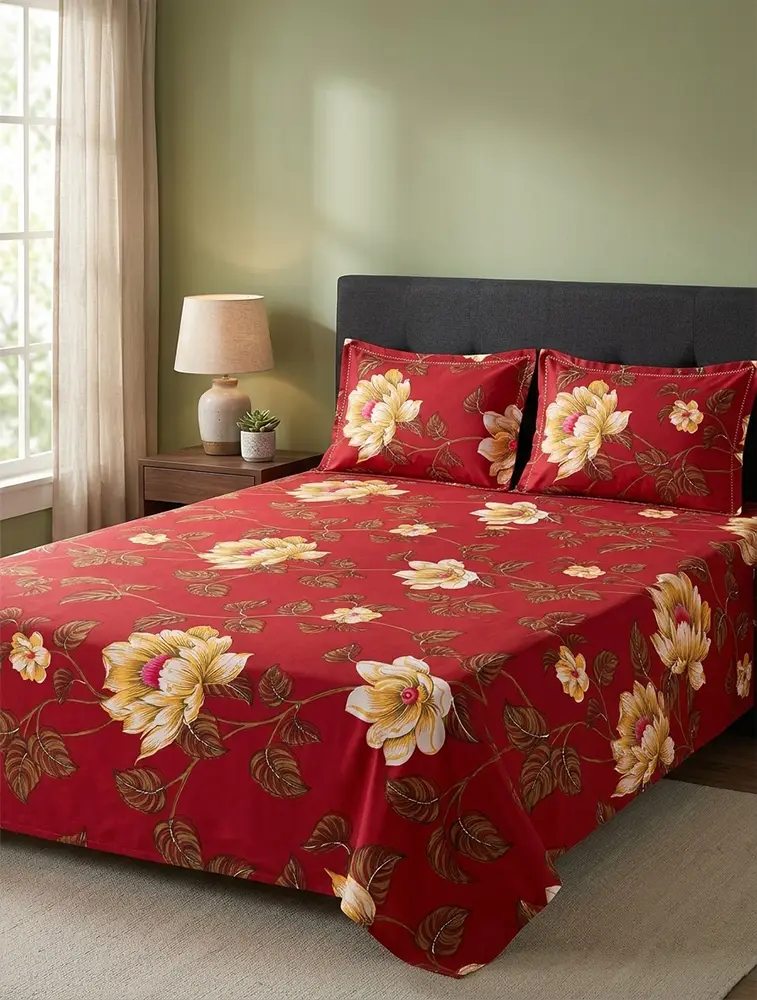
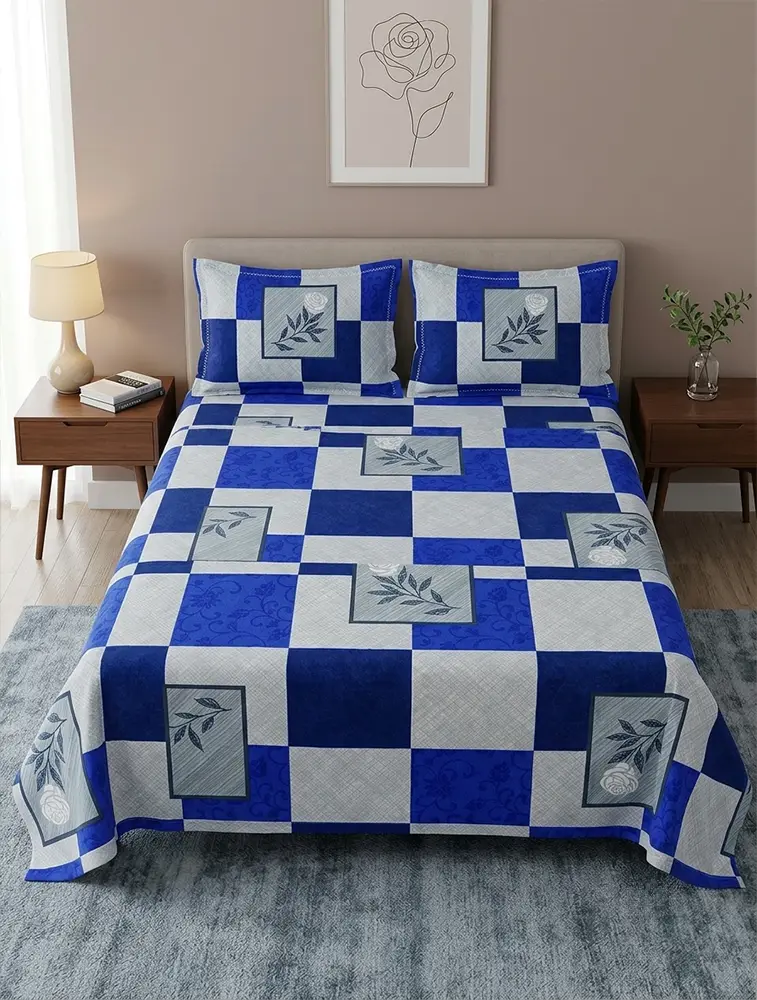
Inside heading 6302 the schedule separates other bed linen, printed from other bed linen. Cotton articles in the printed branch fall to 6302 21, and cotton articles in the unprinted branch fall to 6302 31 00. The printed cotton branch is subdivided again to distinguish handloom production from other production. This matters on this category because the catalogue splits almost exactly along that line. Thirty six of the fifty live articles are described in their titles as printed, twenty six king size and ten queen size, and the remaining fourteen are described as plain or striped sets. Those two families do not share a code.
What the listings give you and what they do not
Every live article in this category carries a colour, a bed size, a pattern word and an article code. The sampled product pages publish a material line reading one hundred per cent cotton. That is enough to point at a heading but it is not enough to complete a shipping bill, because nothing on any page states whether the cloth was woven on a handloom or on a powerloom, and nothing states the country of manufacture. A classification built on the title alone is a guess, and a guess in a customs declaration is the buyer's problem rather than the seller's.
What to ask for before the first purchase order
Ask for the eight digit code the seller intends to use, in writing, article code by article code. Ask for a composition statement expressed as a percentage rather than as a descriptive word. Ask for the loom type on the printed cotton articles specifically. Ask for the country of manufacture. Ask whether any of the articles ship as a set with pillow covers, because a set can be treated differently from a single sheet and the titles in this category are inconsistent about how many covers are in the pack. Then have the codes confirmed by your own customs broker before the shipment is booked.
Two practical consequences
The first is duty exposure. If the code moves after the goods have landed, the difference is recovered from the importer of record. The second is documentation. Export paperwork, preferential origin claims and any subsequent audit all reference the code you declared, so a code chosen loosely at order stage propagates through every document that follows it. Fix it once, at the top.
This is general information about how the tariff is arranged and it is not legal or customs advice. Classification turns on the actual construction and composition of the goods presented at the border. Take your own professional advice on the codes before you declare them.
What the Act actually does
The long title of the Act is to provide for reservation of certain articles for exclusive production by handlooms and for matters connected therewith. Section 2 defines a handloom as any loom, other than powerloom. Section 3 empowers the Central Government, after considering the recommendations of the Advisory Committee and if it is satisfied that it is necessary for the protection and development of the handloom industry, to direct by order published in the Official Gazette that any article or class of articles shall be reserved for exclusive production by handlooms. Section 5 then provides that such an article shall not, on and from the date of reservation, be produced by any loom other than handloom, with a transition window for producers already making it.
There is a penalty attached
Section 10 attaches imprisonment which may extend to six months or a fine which may extend to five thousand rupees per loom, together with forfeiture of the articles and the equipment involved. That is a criminal provision aimed at production rather than at purchase, but a buyer placing a large contract manufacturing order is commissioning production, and a buyer who has written nothing about loom type into the contract has no record of having asked.
The tariff asks the same question
Independently of the Act, the customs schedule cares about the answer. In heading 6302 the printed cotton branch is subdivided so that handloom production is separated from other production. So the loom type is not merely a marketing adjective in this trade. It is a field on a form. A category that publishes thirty six printed cotton articles and no loom declaration anywhere is leaving that field blank for every one of them.
What this category publishes
Across fifty live articles on two grid pages, no title, no attribute row and no description on any of the three product pages sampled uses either word. The sampled pages publish material, colour, pattern, bed size, a care line and a packing line. Loom type is absent, as is the place of manufacture that would let a buyer infer anything about it.
How to close the gap
Put a single line in the specification sheet: loom type, declared per article code, handloom or powerloom. Ask for it before sampling, not after, because it is a property of the mill rather than of the finished pack and it cannot be corrected later. If any part of your programme is being marketed to a government department or an institution on a handloom or artisanal basis, get the declaration on the seller's letterhead and keep it with the purchase order. If your programme has no handloom claim in it at all, you still want the answer, because it decides the subheading.
This is general information and not legal advice. Whether a particular article is reserved at a particular time depends on the orders in force, which change. Take your own professional advice before you rely on, or make, any handloom representation.
The rule does not only bite at the moment of sale. It reaches sell, distribute, deliver, display and store for sale. A wholesaler holding non compliant stock in a warehouse is inside the wording. So is a retailer with the packs on a shelf and none of them sold yet. That is why this is the single most useful rule for the two buyer segments who read this page and then resell: the compliance question is not whether your supplier got it right, it is whether the pack in your possession is right.
What this category publishes on the pack today
The three sampled product pages describe the packing and nothing else. One reads that the set is neatly folded, packed in a transparent polybag with an insert card, and securely sealed. Another reads that the article is neatly folded and packed in a protective polybag to safeguard it from dust and moisture, and then placed inside a durable corrugated box. Both describe the physical pack. Neither describes a single declaration printed on it. There is no country of origin on any sampled page, no manufacturer name or address, no net quantity statement, no month and year of packing and no consumer care contact.
What that means for your order
If you are buying to resell in India, the pack face is part of the specification and it has to be agreed before production, because printing an insert card is a production step and not a warehouse step. Retro labelling a landed consignment is expensive, slow and visibly a repair. The cheap moment to fix it is the moment you approve the sample.
The clauses to write in
List the declarations you require on the pack face, name the party responsible for printing them, and make approval of a photographed pack face a condition of dispatch rather than a courtesy. Require that the pack face be identical across every colour and every article code in the order, because a category whose titles vary in capitalisation from one colour to the next is a category where pack artwork will vary too unless somebody stops it. Require a physical pack sample, not an artwork file, because the artwork is not what gets inspected.
One more practical point
Bed linen is bought in sets as often as in singles, and the sampled pages disagree about how many pillow covers are in the pack. A declaration of quantity that says one when the pack contains two is worse than no declaration, so settle the pack contents first and print the declaration second. Count the pieces in the approved sample yourself and write that number into the purchase order.
This is general information about how the packaging rules are arranged and it is not legal advice. The declarations required depend on the commodity, the pack and the channel. Take your own professional advice on what your specific packs must carry.
What the grid actually contains
The category runs to two grid pages, thirty articles and then twenty, fifty live articles in total, and the grid is ordered from cheapest to dearest. Page one opens at Rs 290 and closes at Rs 416. Page two opens at Rs 416 and closes at Rs 643, where ten printed queen size sheets share the top price. There is no third page of stock: a third page request silently returns the second page again, and the second page still renders a next control although there is nothing after it. So the ceiling is Rs 643 and it can be confirmed by walking the grid in about a minute.
Why a phantom ceiling is a real problem
The Consumer Protection Act 2019 defines a misleading advertisement at section 2(28) as one which, among other things, falsely describes a product, or gives a false guarantee to or is likely to mislead consumers as to the nature, substance, quantity or quality of the product, or conveys a representation which would constitute an unfair trade practice. The unfair trade practice definition at section 2(47) includes making a statement which falsely represents that goods are of a particular standard, quality, quantity, grade, composition, style or model. A published range whose upper bound has no article behind it is a statement about the catalogue that the catalogue does not support.
The commercial reading is simpler
A buyer building a budget from the range sentence will provision for a premium tier that cannot be ordered. A buyer benchmarking a competitor's quote against the top of the range is comparing against nothing. And a buyer who notices, as any procurement team eventually will, now has a reason to check every other number on the page. That is the expensive part. One unverifiable figure makes the verifiable ones look optional.
What to do instead
Build the budget from article codes. Take the codes you actually intend to buy, take their published tier prices, apply the quantity you are actually placing, and total that. Ignore the range sentence entirely, on this page and on any page. A range is a marketing summary of a catalogue at a moment in time and this one carries a prices last updated stamp, which is an invitation to treat it as indicative rather than as an offer.
And ask the seller to fix it
If you are a large buyer, say so in the first call. Either the Rs 933 article exists and is not being displayed, in which case you want to see it, or it has been delisted and the range sentence was not updated with it, in which case the number should come down to Rs 643. Both answers are useful. Neither is available from the page.
This is general information and not legal advice. Whether any particular statement is actionable depends on facts and context. Take your own professional advice before drawing conclusions or making a claim.
This one URL carries three different starting quantities. The statistics band at the top of the category says ready stock from one piece. The live question block underneath says ready stock items can typically be ordered from a single piece and that custom or branded runs usually start from one hundred pieces per style per colour. And the product pages print a minimum order quantity line of their own, which on two of the three articles sampled reads one hundred units and on the third reads a four digit figure that its own ladder immediately contradicts by opening a tier at one hundred.
The most likely explanation, and why it does not help you
A four digit minimum sitting directly above a hundred piece tier reads like a keystroke rather than a policy, and the two comparable pages sampled both print the smaller figure. But a buyer cannot act on that reading. If the number is wrong the seller can correct it at any moment, and if the number is right the buyer who assumed otherwise has budgeted for a tenth of the commitment. Either way the page is not the place the question gets settled.
What actually binds
The quantity that binds is the quantity in the accepted purchase order, per article code, with the unit price for that quantity written next to it. Not the banner, not the question block, not the attribute line. Ask for a proforma invoice that names the article code, the quantity, the tier price applied and the validity date, and place the order against that document.
Watch the per style per colour trap as well
The live question block ties the custom minimum to style and colour together. On this category that phrasing has teeth, because the printed king size family alone runs to more than twenty colours at a single price. A hundred piece minimum per colour across twenty three colours is a very different commitment from a hundred pieces in total, and the difference is the whole order. Get the seller to state explicitly whether the minimum is per colour, per size, per article code or per order, and get that sentence into the contract rather than into an email thread.
A short checklist for the first call
Confirm the minimum for ready stock. Confirm the minimum for custom or branded production. Confirm whether it is measured per colour or per order. Confirm whether a mixed colour order can aggregate to the tier. Confirm what happens if you fall short at dispatch because a colour ran late, which is the ordinary way a mixed bed linen order slips. Five questions, one call, and the answers go in the purchase order rather than in your notes.
Where the disagreement sits
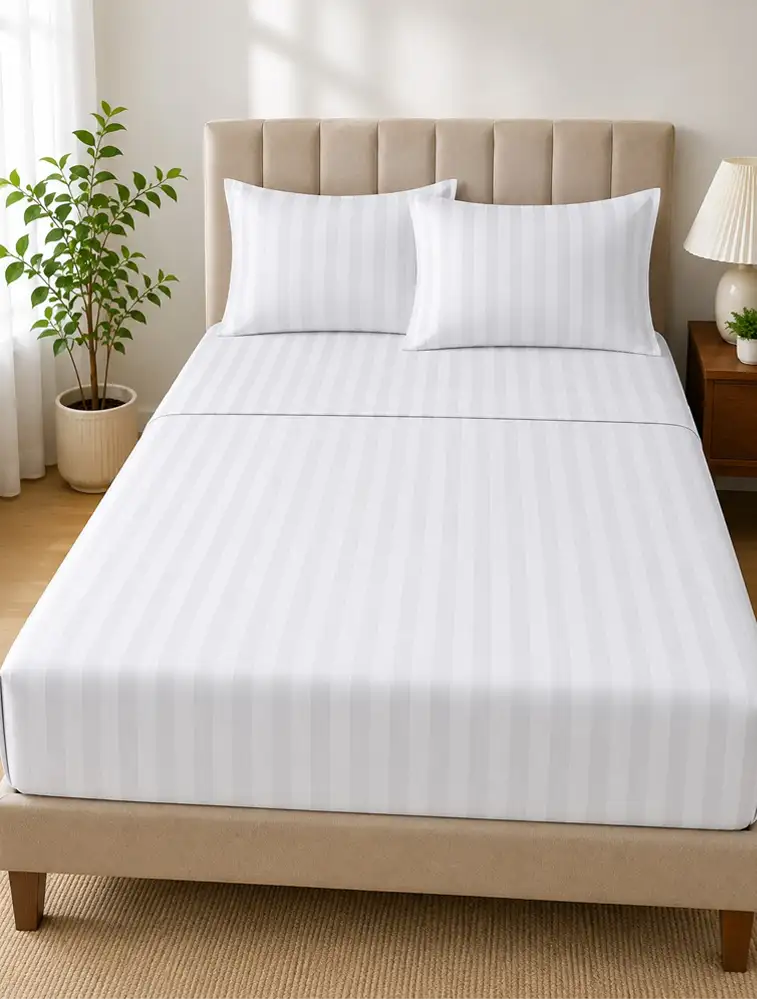
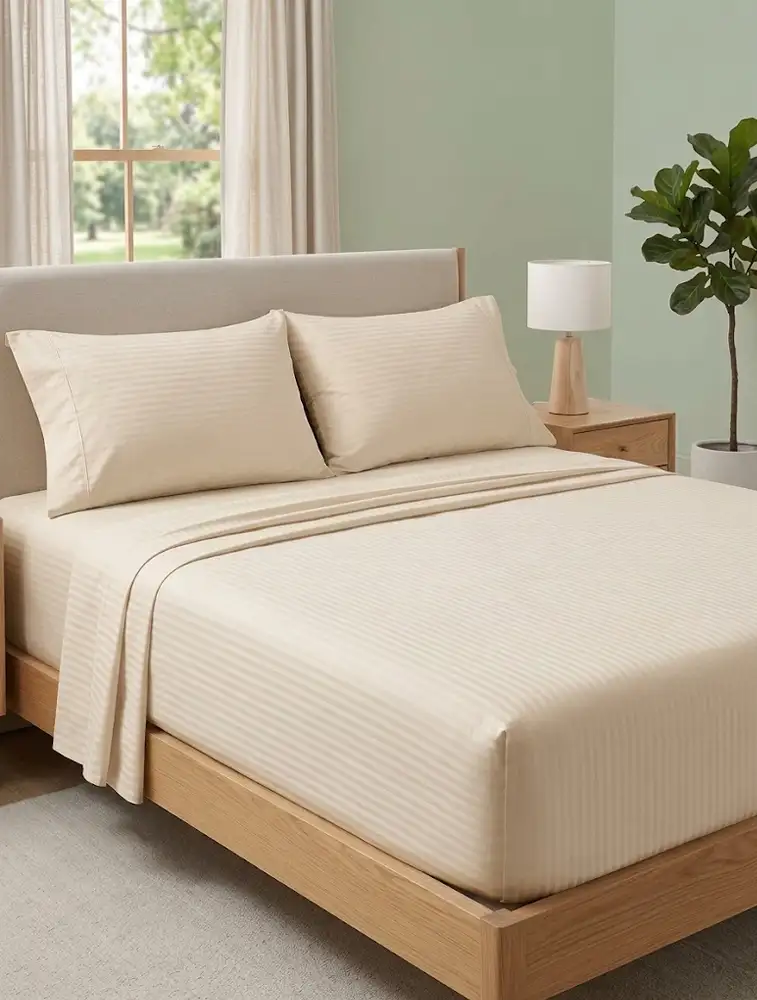
Fourteen of the fifty live articles in this category are sold as sets rather than as loose sheets, and every one of them ends its title with the same three words in the singular. On the cheapest set sampled, the attribute block underneath lists a pair of covers with a stated size, while the descriptive paragraph on the same page refers to a single matching cover. On the queen size set sampled, the attribute block itself says one matching pillow cover included. So across two pages of the same product family there are three different statements of pack contents, and none of them is labelled as authoritative.
Why this is a procurement problem and not a copy problem
Pack contents drive four things at once. They drive the unit economics, because a second cover is cloth, cutting, stitching and packing. They drive the declaration on the pack, because a quantity statement that undercounts the contents is a defect in the pack rather than a rounding error. They drive the goods in count, because a receiving team checking cartons against a purchase order that says set will pass a short pack. And they drive the customer promise, because a hotel or an institution buying a set for every bed has sized its order on a number of covers per bed.
The size of the covers matters too
Only one of the sampled pages publishes a cover dimension at all. If your programme has standard pillows, a cover that is close but not right is functionally a reject, and it is a reject you will discover after the consignment lands rather than at sampling, because a cover looks correct folded in a polybag. Ask for the cover dimension in the same units as your pillow specification, and ask whether it is a finished dimension or a cut dimension.
How to close it in one step
Do not resolve this by email. Ask for the physical sample of the exact article code you intend to buy, open it, count the pieces, measure them and photograph the contents laid out flat. Then write the count and the measured dimensions into the purchase order as a line of specification, seal the sample, and make the sealed sample the reference for goods in acceptance. Every subsequent argument about pack contents is then settled by opening a box rather than by comparing screenshots.
One sentence for the contract
Say that the pack shall contain the stated number of sheets and the stated number of pillow covers at the stated finished dimensions, that any variation is a short supply and not a substitution, and that the sealed reference sample prevails over any page, title or attribute line. That sentence costs nothing and removes the entire ambiguity from the order.
What each number is describing
Fabric weight expressed per square metre is a mass measurement. It tells you how much cloth there is in a given area. Thread count is a construction measurement. It counts yarns in a defined length of cloth, warp and weft together. Two fabrics can share a weight and differ in construction, and two fabrics can share a construction and differ in weight, because yarn fineness sits between them. Neither number on its own tells you how a sheet will feel, how it will wear or how much it will shrink, and neither is a substitute for the other.
What this catalogue does with them
The twelve set articles carry both figures inside the product title, which is unusual and, in a B2B context, welcome. The thirty six printed sheets carry neither. On the printed king size page sampled, the thread count attribute is present but its value is a descriptive sentence about everyday comfort rather than a number. A field that exists and holds prose is harder to work with than a field that is absent, because it looks populated in a data feed and it will import as text into whatever system reads it.
What is missing from all fifty
No article publishes a shrinkage allowance, a colour fastness rating to washing or to light, a tensile or tear figure, a pilling rating, or the test method behind any of it. The care lines describe behaviour rather than performance, and one of them uses a fade resistance phrase with no fastness rating anywhere on the page to support it. For a hotel or a hospital laundering on an industrial cycle, fastness and shrinkage are the two numbers that decide whether the linen survives the year, and they are the two numbers this catalogue does not publish.
What to demand instead of guessing
Ask for a mill test report against a named method for each article code you intend to buy. Specify fabric weight with a tolerance, thread count with a tolerance, dimensional change after a stated number of wash cycles at a stated temperature, and colour fastness to washing and to rubbing. Require that the report reference the same article code that appears on the purchase order, not a generic quality name. Then have your own sample tested independently on the first production lot, and make the report a condition of payment on that lot.
And write the tolerance down
A figure without a tolerance is not a specification, it is an aspiration. State the acceptable band in the purchase order and state what happens outside it, because the negotiation you want to avoid is the one that starts after a container has landed and somebody weighs a sheet.
Twenty six live articles are titled as a double bed king size sheet and ten more as a double bed queen size sheet. Double, king and queen are three different bed sizes in ordinary usage, so a phrase that stacks two of them is a label rather than a dimension. The only reliable size information in this category is the inch figure on the product page, and it appears on the pages sampled rather than on the tiles, which means a buyer scanning the grid cannot size anything.
What the published inches imply
A ten inch difference in length and no difference in width is a narrow gap between two size names that most buyers expect to be far apart. If your beds are the same width, the two articles may be closer to interchangeable than their names suggest, and the queen may simply be the shorter cut of the same cloth. That is not a criticism of the product. It is a warning that the size name will not tell you what you are buying and the number will.
The number that decides fit is not on the page at all
A flat sheet is sized by mattress width plus mattress depth on each side plus tuck. None of the sampled pages publishes a mattress depth the sheet is cut for, and none publishes whether the sheet is flat or fitted. On a hotel or hostel programme with deep mattresses or with mattress protectors already in place, a sheet that measures correctly against the mattress top can still be unusable because there is nothing left to tuck. Ask for the depth assumption in writing.
Also ask when the measurement was taken
Cotton moves. A dimension measured on greige cloth, a dimension measured on finished cloth before the first wash and a dimension measured after five industrial washes are three different numbers, and the third one is the one your housekeeping team lives with. Since no article in this category publishes a shrinkage allowance, specify the post wash dimension you require and the number of wash cycles it must survive, and let the seller work back to the cut size.
A three line size clause
State the finished dimension you require in your own units with a tolerance. State the mattress depth and the tuck the sheet must accommodate. State the post wash dimension after a defined laundering cycle. Attach a sealed sample. Those three lines convert a size name that contradicts itself into something a factory can cut to and an inspector can check.
Each sampled product page shows three quantity bands. The first covers one hundred to nine hundred and ninety nine pieces, the second covers one thousand to nine thousand nine hundred and ninety nine, and the third covers everything above ten thousand. The price falls as the band rises, which is ordinary. What is not ordinary is that the figure promoted everywhere else on the site is the bottom of that ladder rather than the top. The tile, the page heading, the title tag and the statistics band all carry the ten thousand piece number.
The gap is consistent across the range
On the cheapest set sampled the first tier is priced above the headline. On the printed king size sheet the same relationship holds. On the queen size set it holds again. Three articles at three very different price points all show the same shape, which means this is how the catalogue is built rather than an artefact of one listing. A buyer modelling a hundred unit trial order from grid prices will therefore be under budget on every line at once, and under budget by a similar proportion on each, which is the kind of error that survives a spot check.
What the middle tier is worth
The step from the first band to the second is smaller than the step from the second to the third on the articles sampled. If your annual volume sits near a band boundary, the arithmetic of pulling the whole year into one order rather than four is worth doing properly, including the cost of holding the stock, the cash tied up and the risk of a design change mid year. On bed linen that last risk is low, because a plain white sheet does not go out of fashion, which makes consolidation more attractive here than it would be on apparel.
Ask for the two figures the ladder does not show
The ladder shows unit price against quantity and nothing else. It does not show whether the quantity is measured per article code or across the order, and it does not show whether branding, packing changes or a non standard size sit inside the price or on top of it. Both answers change the total. Get them in the proforma invoice.
How to quote it internally
When you take a number to your own approvers, quote the tier price for the quantity you are actually placing, name the article code, and note the date. Do not quote the tile. The tile is the floor of a ladder you are not standing on, and a budget built on it will be short by roughly the same five per cent on every line in the order.
What the grid shows
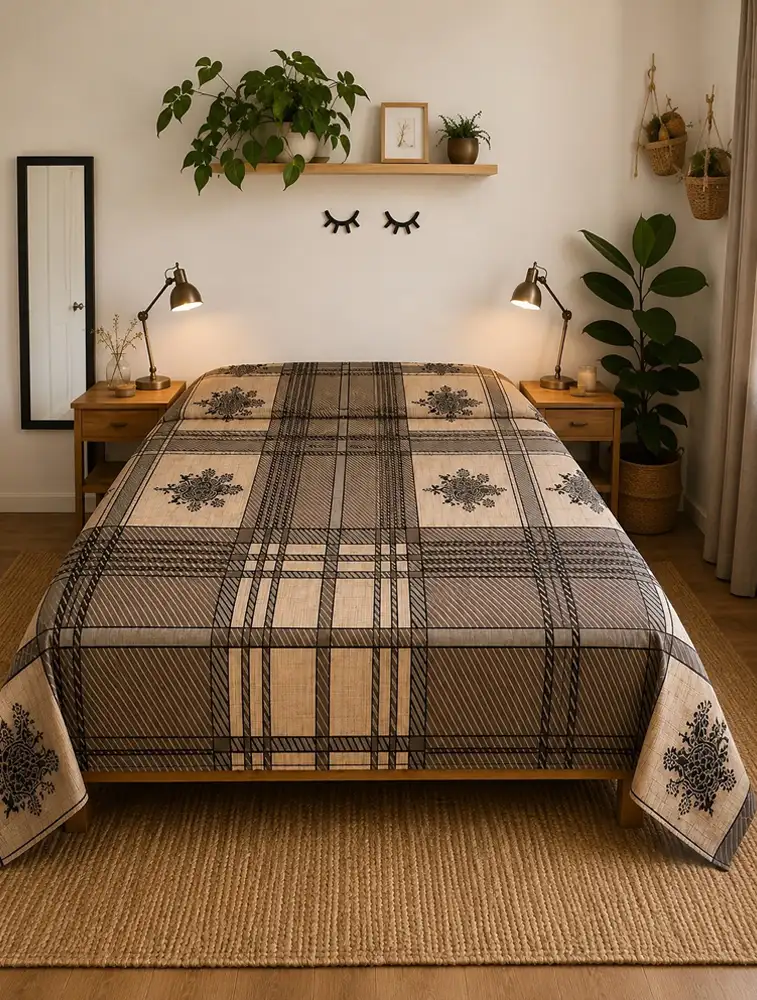
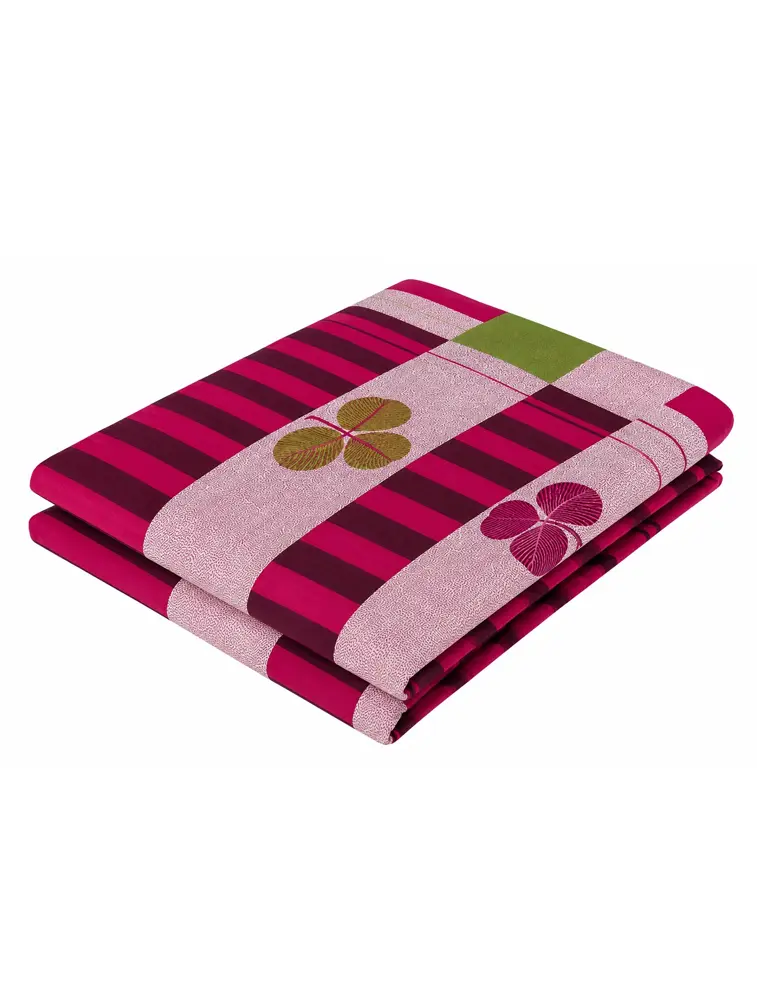
The printed king size sheets are the largest single family in this category, twenty six live articles that share a title pattern and differ only by colour word. Twenty three of them sit at one price and three sit one rupee higher. One of the three higher priced tiles carries a colour name that is spelled identically to a lower priced tile except that the second word begins with a lower case letter on one and a capital on the other. Nothing else distinguishes them on the grid.
Capitalisation is not consistent anywhere in the family
Reading down the same family, some colour words are capitalised and some are not, sometimes within a single title. That is a sign that titles have been entered by hand across more than one session rather than generated from a colour field. It is cosmetic on a web page and it is not cosmetic anywhere else: it breaks alphabetical sorting, it breaks exact match search, it produces two entries in a merchandising report where there should be one, and it makes any future de duplication pass harder, because the strings are not equal.
Why one rupee is worth arguing about
Not for the rupee. A one rupee difference across an otherwise identical family means the price was set per record rather than per family, which means there is no single place to change it. On a thousand piece order the rupee is immaterial. On a catalogue with fifty live articles it tells you that price maintenance is manual, and manual price maintenance is why a range sentence can go on advertising a ceiling that no longer exists.
What a buyer should do about it
Reference the article code in every document. The codes in this category are unique and stable even where the titles are not, so a purchase order, a proforma invoice, a packing list and a goods in report that all carry the code will reconcile. A purchase order that carries a colour name will not, and the reconciliation failure will surface at the worst moment, which is when a short delivery has to be matched line by line.
What the seller should do about it
Generate titles from fields rather than typing them, normalise the case, collapse the price to one value per family, and run a duplicate detection pass on title strings after normalisation. That is an afternoon of work on a fifty article catalogue and it removes an entire class of buyer question. It also removes the impression, which a procurement team will form quickly, that if the titles are approximate the specifications might be too.
The sampled pages state a material in words. Words are not a specification. Write the composition as a percentage by weight per component, state the tolerance, and state that the mill test report must reference the same article code as the purchase order. A composition clause is also the clause that decides your customs subheading, so it earns its place twice.
Loom type, declared per article code
Nothing in this category states whether the cloth was woven on a handloom or a powerloom. The tariff subdivision for printed cotton bed linen distinguishes them, and any handloom representation you make downstream has to be traceable to a declaration from the producer. One line closes it.
Dimensions, in two states
Ask for the finished dimension and the dimension after a defined laundering cycle, both with tolerances, and state the mattress depth and tuck the sheet must accommodate. Two of the three pages sampled publish an inch figure and none publishes a shrinkage allowance, so the second number has to come from the contract.
Pack contents, counted
The pages disagree about how many pillow covers are in a set. State the piece count and the cover dimension, and state that a variation is a short supply rather than a substitution.
The pack face
List the declarations the pack must carry, name who prints them, and make an approved photograph of the pack face a condition of dispatch. If you are reselling, this clause is the one that keeps compliant stock on your shelf rather than in quarantine.
Performance, with methods and tolerances
Colour fastness to washing and to rubbing, dimensional change after washing, and any weight or thread count figure you are relying on, each against a named test method with an acceptable band. The category publishes descriptive care language and no ratings, so every performance number in your file has to be one you asked for.
Price, tied to the code and the tier
Write the article code, the quantity, the tier price applied and the validity date into the proforma invoice, and place the order against that document rather than against the grid. Every grid price in this category is the highest volume tier, so a purchase order that quotes the tile is quoting a price the order does not qualify for.
The sealed sample, as the tiebreaker
Approve a physical sample, seal it, and say in the contract that it prevails over any title, attribute line or page. Then the eight clauses above stop being arguments and become measurements.
This is general commercial guidance and not legal advice. Contract terms should be settled with your own adviser, and the safe general rule is that anything you cannot evidence should not be in the specification and anything you rely on should be.
Match the article code on the carton label to the code on the purchase order and on the packing list, carton by carton. In a category where two articles can differ only by the case of a letter in the title, a receiving team working from colour names will pass the wrong goods and discover it in a stock count three weeks later. The code is the only field that reconciles.
Counts, at two levels
Count cartons against the packing list, then open a sample of cartons and count pieces inside them. Bed linen ships folded and bagged, so a short pack is invisible until a bag is opened. Record the sample size you opened and the result, because a dispute settled later will turn on whether you inspected or assumed.
Open the sets
For every set article, open the pack and count the sheets and the covers separately. This is the check this category most needs, because the title, the attribute row and the description do not agree on how many covers a set contains. Measure a cover as well as counting it.
Measure flat, not folded
Lay the sheet flat and measure length and width against the sealed sample and against the tolerance in the purchase order. Do this on a defined number of pieces per lot rather than on one, because cutting variation shows up across a lot and not in a single piece. Note the ambient conditions if your tolerance is tight.
Colour under one light
Compare against the sealed sample under a single consistent light source, never under two, and never under mixed daylight and fluorescent. In a family of more than twenty colours at one price, batch to batch drift is the defect most likely to reach a customer, and it is the one most likely to be waved through at goods in because each piece looks correct on its own.
Photograph the pack face
Photograph the declarations on the pack before the cartons are broken down. If you are a wholesaler or a retailer, that photograph is your evidence that the stock you took in was compliant when you took it in.
Match the paperwork to the lot
The test report has to reference the lot in front of you, not a previous lot and not the article in general. A report that names a different lot number is not evidence about this consignment. Reject on paperwork before you reject on cloth, because paperwork is cheaper to fix and its absence usually predicts the rest.
Some of the words on these pages are descriptions of a thing and some are claims about how it will behave. Colour, pattern, bed size and shape describe. Fade resistant, durable, low maintenance, quick drying, suitable for all seasons and standard quality for everyday comfort all predict behaviour. The first bin can be inspected on arrival. The second bin cannot be inspected at all unless somebody attaches a number and a method to it.
Why the distinction has legal weight
The Consumer Protection Act 2019 defines an unfair trade practice at section 2(47) to include making a statement, in writing or by visible representation including by electronic record, which falsely represents that goods are of a particular standard, quality, quantity, grade, composition, style or model. Section 2(28) defines a misleading advertisement to include one which falsely describes a product or is likely to mislead consumers as to its nature, substance, quantity or quality. If you republish a performance adjective in your own catalogue or tender response, you are the one making the representation downstream.
What each adjective should become
Fade resistant becomes a colour fastness rating to washing and to rubbing against a named method, with the minimum grade you will accept. Durable stitching becomes a stitch density per unit length, a seam type and a seam strength minimum. Quick drying and low maintenance become a stated laundering cycle the article must survive without dimensional change beyond a tolerance. Standard quality for everyday comfort becomes a fabric weight and a thread count, each with a tolerance, since the attribute row currently holds a sentence rather than a number.
How to translate a claim into a buying decision
Take every adjective on the page, delete the ones that describe, and for each one that remains ask what it would take to fail it. If you cannot describe a test that the article could fail, the word is not a specification and it should not be in your file. Then ask the seller to supply the number instead of the adjective. A seller who can will send a report. A seller who cannot has told you something useful for nothing.
What to write instead
Put the method, the grade and the tolerance in the specification sheet, and add a line saying that descriptive marketing language on any page, listing or brochure forms no part of the contract. That single sentence removes an entire category of later argument and it costs one line.
This is general information and not legal advice. Whether a particular claim is permissible in a particular market depends on the market, the channel and the facts. Take your own professional advice before you make or rely on a performance claim.
A hem label identifies the article for the laundry and the housekeeping team and is invisible to the guest. A discreet mark on the turn down face is a brand statement seen once a day. A mark on a pillow cover sits nearest the guest and takes the most laundering per square centimetre. These are not interchangeable, and a brief that says put our logo on it will get you whichever one is cheapest to produce.
Method follows placement
Woven and printed labels are stitched into a seam and take the abrasion the seam takes. Embroidery adds thread on the face, which adds bulk and a hand feel where a sleeper will notice it. Printing on the face is the cheapest and sits in the place that gets the most mechanical wear. None of these is wrong. The mistake is choosing the method for its unit cost and discovering the consequence in the second wash cycle.
Ask the laundry before you ask the factory
Institutional linen is washed hot, dried hard and often processed with chemistry that domestic linen never sees. Your own laundry, or your contractor, can tell you the cycle in numbers. Give those numbers to the seller as part of the brief and ask for the branding to be sampled and then laundered through that exact cycle a stated number of times before you approve it. That single test tells you more than any amount of specification language.
Get the commercial terms of branding in writing
The live question block on this page says artwork or specifications are shared and a mock up is prepared free for approval before production. Take that at face value and then ask the three questions it does not answer: whether the branded minimum differs from the unbranded minimum, whether the branding cost sits inside the tier price or on top of it, and what the lead time becomes once branding is added. All three change the total and none of them is published.
And protect the artwork
Supply vector artwork with a stated colour reference rather than a picture of a logo. State the finished mark size in millimetres and the exact placement measured from a named seam. Require a strike off, approve it physically rather than on screen, and treat that strike off as the specification for the whole run. Approve it once, in the right place, and the run reproduces it.
Governments and institutions
You are buying repeatability across years and across tenders, so the specification matters more than the shade. Work from the plain and striped sets, because a set with a published fabric weight and thread count is easier to write into a tender document than a printed sheet whose thread count field holds a sentence. Ask for composition as a percentage, a colour fastness rating and a post wash dimension, and require that the same figures be quoted at every renewal so that like is compared with like.
Hotels and hospitality
You are buying appearance, laundry survival and replenishment. Choose from the plain and striped end, fix the colour once, and treat the specification sheet as the deliverable rather than the sample. Ask for the laundering cycle in numbers, ask for the branding placement to be sampled and laundered before approval, and budget the replacement rate rather than only the first order. The narrow gap between the published king and queen lengths is worth checking against your own mattresses before you split the order between two sizes.
Hospitals and care institutions
You are buying a wash cycle above all. Dimensional stability and colour fastness after repeated high temperature laundering decide the cost per bed per year, and neither figure is published anywhere in this category, so both have to come from a test report you commission. Specify them, test the first lot, and make the report a condition of payment on that lot.
Corporates buying for staff accommodation
You are usually buying the single size sets, and your constraint is the pack rather than the cloth. Confirm the piece count in the pack, confirm the cover size against the pillows you already own, and confirm the minimum, because one sampled page carries a minimum figure that its own price ladder contradicts.
Brands and retailers
You are buying a labelled product, and the pack face is the order. The only articles here that arrive in something resembling a retail pack are the sets, and no sampled page describes a single declaration printed on the pack. Agree the pack face before production, take a photograph of it at goods in, and remember that the rules reach display and storage as well as sale.
Wholesalers
You are buying depth at the sharpest tier, so the ladder is your negotiation. Every grid price is the ten thousand piece tier, which means the number you see is the number you get only at a volume most single orders do not reach. Confirm whether the tier can be met across article codes or only within one, confirm the origin and declaration wording, and confirm that the article codes on the invoice will match the codes on the cartons.
What all six have in common
Order against the article code. Get the specification sheet filled in per code before you commit. Approve a physical sample and seal it. Write the tier price and the quantity into the purchase order rather than referring to a page that carries a prices last updated stamp. Agree the pack face before production, not after delivery. Those five steps cost an afternoon and they are the difference between a catalogue that is cheap and a catalogue that is safe to buy from.