factori.com supplies bulk healthcare uniforms from ₹392/piece across 619 partner factories in India — ready stock from 1 piece, custom printing with your logo, and contract manufacturing at any scale. Delivered pan-India and to 133 countries.
Prices last updated August 2026
Brand-ready healthcare uniforms for corporate, retail, uniforms and large custom programmes — sourced across partner factories with published prices.
Brand-ready healthcare uniforms for offsites, launches and conferences — plain or customised, with free mock-ups before production.
Get QuoteConsistent supply for schools, factories and frontline teams. Pair with our corporate and industrial uniform programmes when you need a complete kit.
Corporate UniformsUnbranded or private-label stock for retail brands, or launch a ready storefront with stock from the same factory network.
Launch Your StoreContract manufacturing for high-volume programmes across hundreds of partner factories, with payment-secure POs.
Contract ManufacturingThere is an Indian Standard for exactly this garment, and it is worth knowing it exists. IS 17334:2019 was published by the Bureau of Indian Standards under technical committee TXD 36 and is active with Amendment 1 of 2021. Per BIS's own description of the medical-textiles series, it sets requirements covering impact penetration, hydrostatic resistance, blood resistance and viral resistance, particle release, tensile strength and bursting strength, resistance to microbial penetration, and biocompatibility evaluation. That is a long list, and the reason it is long is that a surgical gown is asked to do several unrelated jobs at once: hold out liquid under pressure, not shed fibres into an open field, not tear at a seam when someone reaches across a table, and not irritate the skin of the person wearing it for four hours. A fabric can pass one of those and fail the rest.
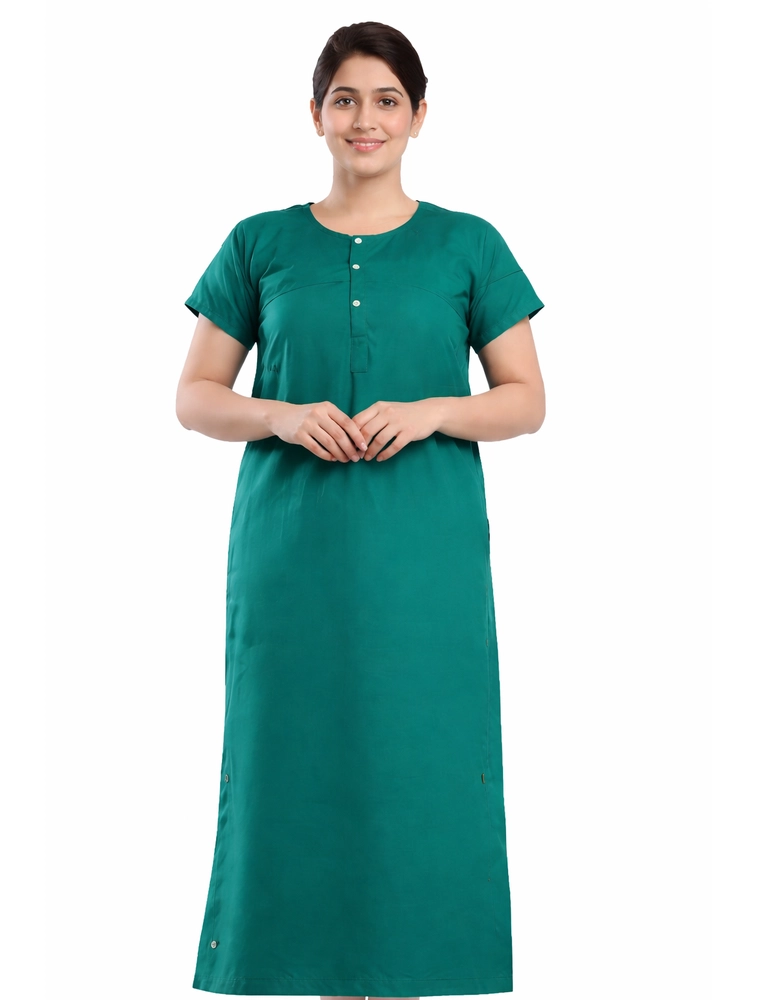
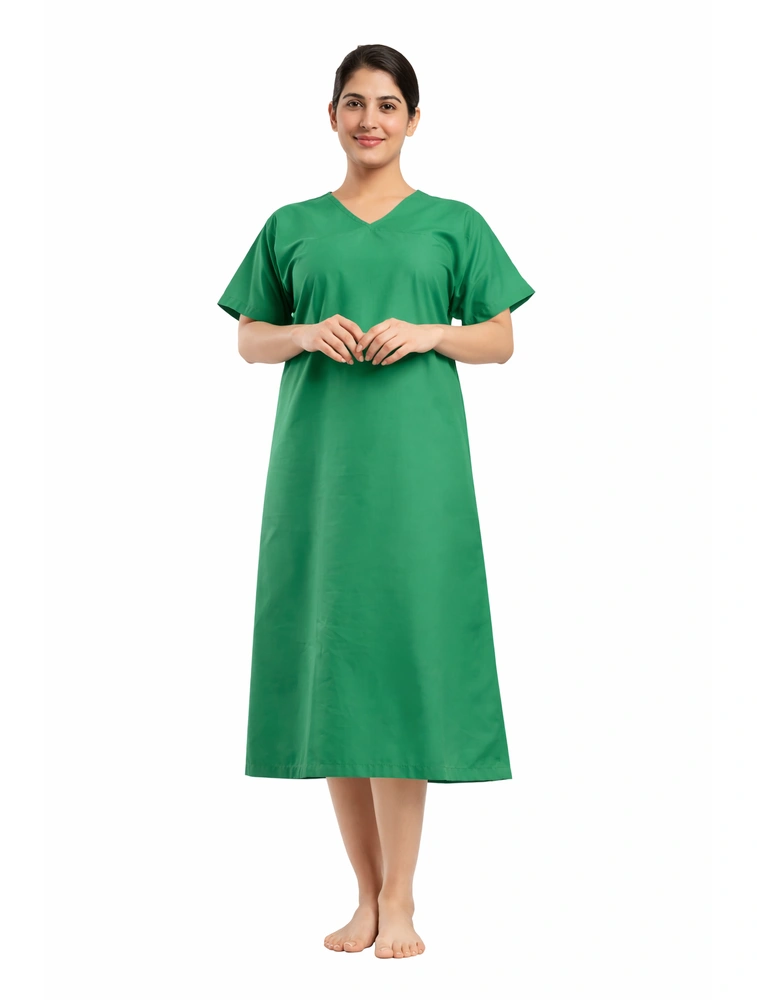
What our own listing actually says, stated plainly, because you should not have to discover it after the purchase order. The product page for the green wraparound gown makes four claims: wraparound style providing full-body coverage with secure tie closures; breathable, durable fabric suitable for extended medical use; lightweight construction; and available in multiple sizes. It is simultaneously sold as Free Size, which contradicts the fourth claim. Its care instruction reads, in full, machine washable for reusable variants, do not bleach, dry in shade, sterilize as per medical standards. That last phrase is not a specification. It instructs you to sterilise a garment whose fibre content is not published, by a method that is not named, to a standard that is not identified. We are flagging that on our own page rather than waiting for a hospital quality team to flag it for us.
What factori will and will not say about it. We do not make a barrier claim for this garment. We do not describe it as sterile, as fluid-resistant, as surgical grade or as tested to any level, because no lot-specific report has been issued that would support saying so. What we can do is have the construction made to a written specification you supply or we agree, and have the resulting lot tested by an independent laboratory against a named standard, with the report issued in your name. That is a different commercial conversation from buying a listed SKU off a grid, and it is the correct one for a garment used in an operating theatre.
The five lines to put in your purchase order. First, the standard and its edition year, in full, rather than the phrase medical standards. Second, whether the gown is single-use or reusable, and if reusable, the number of laundering cycles the test report covers, because a barrier property that survives one wash and not twenty is a different product. Third, which areas of the garment are treated as the critical product area, since standards for this category distinguish critical from less-critical zones and a report that tests only a sleeve tells you very little. Fourth, fibre composition and fabric mass in g/m², declared per lot, not per catalogue. Fifth, the testing laboratory, with a preference for NABL accreditation, and who pays for retesting if a lot fails.
What this means depending on who you are. A government health department or a medical college buying gowns through a tender should be writing IS 17334:2019 into the technical bid and rejecting bids that answer with adjectives. A private hospital chain with an infection-control committee already has someone who will ask these questions; give them the specification, not the brochure. A distributor or wholesaler reselling into hospitals should understand that an unspecified gown is a liability that travels with the invoice. If you want a gown built and tested to a named standard, start at get a quote or call +91 87470 71444, and tell us the standard before you tell us the quantity. Nothing here is medical, regulatory or legal advice; whether a given garment is fit for a given clinical use is a determination for your own clinical and quality advisers.
The tests behind the numbers, because the numbers only mean something with the method attached. Levels 1 to 3 use AATCC 42, a water-impact test where water is sprayed at a specimen backed by blotting paper and the paper is weighed, and AATCC 127, a hydrostatic-pressure test where water is pushed against the fabric and the height of the water column at first leak is recorded in centimetres. Level 4 abandons water entirely and uses ASTM F1670 with synthetic blood and ASTM F1671 with Bacteriophage Phi-X174 as a surrogate virus, at a pressure of 2 psi, which is 13.8 kPa, and the pass condition is binary: no penetration. So Level 3 to Level 4 is not one more step up a scale. It is a change of question, from how much water got through to whether anything got through at all.
Where each level is intended to be used. The United States Food and Drug Administration publishes intended-use guidance alongside these levels, and it is the clearest short mapping available. Level 1 is minimal risk, for basic care, standard isolation, a cover gown for visitors, or a standard medical unit. Level 2 is low risk, for blood draw, suturing, the intensive care unit, or a pathology lab. Level 3 is moderate risk, for arterial blood draw, inserting an intravenous line, the emergency room, or trauma cases. Level 4 is high risk, for long, fluid-intense procedures, surgery, where pathogen resistance is needed, or where non-airborne infectious disease is suspected. Read that list against your own department map and most of a hospital's gown volume is not Level 4.
The critical zone is the part buyers most often miss. The FDA describes the critical zones of a surgical gown as the front of the body from the top of the shoulders to the knees and the arms from the wrist cuff to above the elbow. For a surgical isolation gown, all areas except bindings, cuffs and hems are critical. That distinction decides what a test report is worth. A report on fabric taken from the back panel of a gown whose critical zone is the front is not evidence about the gown. When you ask for a report, ask which zone the specimen came from.
The European route asks a related question differently. EN 13795 splits products into standard performance and high performance and evaluates the critical product area separately from the less-critical area. Its liquid-penetration threshold under EN 20811 is at least 20 cm H₂O for standard performance and at least 100 cm for high performance, and wet microbial penetration under EN ISO 22610 carries a barrier index requirement of 6.0 for high performance. It also includes bursting and tensile durability requirements that the AAMI framework leaves out, which matters for a reusable garment that will be handled by an industrial laundry rather than thrown away. If you are exporting, or buying against a European specification, the two frameworks are not interchangeable and a PB70 level is not an EN 13795 classification.
How to use this without over-buying. Write your gown requirement as a table with three columns: department, expected fluid exposure, required level with the standard named. Then count how many garments sit in each row. Most buyers discover they have been paying one blended price across a range where two-thirds of the volume genuinely needs a low level and a small fraction needs the highest. Splitting the specification usually costs less in total than a single mid-level compromise, and it is easier to defend in an audit because each line traces to a named standard. factori does not assign a level to any garment it has not had tested; what we can do is manufacture to a specification that names one and have the lot tested against it. Start at get a quote. This is a description of published standards, not medical, regulatory or legal advice, and the choice of level for a given procedure rests with your clinical team.
What the framework actually says. CDSCO's own frequently asked questions on the Medical Devices Rules, 2017 state that following notification S.O. 648(E) dated 11 February 2020, all medical devices are regulated under those Rules. Devices are placed in four risk classes: Class A for low risk, Class B for low-moderate risk, Class C for moderate-high risk and Class D for high risk, per the First Schedule. The same document states that only the Central Licensing Authority is the competent authority to classify a medical device, and that the risk-classification list published on CDSCO's website is dynamic. For a Class A non-sterile, non-measuring device, the FAQ describes mandatory registration through the medical devices online portal rather than a licence, with a system-generated registration number and no fee. That is a materially different administrative burden from a licensed class, which is exactly why the classification question has to be settled before an order, not after.
The one entry we can point to with certainty. The CDSCO classification list issued under File No 29/Misc.l3/2017-DC(292), dated 1 November 2017, lists Sterile Drapes in the Surgical Dressings category as Class B, with the intended use given as for use during various surgeries. Surgical gowns are not on that list. We are not going to fill that silence with a guess. The honest position is that the classification of a specific gown depends on how it is presented, whether it is sterile, and how the Central Licensing Authority classifies it, and that the FAQ itself provides the route: where a device is not included in the published risk classification, a request with product technical documents can be submitted to the Central Licensing Authority for classification.
Why this is a sourcing question and not only a paperwork question. If a garment you are buying falls inside the device framework, then the obligations that attach to it are obligations on a manufacturer or importer of a device, and they do not disappear because the item looks like clothing and arrives from a garment factory. Conversely, a great deal of what a hospital wears is not a device at all. A scrub suit worn on a general ward, a doctor's coat, a patient gown and a housekeeping overcoat are ordinary garments and should be bought as garments, on fabric specification, construction quality, shrinkage and colour continuity. Treating everything as regulated wastes money; treating a regulated item as ordinary clothing creates a problem no discount is worth.
What factori is, and is not, in this picture. We are a bulk garment manufacturing and sourcing business. We are not a licensed medical-device manufacturer, we hold no CDSCO device licence or registration, and we do not represent any garment we supply as an approved or registered device. We will manufacture to a written specification, we will arrange independent laboratory testing against a standard you name, and we will tell you plainly when a request has moved out of what we can responsibly supply. Several buyers have found that the most useful outcome of this conversation is a clean split of their requirement into a regulated line, which goes to a device supplier, and a much larger garment line, which comes to us.
What to do next. Have your regulatory adviser confirm, in writing, the classification of each item on your list before you tender it, because the classification changes the qualification criteria you must publish. Then send us the garment lines. Talk to us at get a quote or on +91 87470 71444. Nothing in this answer is legal, regulatory or compliance advice, and no part of it should be read as a determination of any product's classification; that determination rests with the Central Licensing Authority and with your own advisers.
The exact wording, because the conflict is only visible side by side. The AIIMS infection control manual describes central laundry practice: disinfection of soiled linen is achieved by chemical and thermal methods, the soiled linen is first sluiced and then treated with 1 per cent bleach, then the linen is washed in mechanized washing machines through which steam is bubbled heating the water to 70 °C for disinfection. A NABH-referenced hospital linen policy carried under standard HIC / 02 / H goes further on the infected category: infected linen must be soaked in 1 per cent hypochlorite solution for 30 minute, wash with plain water before taken in to washing machine, followed by a normal wash again with water for five to ten minutes. Now read the care instruction printed on the healthcare garments listed on this page. Every one we sampled says avoid bleach or do not bleach. One of them, the patient gown, says do not bleach and, in the very next breath, suitable for regular hospital laundering cycles. Those two sentences cannot both be true in a hospital that follows either of the protocols above.
Which linen the protocol applies to, because it is not all of it. NABH's Standards for Hospitals, Fifth Edition of April 2020, requires under HIC 1e that laundry and linen management processes are included in the infection-control programme, and the associated policy language classifies linen in three categories: dirty linen is used linen without any stains; soiled linen is linen soiled with blood and body fluids; infected linen is linen used by a patient with a known infection. The hypochlorite soak attaches to the infected category. The 70 °C thermal cycle attaches much more broadly. So the fraction of your garment stock that will ever meet a 1 per cent hypochlorite soak is small, but the fraction that will meet a hot alkaline industrial wash is close to all of it, and a do-not-bleach label is a warning about both.
What actually happens to the garment. Two separate failures, and buyers usually blame the wrong one. Colour loss under an oxidising agent is a dye-selection problem: reactive and vat dye classes behave differently under hypochlorite, and a shade chosen for a corporate shirt can strip or shift to a different hue rather than simply fade. Strength loss is a fibre problem: cellulose is attacked by hypochlorite under the wrong pH and dwell time, so a cotton-rich garment can pass a colour check and still tear at the shoulder in month four. A garment can therefore survive the eye test and fail the service test, which is why a wash-life clause and a colour-fastness clause are two clauses, not one.
What to require, in order. Ask your supplier which of your three linen categories each garment is intended for, and refuse the answer all of them. For anything that may meet hypochlorite, require fastness testing to a named method with the oxidising agent and the concentration written into the test request, and require the result to be reported on the grey scale rather than described as good. For everything else, require the wash temperature the fabric is warranted to, in degrees, and have it printed on the label so a laundry supervisor can act on it. Then reconcile the label with your own standard operating procedure before the first delivery, not after the first complaint.
Our position on this page. We are not going to tell you our garments are unaffected by hypochlorite, because the labels on the current listings say otherwise and we would rather correct the listing than defend it. What we can do is have a fabric selected and dyed for the wash chemistry you actually run, have it tested, and have the label state a temperature and a chemistry instead of a prohibition. Bring us your laundry's written wash formula and we will specify against it: get a quote. Nothing here is medical, infection-control or regulatory advice; your infection-control committee owns the protocol and we build to it.
Why domestic wash data is the wrong evidence for a hospital. Most garment test reports in circulation are generated under domestic laundering conditions, which means a household front-loading machine, a reference detergent, a load of about 1.8 kg including ballast and a tumble dryer with exhaust air not exceeding 80 °C. A hospital laundry is a different machine and a different chemistry. ISO 15797:2017 exists precisely because of that gap: it specifies a washer-extractor with a cage volume of 220 to 250 litres, a dryer of 600 to 720 litres and a steam finishing cabinet for which an inlet temperature option of 160 °C is required, and it runs washing programmes numbered one to eight, with drying by Procedure A for tumble drying or Procedure B for tunnel or cabinet finishing. A garment can be perfectly stable under domestic conditions and lose 4 per cent in length under a tunnel finisher. If your uniforms go to an industrial laundry, ask for industrial data.
What the standard measures, and what it does not. It measures dimensional stability, colour characteristics, creasing, seam puckering, pilling and general visual aspects. It does not declare that a scrub suit shall survive fifty washes. No textile standard we can cite issues that number, and we will not invent one for our own garments. We have not had a lot of healthcare garments tested through a defined number of ISO 15797 cycles, so we are not going to publish a wash-life figure and dress it up as factory data. That gap is recorded here deliberately.
So write the number yourself, and write it as a test. A workable clause has four parts. Specify the programme number and drying procedure from ISO 15797 that matches your laundry. Specify the number of cycles the garment must complete, chosen from your own replacement history rather than from a brochure. Specify the acceptance criteria after those cycles, as measurable outcomes: dimensional change within a stated percentage in length and width, colour change not worse than a stated grey-scale grade, no seam failure, pilling not worse than a stated grade. Specify who tests, who pays, and what happens on failure. That clause is enforceable. A supplier promise of long-lasting is not.
The commercial consequence is already visible in real hospital contracts. AIIMS's outsourced laundry tender shows how a large public hospital prices garment condition. If washing of the linen is not up to satisfaction, the linen shall be sent for rewashing with no payment for that piece, and in addition a penalty of Rs 50 per piece is imposed. If the recorded rewash rate exceeds an acceptable level of 5 per cent, a further penalty of Rs 1,000 applies. Loss or damage may be claimed from the service provider up to the book value of the item. Note what that structure does to your supplier: a garment that greys, puckers or shrinks does not merely disappoint a nurse, it generates a rewash record, and the rewash record generates money. A uniform bought two rupees cheaper per piece and rewashed 8 per cent of the time is not cheaper.
How to size a first order around an unknown wash life. Do not buy a year of stock against an unproven specification. Buy a pilot quantity for one ward or one shift group, put it through your own laundry for the number of cycles you care about, measure it against the four acceptance criteria above, and only then place the annual volume. The cost of a pilot is a rounding error against the cost of discovering shrinkage at scale. We would rather run that pilot with you than win a large first order and lose the account in month five. Send your laundry's wash formula and programme details to get a quote or call +91 87470 71444, and if you need the company-level questions on minimums, sampling and payment terms, they are answered once on the home page FAQ.
What ISO 3759:2011 actually requires, and why the mechanics matter. Its principle is stated simply: pairs of reference points are marked on each specimen, and the distance between each pair of reference points is measured before and after specified treatments. The detail is where disputes are won. A fabric specimen is at least 500 mm by 500 mm with edges parallel to the length and width of the fabric. At least three pairs of marks are made in both the length and the width directions. The distance between each pair is at least 350 mm, no mark is less than 50 mm from an edge, and the points are regularly spaced across the specimen. Specimens are conditioned per ISO 139 for at least four hours or until constant mass, defined as a mass change of 0.25 per cent or less across one-hour intervals. Measurement accuracy is at least 1 mm, using a rule or a glass-fibre tape whose accuracy is verified every six months. Dimensional change is calculated as the after dimension minus the before dimension, divided by the before dimension, times 100, and recorded separately as a percentage for each direction.
Read that list again as a checklist for a rejected consignment. Almost every shrinkage argument we have seen between a hospital and a supplier turns on one of those clauses being skipped. The specimen was too small, so three 350 mm pairs never fitted. The marks were near the edge. The fabric was measured straight off a delivery van in Chennai in August without conditioning, which is a humidity measurement, not a shrinkage measurement. Length and width were averaged into one number, which hides the direction that actually ruined the garment, since a coat that loses 3 per cent in length and gains 1 per cent in width reads as a comfortable minus 1 per cent average and is still unwearable. Insisting on the method is not pedantry; it is the difference between a claim and an opinion.
Then choose the wash procedure to match the real laundry. ISO 6330 supplies domestic washing and drying procedures for textile testing, using an automatic front-loading machine, AATCC 1993 standard reference detergent powder in a with-brightener or without-optical-brightener version, roughly 1 g of detergent per litre, a total load of 1.8 ± 0.1 kg including specimens and ballast, temperatures from room temperature up to 60 °C, and typically three complete wash-and-dry cycles unless otherwise agreed. If your uniforms are washed at home by staff, that is the right procedure. If they go to a central hospital laundry with steam-heated water and a tunnel finisher, ISO 15797 is the right procedure and ISO 6330 data will flatter the garment.
A clause you can paste into a tender, adapted to your own numbers. Dimensional change shall be determined in accordance with ISO 5077, with specimens prepared, marked and measured in accordance with ISO 3759:2011 and conditioned per ISO 139, after three cycles of the wash procedure specified at clause X. Maximum permissible dimensional change shall be stated separately for length and width. Results shall be reported per direction, per size, from garments drawn at random from the delivered lot rather than from fabric supplied for approval. That last sentence closes the most common loophole of all, which is testing an approval swatch that was never in the production lot.
What we will do on our side. We will accept a clause written this way, we will have the testing done by an independent laboratory, and we will tell you before production if a construction you have asked for is unlikely to meet the figure you have written, rather than discovering it together at delivery. Send us the clause and the laundry conditions at get a quote. Fabric behaviour is measured, not promised, and a specification that names its methods costs nothing extra to write.
What the two test methods do. ISO 20743 defines three inoculation routes: the absorption method, where bacteria are inoculated directly onto the specimen; the transfer method, where they arrive via an agar plate; and the printing method, where they arrive via a filter. Incubation runs 18 to 24 hours. AATCC 100 offers a single quantitative method with a 24-hour incubation. Both express the outcome as a log reduction value or a bacterial reduction percentage, comparing a treated specimen with an untreated control. Because the inoculation route differs, results from the three ISO methods are not interchangeable with each other, let alone with AATCC 100, so a report that names a number without naming the method and the organism has told you almost nothing.
The two facts that decide the purchase. First, both standards leave the pass mark to the parties: there is no universal threshold above which a fabric is antibacterial and below which it is not. That means the buyer, not the standard, has to state what reduction against which organism is acceptable, and any supplier who says the fabric passed without stating against what has not answered. Second, laundering durability is not part of either test; separate laundering durability tests must be performed. This is the crux for a hospital. A hospital garment is washed dozens of times under hot alkaline conditions with oxidising chemistry. A finish that gives an impressive log reduction on a virgin specimen and is gone by the tenth industrial wash has cost you money and delivered a number you cannot rely on beyond week three.
What factori claims about its own garments, precisely. Nothing. We do not describe any garment on this page as antimicrobial, antibacterial or infection-reducing, because we hold no lot-specific test report that would support it. If you want a finished fabric, we will source it, we will have the finished cloth tested by an independent laboratory under a method you name, against organisms you name, before and after a stated number of wash cycles under a stated procedure, and we will give you the report. If the report is weak, you will see the weak report. That is the only version of this conversation worth having.
The question worth asking before the finish question. An antimicrobial finish is a property of cloth. Most of what determines whether a uniform contributes to a hygiene problem is behavioural and logistical: how many sets each person has, so that a garment is changed daily rather than worn for three shifts; whether there is a changing facility so that ward clothing does not travel home on public transport; whether the laundry turnaround actually returns garments before the next shift needs them. A hospital with two sets per nurse and a three-day laundry cycle will not fix anything by buying a finish. A hospital with four sets and a next-day cycle may not need one. Count sets and cycle time first; it is usually the cheaper intervention and it is entirely within your control.
Where the money is better spent, in our experience of these enquiries. Fabric mass and construction appropriate to the wash chemistry, so garments survive the cycle. Dye selection that holds shade under your disinfection protocol, so a ward does not end up with three visibly different blues. Enough sets in circulation to allow daily changes. Correct sizing, so garments are actually worn and not swapped. Those four spend items are measurable, defensible in an audit and hard to argue with. Talk it through at get a quote or on +91 87470 71444. Nothing in this answer is medical, infection-control or clinical advice; the selection of any hygiene intervention is for your infection-control committee.
What a real government colour instruction looks like. The Odisha government decided to change the dress code of both female and male employees of the nursing service cadre, communicated by the Health and Family Welfare Department to the Nursing Director. The scheme is cadre-wise: light lavender for nursing officers and senior nursing officers, cyan blue for assistant nursing superintendents, white with deep purple collar-bordered aprons for deputy nursing superintendents and nursing superintendents, and deep navy blue formal trousers for male officers in general wards. It also requires that all nursing employees, both men and women, wear scrub suits for indoor duty such as ICU, operation theatre and labour room. The decision was taken in principle after consideration of a proposal from the Odisha Nursing Employees' Association. Note what that is and is not: it is an employer's policy for one state's cadre structure, arrived at through consultation. It is not a textile standard, it has no test method, and it does not apply outside that service.
Why the absence of a standard is a practical problem for you and not a philosophical one. Light lavender is not a specification. Two factories will read it two ways, and so will two dye lots from the same factory. If your purchase order says light lavender and your reorder six months later says light lavender, you have authorised the second batch to be visibly different from the first, and you will be the one explaining to a nursing superintendent why one ward looks purple and another looks grey. Departmental colour coding only works if the colour is reproducible, and reproducibility is a specification problem, not a naming problem.
What to write instead. Four things. A shade reference: an approved physical swatch, signed and dated by both parties, held by both, and if you work with a colour system, its reference number recorded alongside. A tolerance: the maximum acceptable colour difference between delivered goods and the approved swatch, assessed under a stated illuminant, so that assessment does not depend on whether the storekeeper is standing near a window. A within-lot and between-lot requirement, since the harder promise is not matching the swatch once but matching it again next year. And a fastness requirement appropriate to your laundry, because a shade that is correct on delivery and shifts after the first hot alkaline wash was never fit for the ward.
The reorder problem, stated honestly. Perfect shade continuity across dye lots separated by a year is difficult and no supplier who tells you otherwise is being straight with you. There are only three real mitigations. Order the full year's fabric for a colour in one lot and hold it, which costs working capital but solves the problem outright. Or accept a stated tolerance and hold the approved swatch so that acceptance is a measurement rather than an argument. Or deploy by ward, so that a new lot goes to a whole ward at once and any small difference is never seen side by side within a room. Choose one deliberately at the start rather than discovering the issue at the second delivery.
What this looks like commercially. If you are a state health department implementing a cadre-wise scheme across hundreds of facilities, the specification document matters more than the price, because the scheme will be judged on whether it looks consistent. If you are a single private hospital, a signed swatch and a tolerance in the purchase order is ten minutes of work that removes most future disputes. Send us your colour scheme, including any government order it derives from, and we will convert it into a specification with references and tolerances before we quote: get a quote.
Three size systems on one page is a procurement risk, not a detail. A hospital ordering a coat, a scrub suit and a gown from this grid is ordering against three different size logics: a numbered chest range with a price ladder, the same numbered range flat-priced, and a single garment for everybody. Nothing tells you whether size 42 on the coat corresponds to size 42 on the scrub suit, because no measurement chart is published for either. A number on a label is not a measurement. Two garments can both be labelled 42 and differ by four centimetres across the chest, and in a hospital that difference lands on a person who then swaps garments with a colleague, which quietly destroys your laundry accounting.
What Free Size actually costs. A wraparound gown with tie closures genuinely does accommodate a wide range, which is why the category exists. But Free Size on a garment whose product copy also says available in multiple sizes means somebody has published two contradictory things, and you cannot write either into a purchase order. More practically, Free Size means sleeve length and body length are fixed. On a 150 cm wearer the sleeve is long enough to trail into a field it should not touch; on a 185 cm wearer the coverage stops higher than the specification implies. If the garment's whole purpose is coverage, Free Size is the wrong place to economise. For patient gowns, where dignity and ease of dressing are the point, a two-size range costs very little more and is noticeably better received on the ward.
The surcharge arithmetic, done properly. Buyers usually evaluate the headline price and ignore the ladder, then get an invoice that does not match the quote. Do it the other way round. Take your actual size distribution, and for a general Indian adult staff population a meaningful share sits at 44 and above. Suppose 22 per cent of a 1,000-coat order lands at 46, 48 and 50 in some mix. That is roughly 220 garments carrying between Rs 25 and Rs 75 each, so several thousand rupees of surcharge that never appeared in the comparison you approved. Meanwhile the scrub suit charges nothing for the same sizes. Whether that inconsistency is deliberate or a listing artefact, you should price against your own distribution, not against the smallest size on the page. Ask for a single blended rate across the full size range and you will usually get one; asking is the whole trick.
How to get the distribution before you order. Do not survey staff by asking their size, because people report the size they wish they wore. Order a size set, which is one garment in every size in the construction you have chosen, and run a physical fitting session per shift group. A morning of fittings across a 400-person hospital produces a distribution accurate enough to buy against and it removes almost all of the exchange traffic that follows a blind order. It also surfaces the cases a chart never will: pregnancy, post-operative staff, anyone who needs a longer sleeve. Build 3 to 5 per cent of buffer into the largest and smallest sizes, because those are the ones you cannot fix by swapping.
What we will provide. A measurement chart in centimetres for each construction, stating the garment measurement and the intended body measurement separately, which are two different numbers and are routinely confused. A size set before bulk. A blended rate quoted across your distribution rather than a base price with a ladder. And a written tolerance per measurement point, so that acceptance at delivery is a measurement and not a debate. Send your headcount by shift group to get a quote or call +91 87470 71444 and we will start with the size set.
The clause language, because it is more useful than any summary. The same tender requires that only undamaged linen will be collected by the vendor, and at the time of collection his representative will identify torn linen and shall not collect it. Infected linen, if any, shall be identified by the hospital staff and shall be processed as per the protocols before giving for laundry. Collection of dirty linen from designated areas shall be done before 10:00 AM every day, and clean linen shall be delivered to the designated areas before 2:00 PM the next day. Details of washing formulae as well as the processes to be used will be submitted by the vendor with the technical bid, only eco-friendly and laboratory-tested detergents from reputed firms shall be used, and the institute may make surprise checks to verify that items used match the approved formula, quality and quantity. An independent agency, approved by the hospital, conducts a quarterly audit of the laundry, with minor shortcomings rectified within 48 hours and the remainder within seven days. Prices quoted remain fixed for the contract period, a fall clause passes any downward price trend through to the hospital, and the contract runs two years, extendable annually on satisfactory performance.
Read those clauses as a garment buyer, not as a laundry buyer. Three of them decide what you should be buying. The pre-collection damage inspection means a garment that fails at a seam is refused at the door and never enters the wash cycle, so poor make-up shows up as an availability problem in the ward rather than as a laundry complaint. The 5 per cent rewash threshold means a fabric that greys or holds a stain has a direct financial consequence for your laundry contractor, who will price that in next cycle or dispute your specification. And the fixed-price, two-year term means the laundry priced its bid against the linen it expected; change to a heavier fabric mid-contract and you have changed their cost base, which is a conversation worth having before you switch, not after.
Who owns the garment matters as much as who damaged it. There are three ownership models in use and they produce different answers. Hospital-owned stock washed by a contractor puts loss risk on the contractor, per the book-value clause above, and requires the hospital to run an accurate count. A rental or linen-pool model where the contractor owns the garments moves replacement into the per-piece rate and takes the count off your books, at the cost of losing control over specification and shade. Staff-owned uniforms, common for scrubs in some private hospitals, shift both cost and laundering out of the institution and with it any ability to enforce colour, fabric or wash chemistry. Decide the model before you write the specification, because a garment bought for a linen pool and a garment bought for staff ownership are not the same purchase.
The counting problem nobody budgets for. Book-value claims only work if you can prove what you sent. That needs a per-piece count at both ends, which needs either a durable marking system or an accepted reconciliation window. Marking is a garment specification decision: a woven label or a heat-transfer mark placed where an industrial press will not destroy it, and if you use barcodes or tags, a placement that survives the finisher. Ask for it at order stage. Retro-fitting identification onto delivered stock is expensive and usually done badly.
What we can put into the garment to make your contract work. Woven size and care labels stating the wash temperature and chemistry the fabric is warranted to, so a laundry supervisor can comply rather than guess. Ward or department identification woven or printed in a position agreed with your laundry. Construction detailing at the stress points that fail first, since a garment refused at collection for a torn seam is a garment you paid for and never used. Send us your laundry contract's technical annexure and we will specify to it: get a quote.
What Schedule I actually covers. The yellow category includes human and animal anatomical waste, soiled waste, expired or discarded medicines including antibiotics and cytotoxic drugs, and microbiology and laboratory waste, with treatment by incineration or plasma pyrolysis or deep burial, and a requirement to pre-treat to sterilise with non-chlorinated chemicals on site for the relevant streams. The red category covers contaminated recyclable plastic waste, specified as tubing, bottles, intravenous tubes and sets, catheters, urine bags, syringes without needles and fixed-needle syringes, and gloves, treated by autoclaving or micro-waving or hydroclaving followed by shredding or mutilation. The white category covers sharps, autoclaved or dry-heat treated and then shredded. Glassware goes through hypochlorite treatment or autoclaving and is then recycled. The Rules do reference linen and mattresses contaminated with blood or body fluid, but we are not going to assign a colour category to your linen, because the excerpt we can source does not do so and guessing at a statutory category on a supplier's web page would be irresponsible.
Why a garment buyer needs to care about this at all. Because it determines whether end of life is a laundry decision or a waste decision, and those have different costs and different paperwork. Ordinary worn-out ward uniforms that were never contaminated are, in most hospitals, a condemnation-and-disposal question handled through stores. A garment contaminated in a specific incident is a waste-stream question handled through the biomedical waste process, at a per-kilogram cost, with a manifest. If your specification does not distinguish single-use from reusable, you will find some of your reusable stock leaving through the expensive door. Ask your waste contractor what each stream costs you per kilogram and the arithmetic gets clear quickly.
The order-quantity consequence, which is the real answer to the question. Two effects, pulling in opposite directions. Single-use items must be ordered against consumption with no recovery, so demand is linear in activity and stockouts are immediate and visible. Reusable items are ordered against circulation, so the number you need is a function of sets per person, laundry turnaround and loss rate, not of headcount. A hospital with a next-day laundry and three sets per nurse needs a very different quantity from one with a three-day turnaround, at the same headcount. Model circulation rather than headcount and you will typically find you are either badly short in one category or holding dead stock in another.
What to fix in your own records first. A written condemnation criterion per garment type, so that a decision to retire a coat is made against a rule and not a supervisor's mood, and so that your replacement forecast is a forecast rather than a reaction. A loss rate measured over a quarter, per garment type, because loss is usually the largest single driver of replacement volume and is almost never measured. And a clear internal rule on which contaminated items may re-enter the laundry under your infection-control protocol and which may not. Those three data points turn uniform purchasing from an annual argument into a calculation.
What we can help with, honestly bounded. We can supply against a circulation model once you have it, we can split a requirement cleanly into single-use and reusable lines, and we can make reusable garments to a construction and wash specification that supports the service life you are counting on. We are not waste consultants and we hold no authorisation under the Biomedical Waste Management Rules. Nothing in this answer is legal, regulatory or compliance advice; the categorisation, treatment and disposal of any waste stream at your facility is a determination for your own advisers and your authorised waste operator, under the applicable Rules and your State Pollution Control Board. To discuss the garment side, use get a quote or call +91 87470 71444.
The specific requirements that touch this area. HIC 1e states that laundry and linen management processes are included. HIC 1d addresses cleaning, disinfection and sterilisation of equipment. HIC 2b states that adequate gloves, masks, soaps and disinfectants are available and used correctly. The associated linen classification, carried in hospital policies written against these standards, distinguishes three categories: dirty linen is used linen without any stains; soiled linen is linen soiled with blood and body fluids; infected linen is linen used by a patient with a known infection. Those three definitions do more work than anything else in this answer, because almost every other requirement, including your wash protocol, your segregation bagging and your garment specification, hangs off which category an item is in.
What that means for the paperwork you actually have to hold. A documented linen and laundry policy referenced in the apex manual. Evidence that the three categories are segregated in practice, which in most accredited hospitals means a colour-coded bagging scheme written into the policy and observable on the ward. A wash and disinfection protocol with named chemicals, concentrations and contact times. Records showing the protocol is followed, not merely written. Defined responsibility for linen at ward level and in the laundry. And a stated adequacy position, meaning you can show you have enough garments in circulation to run the protocol, because a policy requiring daily changes with two sets per person and a three-day turnaround is a policy that documents its own failure.
Now the honest division of labour. What we can put in your hands: a written specification per garment stating fibre composition, fabric mass in g/m², construction and colour reference; independent laboratory test reports against standards named by you; lot traceability so a delivered batch can be tied to its report; care labelling that states the wash temperature and chemistry the fabric is warranted to, which is the single most useful document your laundry supervisor will receive from us; and a size chart in centimetres. What we cannot put in your hands: accreditation, certification of your process, any statement that a garment makes your facility compliant, or any claim that a garment prevents or reduces infection. factori holds no NABH accreditation and does not certify hospitals; we manufacture garments.
The gap assessors find most often in this area, in our reading of published hospital policies. Not the absence of a policy, which most accredited hospitals have, but a mismatch between the policy and the label. A policy mandates a hypochlorite soak or a hot disinfection cycle; the garment in the linen room says do not bleach and states no temperature. The policy is correct, the garment was bought without reference to it, and nobody reconciled the two at purchase. Fixing that is not an accreditation project. It is one meeting between whoever owns the infection-control policy and whoever signs the uniform purchase order, held before the order rather than after.
How to run that meeting. Bring the wash protocol, the three linen categories with the garments assigned to each, the current care labels, and last year's replacement volumes. Decide, per garment, what wash chemistry and temperature it must survive and what colour tolerance you will accept. That single page becomes your specification, and we will quote against it rather than against a product name. Send it to get a quote. Nothing here is accreditation, legal, regulatory or clinical advice, and no supplier document can substitute for your own assessment; the standards themselves and your assessor's interpretation govern.
Start with what a fabric mass figure is for. Grams per square metre is the single most useful number on a garment specification because it constrains everything downstream: opacity, drape, wash life, ironing behaviour and cost. A garment described as a high-quality polyviscose blend with no figure has told you the fibre family and nothing about the cloth. Two polyviscose scrub suits at 140 and 200 g/m² are different products with different service lives and different prices, and if the listing does not say which one you are buying, the answer is whichever one was available. The medical coat's 180 to 200 g/m² band is a real specification; the other two listings are not, and we would rather say so on our own page than let a hospital find out at delivery.
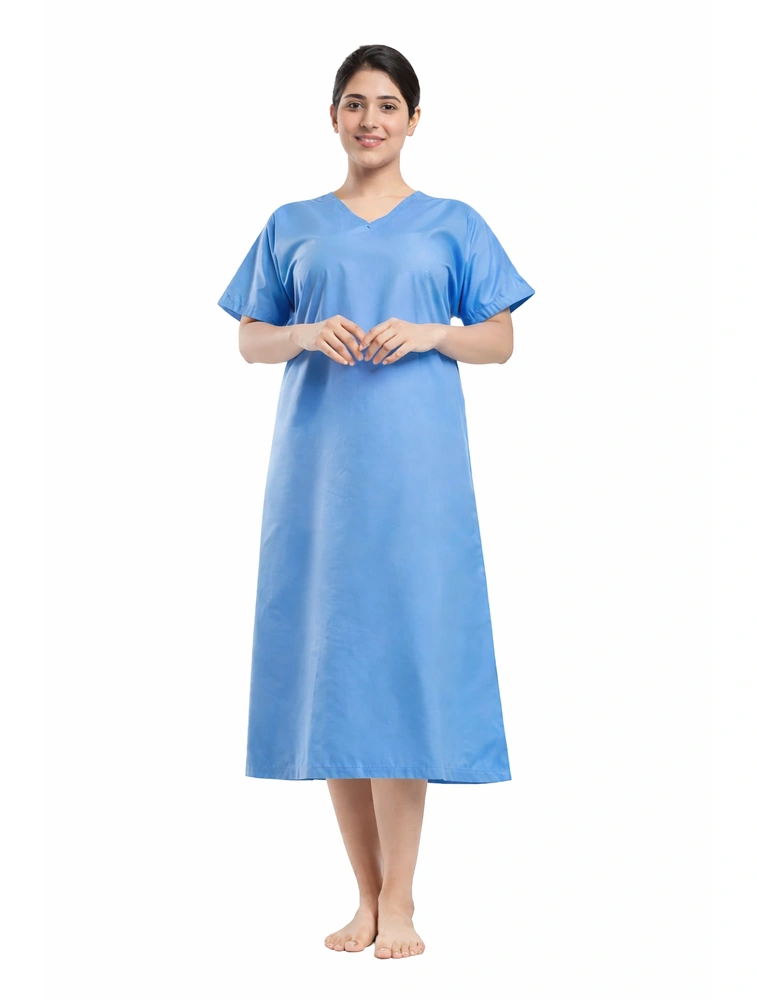
The patient gown is a different garment problem than either staff item. It is worn once by a person who did not choose it, often while unwell, then goes into the heaviest part of the wash cycle. Its priorities are opacity when wet, ease of dressing for someone with a line in their arm, closure that a nurse can manage one-handed, and a fabric that does not become transparent after forty washes. 100 per cent cotton is a defensible choice for comfort and for tolerance of hot washing, but with no fabric mass declared, opacity is unpredictable, and opacity is a dignity issue that generates complaints faster than any other uniform defect in a hospital. Specify the mass, and specify it wet.
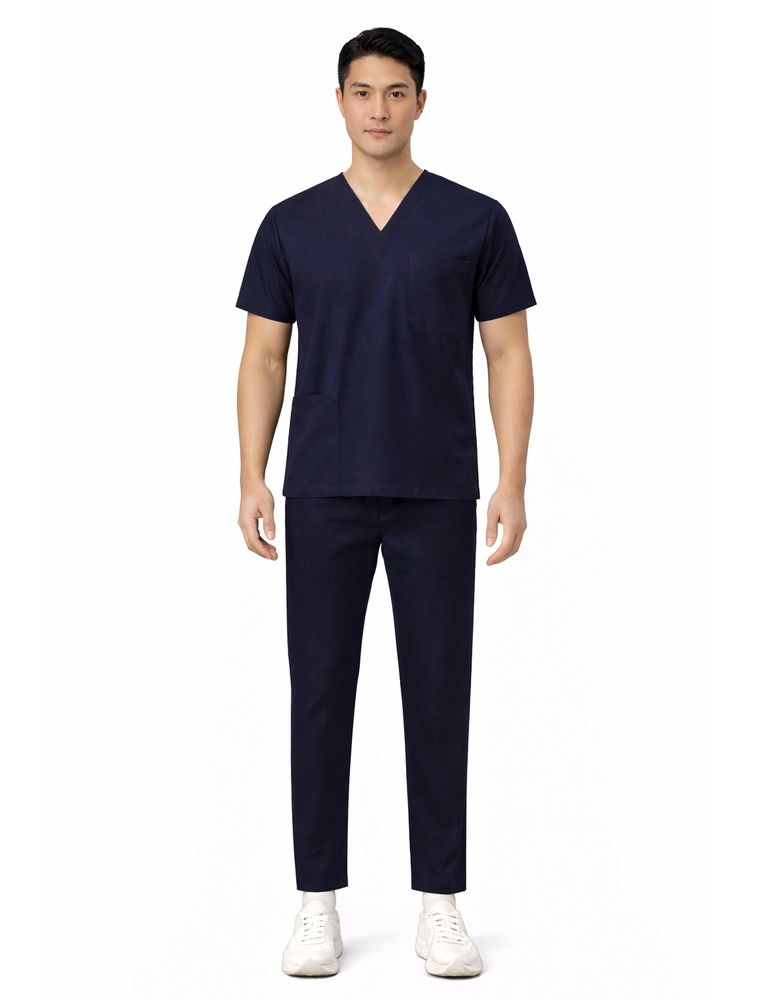
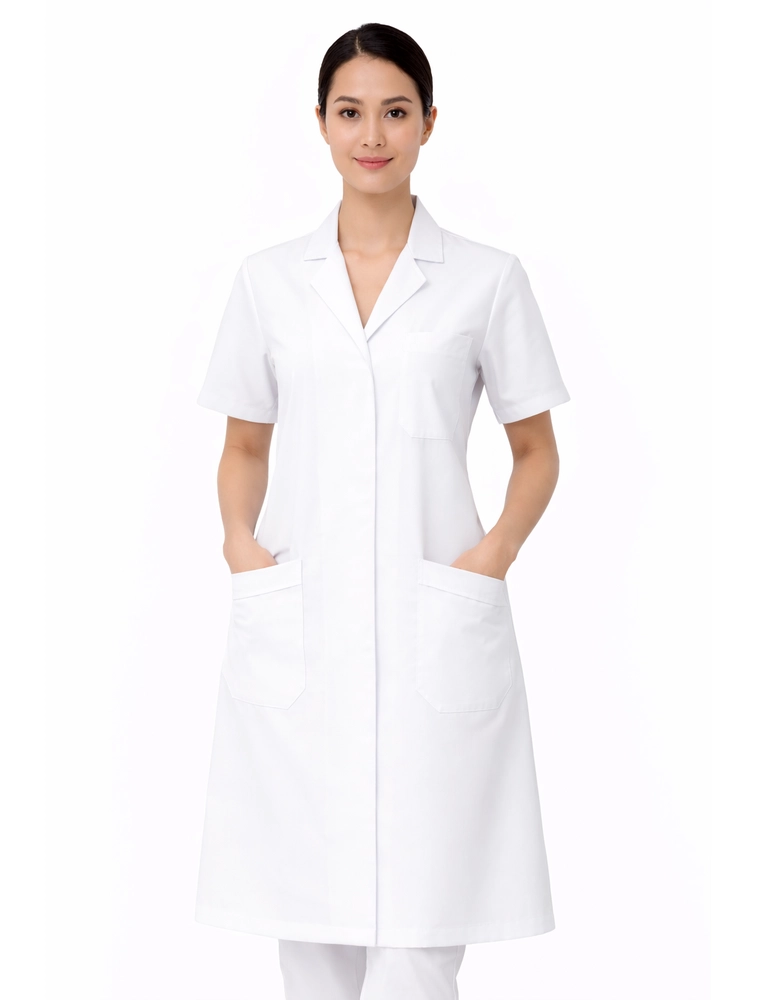
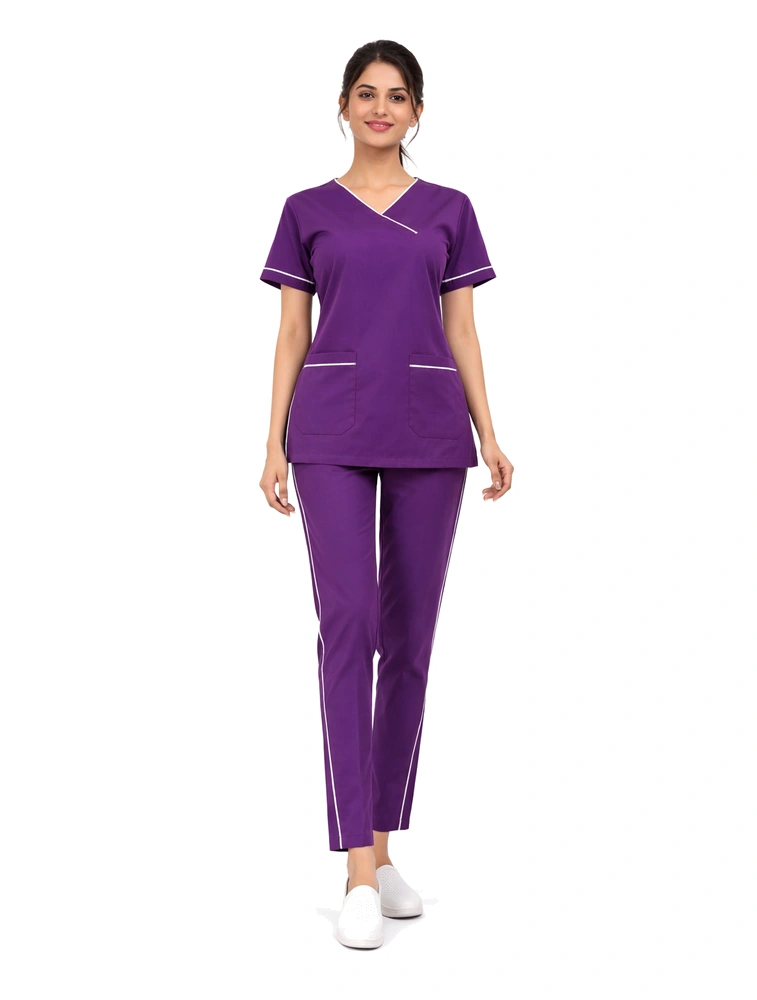
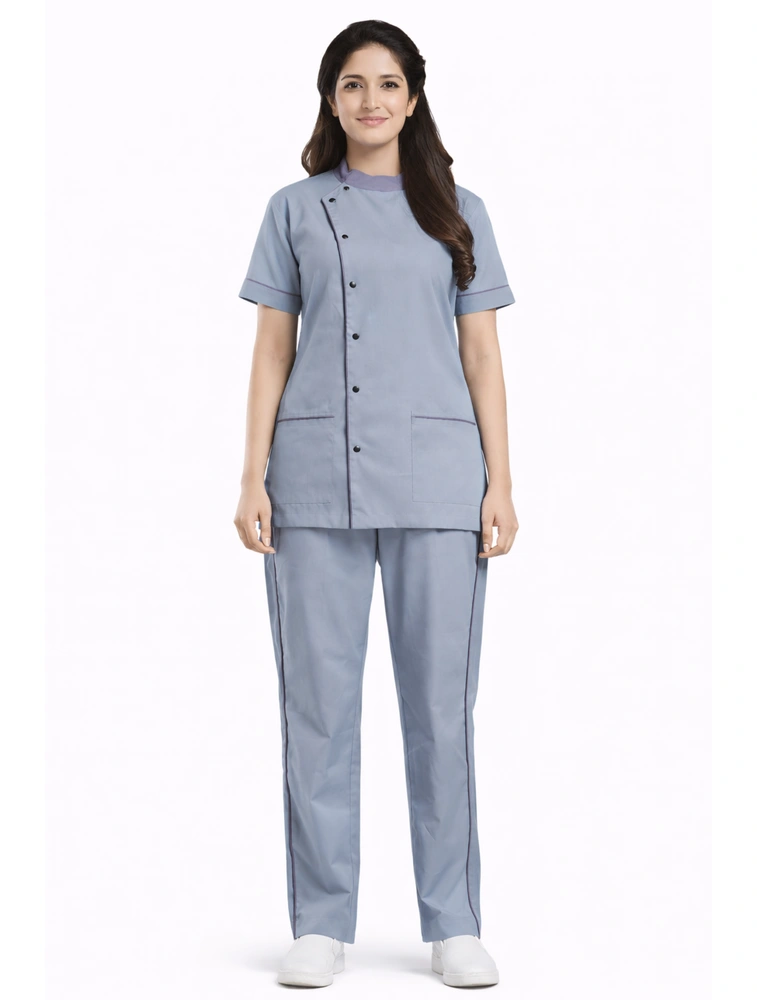
The scrub suit's priorities are almost the opposite. Worn all day by the same person, moved in constantly, washed frequently, and judged on whether it still looks presentable in month six. That points to a polyester-rich blend for dimensional stability and colour retention, double-needle stitching at stress points as the current listing does state, and enough mass to be opaque under theatre lighting while staying breathable in a Chennai summer. The doctor's coat, third, is the most visible garment in the building and the least physically stressed, so its priorities are shade stability, collar and cuff finishing, and a white that survives repeated hot washing without yellowing, which is a fabric-and-dye question rather than a construction one.
Now the reason this is a purchasing problem and not a design one. Those three garments are usually signed for by three different people. Patient gowns come out of a materials-management or housekeeping linen budget. Scrubs are often driven by the nursing superintendent and sometimes paid for by staff. Coats can sit with human resources or with the medical superintendent, and in teaching hospitals with the college. Three buyers with three budget lines produce three unrelated specifications, three suppliers and three quality baselines inside one building, and the result is the shade inconsistency and fit inconsistency that visitors notice and no single person owns.
The fix that costs nothing. One specification document for the institution, covering all three garment families, with per-garment fabric mass, composition, colour reference, wash warranty and size chart. The three budget holders keep their budgets and their sign-off; they buy against one document. Then a single supplier relationship becomes possible, which is where the actual money is, because a consolidated annual volume across coats, scrubs, patient gowns and housekeeping wear prices very differently from three separate mid-sized orders placed at different times of year. We will help you draft that document at no charge, whether or not you place the order with us, because a hospital that knows what it wants is a better customer than one that does not. Start at get a quote or call +91 87470 71444.
How to read the tier table without mis-costing your order. On the four products we checked, the tier table is presented with the best price first, which means the number you see at the top is the rate at 10,000 pieces and the buyer ordering at the 100-piece minimum pays the highest of the three. On the medical coat the ladder runs Rs 413, Rs 405 and Rs 392. On the surgical gown it runs Rs 1,073, Rs 1,052 and Rs 1,019. On the scrub suit, Rs 785, Rs 770 and Rs 746. On the patient gown, Rs 743, Rs 728 and Rs 706. In every case the gap between the minimum-quantity price and the best price is around 5 per cent. We are flagging the presentation because it invites a buyer to budget at Rs 392 and be invoiced at Rs 413, and a 5 per cent surprise on a large order is not a small thing. Assume the higher figure until a quotation says otherwise.
What the 5 per cent tells you about where the real savings are, and are not. Going from 100 pieces to 10,000 pieces on a listed SKU saves you roughly 5 per cent. That is a thin ladder, and it means volume alone is not your lever on this page. The levers that move the number materially are different ones: consolidating several garment types into one order so that cutting, sourcing and freight are shared; fixing a specification for a year so fabric can be bought in one lot rather than four; ordering plain stock where branding is not required, since decoration is a separate cost line; and giving a lead time that lets production be scheduled rather than expedited. A hospital that consolidates coats, scrubs, patient gowns and housekeeping wear into one annual specification with a scheduled call-off is in a different pricing conversation from one placing a 200-piece order in a hurry.
What is genuinely orderable today, and what is not on this page at all. The grid holds medical coats, scrub suits, patient gowns and surgical gowns across 28 SKUs, with several colourways clustering at particular price points. What it does not publish, and you will need most of it, is caps and theatre caps, masks, shoe covers, aprons, gloves, footwear, patient slippers, bed linen, draw sheets, blankets, towels, curtains and OT drapes. A hospital pricing a full soft-goods requirement from this grid will under-cost it substantially, and it is better to hear that here than at the second delivery. Those items are quotable, they are simply not listed, and several of them are made in different factories than garments are.
One page-level error you should know about before you budget. The healthcare tile on our own home page says starting at Rs 695, while the lowest price on this page is Rs 392, and Rs 695 does not correspond to any product listed here. That is a website defect, it is on our list to fix, and the price on this page is the one to work from. We would rather publish that correction than have a procurement officer build a budget on a tile.
How to get a number you can actually put in a budget. Send four things: the garment list with quantities, your size distribution or a request for a size set, your laundry's wash conditions, and whether you need branding. With those four we can quote a blended per-piece rate across your real size mix, with the decoration and freight lines shown separately, and a delivery schedule. Ready stock moves in roughly 7 to 10 days and custom production in roughly 15 to 30 days on the terms published on this page. Start at get a quote or call +91 87470 71444; the company-level questions on minimums, sampling, payment terms and export are answered once, on the home page FAQ.
Government health departments. The purchase is a tender, the technical specification is published before price is discussed, and the qualification criteria decide who is allowed to bid at all. Colour and cadre may already be fixed by a government order, as Odisha's Health and Family Welfare Department did in setting cadre-wise dress for its nursing service, in which case colour is not negotiable and your job is to reproduce it consistently across hundreds of facilities. What matters here is the specification document, the ability to deliver to many locations against a schedule, and documentary compliance at bid stage. Price matters, but bids are lost on paperwork more often than on rate. If you are drafting such a tender, we will help you write the technical annexure with named standards and test methods, whether or not we bid.
Private hospitals and hospital chains. Two decision-makers who often have not met about this: the infection-control committee, which owns the wash protocol and therefore ought to own the fabric specification, and materials management, which owns the rate and the vendor. The garment specification belongs at the intersection and usually falls through it. For a chain, add a third factor: consistency across units, which is a shade-and-size-chart problem more than a price problem, and which is why a chain benefits most from a single specification document and a single dye-lot strategy. Nursing leadership is the group whose acceptance determines whether garments are actually worn.
Medical colleges and teaching institutions. Distinct because they buy for three populations at once: staff, students and patients. Student coats are frequently paid for by students or through a fee line, which turns the institution into a specifier rather than a purchaser, and creates a real risk of twelve different whites in one classroom unless the institution nominates a specification and a supplier. Intake timing also makes demand seasonal and sharp in a way it never is in a hospital, so lead time and a pre-agreed size distribution matter more than unit price.
Corporates with occupational health centres, and industrial medical rooms. Small quantities, high visibility, bought by human resources or administration rather than by anyone clinical, and usually needed to match a corporate identity rather than a cadre scheme. The specification question here is simple and often missed: the coat worn in the plant medical room is subject to the same laundering reality as any hospital coat, but it is bought on the same logic as office wear. Specify it as a healthcare garment and it will last; specify it as branded apparel and it will not.
Brands, retailers and wholesalers. A different purchase entirely. The end buyer is a hospital or an individual practitioner, so what matters is landed cost, a size curve that sells through, shade consistency across repeat orders and correct labelling. The commercial risk in this segment is specification drift: an unspecified garment resold into a clinical setting carries a problem that follows the invoice, and a distributor who cannot answer what standard, what composition, what fabric mass is exposed in a way the manufacturer is not. Get the specification in writing at first order and it becomes an asset in every subsequent sale.
What to send us, whoever you are. The garment list with quantities; who owns the wash protocol and what it says; whether colour is fixed by an order or open; your size distribution or a request for a size set; the delivery locations and the date the garments have to be on the ward. That is enough for a real quotation rather than a range. Send it to get a quote or call +91 87470 71444. We manufacture garments to specification; the clinical, infection-control and regulatory determinations behind that specification rest with your own advisers, and nothing on this page is medical, legal or compliance advice.