Choose your delivery location
Enter a 6-digit Indian PIN code to see delivery options for that area.
Currently delivering to Bengaluru 560105
Ready stock & made to order
Bulk caps
factori.com supplies bulk caps from ₹42/piece across 662 partner factories — ready stock and custom programmes with GST invoices.
Prices verified October 2026 · shown excluding GST
₹42Entry price
Same dayDispatch on working days








Page 2 of 2
Bulk caps for every use case
Brand-ready caps for corporate, retail, uniforms and large custom programmes — sourced across partner factories with published prices.
Corporate & events
Brand-ready caps for offsites, launches and conferences.
Get quote →
Uniforms & programmes
Consistent supply for schools, factories and frontline teams.
Corporate uniforms →
Own brand / resale
Unbranded or private-label stock for retail brands.
Launch your store →
Large custom runs
Contract manufacturing for high-volume programmes.
Contract manufacturing →Bulk caps — frequently asked questions
Every cap on this page lists its size as "Baseball Cap". What size are they actually, and how do we specify head size on a bulk order?
"Baseball Cap" is a silhouette, not a size, and the size chart on this page is a generic placeholder with no measurements on it. A cap has exactly one real size dimension: internal head circumference in centimetres. Specify that number, or a range, in writing on your purchase order.
This is the single largest specification gap on the page, and we would rather say so than paper over it. Thirty listings carry a size field, and on every one of them the field is filled with a construction type. A buyer ordering 2,000 caps for a marathon, a dealer conference or a housekeeping team gets no number he can check a delivery against.
The number to use. Head circumference is measured with a soft tape around the head, sitting just above the ears and across the middle of the forehead, at the point where the cap band will actually rest. The adult range that commercial headwear works to runs roughly from 54 cm to 65 cm, and the industry convention maps it as follows: XS 54–55 cm, S 56–57 cm, M 58–59 cm, L 60–61 cm, XL 62–63 cm, XXL 64– 65 cm. Those bands are a trade convention rather than an Indian Standard; there is no BIS size standard for headwear that we can point you to, which is precisely why the number has to be agreed contractually instead of assumed.
What "one size fits most" really commits to. An adjustable cap with a strap at the back does not fit every head. The commercial convention is that it covers approximately 56 cm to 61 cm — S through L. That leaves out the XS end and, more importantly for an Indian workforce order, the 62 cm and above end. If you are buying for a 500-person site, planning on the assumption that one adjustable size covers everybody is planning for a tail of people who will wear the cap loose, wear it strap-out, or not wear it. Ask us for the measured range of the specific style before you commit, and put the answer in the order.
How to write it into a purchase order. Four lines are enough, and they are four lines this page cannot currently give you: the internal band circumference at the relaxed setting in centimetres; the adjustment range in centimetres from tightest to loosest; the measurement method used to arrive at both; and the tolerance you will accept, stated as plus or minus centimetres. Then require that the pre-production sample is measured against those four lines and the measurement recorded on the approval sheet. That single sheet is what converts a cap from a picture into a specification, and it is what you hold up if a delivery arrives tight.
Where the difference actually bites. Two order types are unforgiving about this. The first is any programme where the cap is part of a uniform that must look identical across a shift — security gate duty, hotel front-of-house, a retail floor — because a cap worn at three different strap settings reads as three different caps in a photograph. The second is any order where the caps are being handed out unsorted at an event, since there is no chance to exchange. For the first, specify sized caps in a distribution rather than a single adjustable size. For the second, specify adjustable and accept that the tail exists.
What we will do about it. If you are quoting a cap order with us, ask for the head-circumference range in writing and we will give you the figure for the style you are quoting rather than repeating the size field on the listing. Where a style is genuinely adjustable-only, we will tell you the measured range instead of calling it one-size. And if your programme needs sized headwear in bands, that is a contract manufacturing specification rather than a shelf pick — start at contract manufacturing or send the requirement through get a quote.
SpecificationQueries Targetedcap size chart head circumference cm, bulk cap sizing India, one size fits all cap circumference, how to specify cap size purchase order, adjustable cap size range
One family on this page is described as a 5-panel cap and the rest say nothing about panels. What is the difference between 5-panel and 6-panel, and does it change what we can print on it?
Panel count describes how many pieces of fabric form the crown, and it decides whether there is a seam running up the middle of the front. A 6-panel cap has a centre front seam; a 5-panel cap replaces the two front panels with one, giving an unbroken front. Only the Drill Cotton family on this page publishes its panel count.
Twenty-nine of the thirty listings on this page do not tell you how the crown is built. That matters more than it sounds, because panel count and crown structure between them determine the shape the cap holds, how it sits on a head, and how large and how clean a logo can be applied to the front.
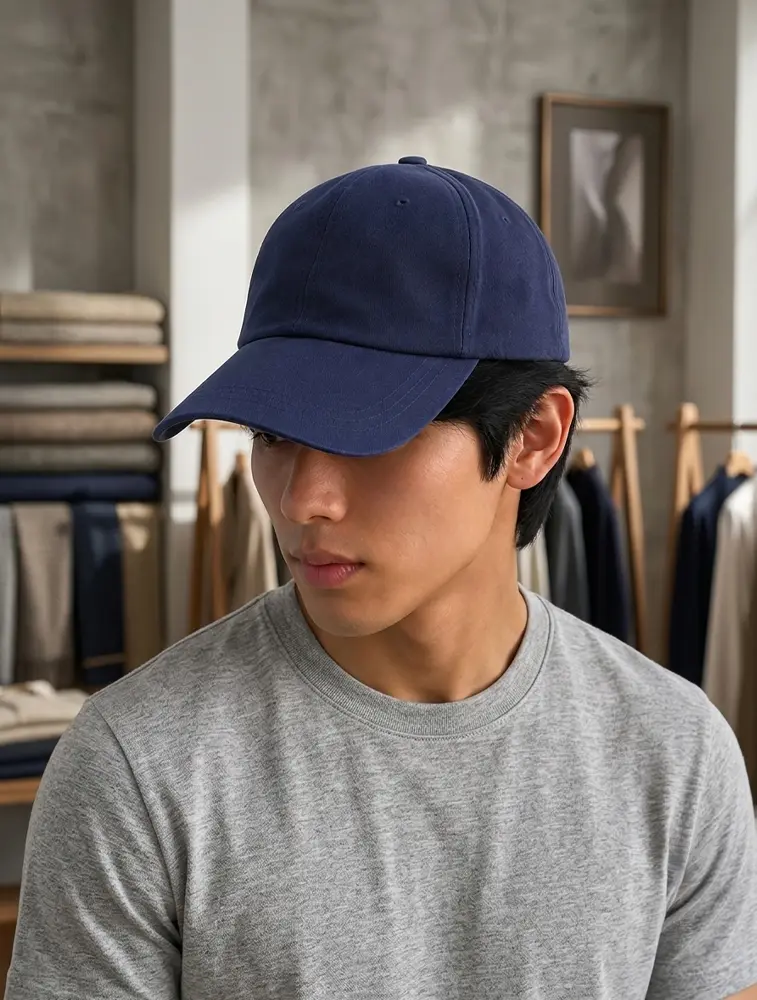
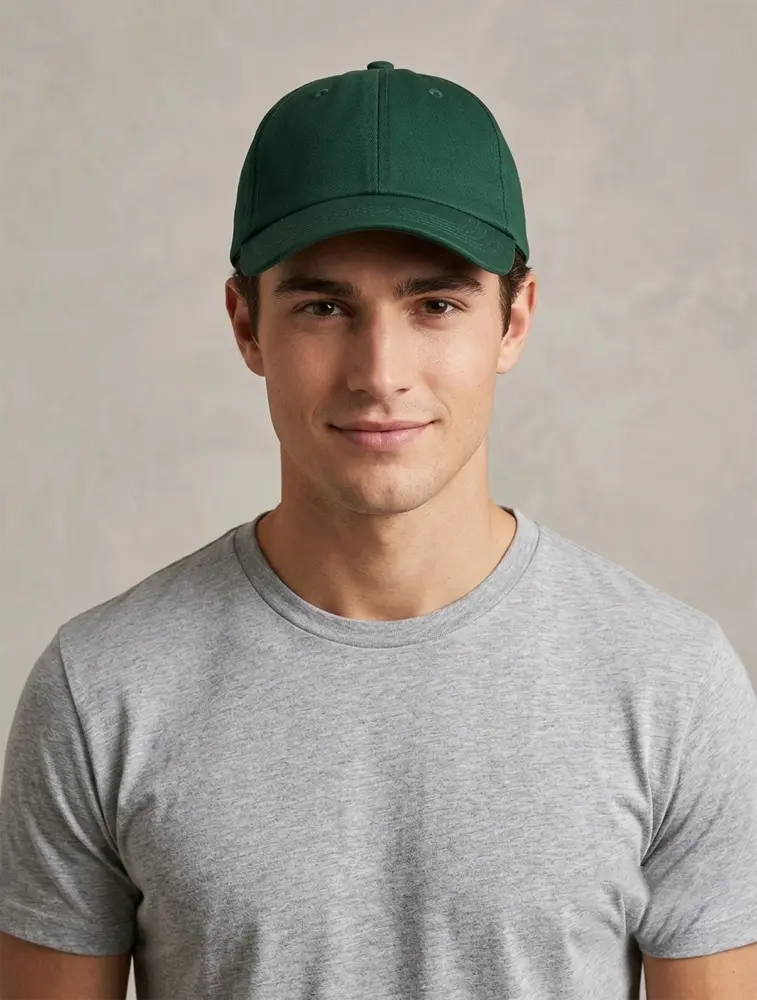
Six panels. The traditional construction: six triangular sections joined at the apex, usually with a covered button at the crown and eyelets for ventilation. Because the two front panels meet in the middle, there is a raised seam running vertically up the centre of the branding area. That seam is not a defect. It is the reason six-panel caps sit closer to the head shape and hold their form well. It is also the reason a wide, solid, single-piece logo across the front of a six-panel cap is harder to execute cleanly than the same logo on a five-panel.
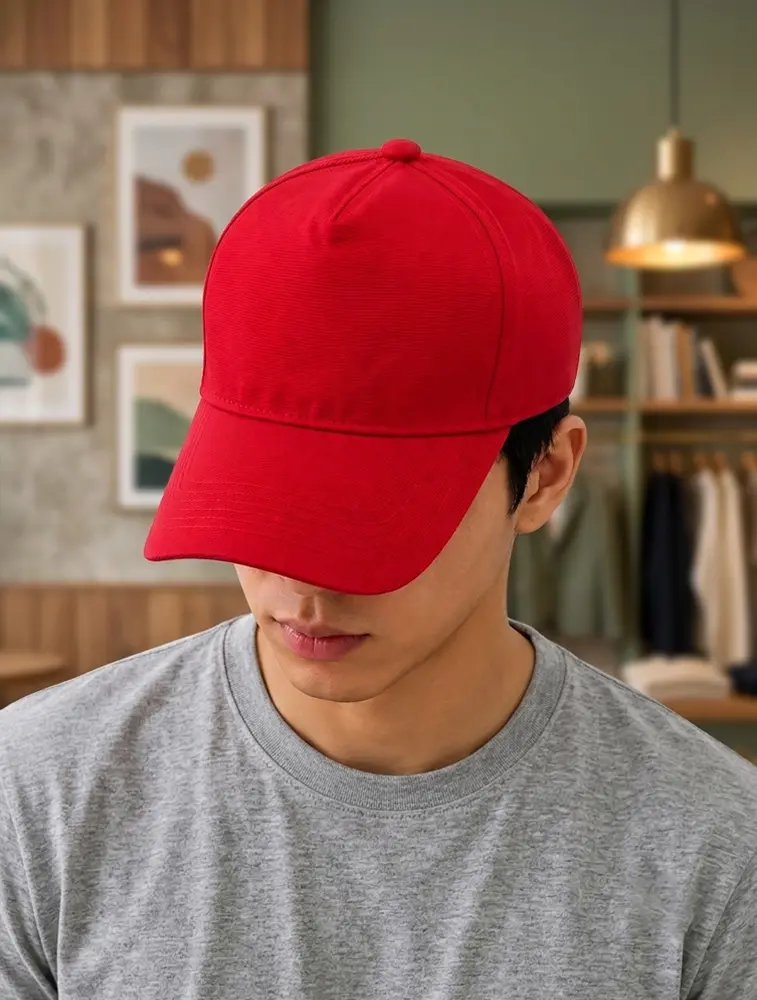
Five panels. One continuous front panel replaces the pair, so the front face is unbroken from the peak to the crown. The rest of the crown is made up of the four remaining sections. The commercial consequence is a flat, uninterrupted branding field — which is why five-panel is the construction most often specified when the logo is the point of the cap. The Drill Cotton family on this page is described as a structured five-panel construction, and it is the only family here for which that is stated.
Structured versus unstructured, which is the bigger variable. Independently of panel count, a crown is either stiffened or it is not. A structured crown carries an interlining — buckram or a fused equivalent — behind the front panels, so the cap stands up off the head and keeps its shape empty on a shelf. An unstructured crown has no stiffener and collapses softly onto the head. For a branded corporate cap, structured is almost always what the buyer has in his head when he pictures the product, and unstructured is what arrives when nobody wrote the word down. This page does not state structure for any family except the Drill Cotton one, so it has to be asked for.
How it changes the branding decision. A structured front panel gives an embroidery machine something firm to sew into, which is why machine-embroidery guidance for structured caps is to use a single layer of tear-away backing rather than building up multiple layers. An unstructured front panel moves under the needle and needs more support and a more conservative design. And on any six-panel cap, embroidery guidance is to build the design outward from the centre, alternating across the centre seam, and to avoid running fill stitches parallel to that seam — take a slight diagonal instead — because stitching hard along a seam is where puckering and registration errors show up.
The four lines to add to your enquiry. Panel count, stated as a number. Crown structure, stated as structured or unstructured, and if structured, what the stiffener is. Whether there are eyelets or mesh panels for ventilation. And whether there is a sweatband, and in what material, because that is the part of the cap in permanent contact with perspiration.
Practical guidance. If the logo is wide, single-colour and must read cleanly at a distance, specify five-panel and structured. If the cap has to look conventional and sit well over long wear — a driver, a guard, a groundskeeper — six-panel structured is the safer pick and the logo should be designed to live either side of the seam or to sit above it. Either way, write the number down. Send the specification through get a quote and we will quote to it rather than to a picture.
SpecificationQueries Targeted5 panel vs 6 panel cap difference, structured vs unstructured cap, cap crown construction buckram, front seam cap embroidery, cap panel count specification
Your caps are listed as "regular cotton", "drill cotton" and "dry fit polyester". Those are not specifications. How do we find out what we are actually buying?
Of those three, only one maps to a published Indian Standard. Cotton drill is defined by IS 177:1989, Cotton Drills — Specification (Fourth Revision), which prescribes constructional details for four varieties of cotton drill. "Regular cotton" and "dry fit polyester" are trade descriptions with no standard behind them, so both need to be pinned down in writing.
There are four distinct fabric descriptions across the thirty listings on this page and they are not equivalent kinds of information. One is a standardised fabric name. Two are commercial shorthand. And one is a supplier trade name with no textile meaning we were able to source at all — which is why we are not repeating it here as though it were a specification. If a fabric name on a listing cannot be traced to either a standard or a stated construction, treat it as a marketing label and ask for the construction instead.
Cotton drill, and what IS 177 actually gives you. IS 177:1989 states in its scope that it "prescribes constructional details and other particulars of four varieties of cotton drills, grey, scoured, bleached or dyed". The characteristics it tabulates are the ones a buyer would want: ends per decimetre, picks per decimetre, mass per square metre, breaking load in both warp and weft, and the dimensions of the piece. Colour fastness and dimensional change are dealt with separately, with ratings for light, washing, bleaching and perspiration and shrinkage limits that differ by finish — grey, bleached or dyed, and the mercerised and preshrunk variety. We are deliberately not quoting the numeric limits from those tables, because we have the standard's structure but not a citable copy of its values. What matters commercially is that the standard exists and can be referenced in a purchase order: ask for the drill to be supplied to a named variety under IS 177:1989 and for a mill test report against it.
"Regular cotton". This tells you the fibre and nothing else. Two caps can both be honestly described as regular cotton and differ in yarn count, weave, fabric mass, finish and shrinkage behaviour to the point of being different products. On this page the phrase covers listings at two different price points, which is itself the clue that it is describing more than one fabric. Require, in writing: fibre composition as a percentage; yarn count; weave; and mass per square metre.
"Dry fit polyester". "Dry fit" is a moisture-management marketing term, not a test result. What it usually means is a knitted polyester with a construction and finish intended to move perspiration off the skin. There is no pass mark attached to the phrase. If moisture management is a real requirement for your order — an outdoor workforce, a sports programme — ask for a named wicking or moisture-management test and its result, rather than accepting the phrase. Three listings in this family do publish a fabric mass of 120 GSM, and those three are the only listings on the entire page carrying a GSM figure.
The one specification contradiction we found, stated plainly. One listing in the Dry Fit Polyester family carries "Dry Fit Polyester" in its title, "100% cotton" in its specification body, and the words "Cotton Cap" in its description. Those cannot all be true. Until it is corrected, do not order from that listing on the strength of the fibre content shown; ask us to confirm the composition in writing against the specific SKU. The same family also has two listings whose descriptions were clearly written for a different colour than the one being sold.
What a defensible fabric line looks like. "100% cotton drill, IS 177:1989 variety as agreed, mill test report required; mass per square metre stated and toleranced; shrinkage limit stated; colour fastness to washing, light and perspiration reported." That is a fabric specification. "Regular cotton" is not. Send the specification you need to get a quote, or if the construction has to be built rather than picked, start at contract manufacturing. We manufacture garments to specification; the testing and certification determinations behind that specification are yours to set, and nothing here is compliance advice.
SpecificationQueries Targetedcap fabric specification cotton drill IS 177, drill cotton cap fabric standard India, dry fit polyester cap fabric meaning, cap fabric GSM yarn count weave, bulk cap fabric test report
Only three of your caps publish a GSM figure. Does GSM mean the same thing on a cap as it does on a T-shirt, and should we be specifying it?
GSM measures one thing only: the mass of one square metre of the fabric. On a T-shirt that number largely governs how the garment feels and drapes. On a cap it governs much less, because a cap's feel, shape and durability come mostly from the crown stiffener, the seam construction, the peak insert and the sweatband — none of which GSM describes.
Three listings on this page publish 120 GSM. Twenty-seven publish no fabric mass at all. Before you write a GSM figure into a headwear order, it is worth understanding what it will and will not protect you against, because a buyer who specifies GSM and nothing else on a cap has specified almost nothing.
Why GSM carries a T-shirt and not a cap. A T-shirt is essentially one fabric hanging on a body. Change the fabric mass and you change the product: the opacity, the drape, the hand, the way it survives washing. A cap is an assembly. The visible fabric is one of five or six components, and the ones the wearer actually notices are structural. Whether the crown stands up is decided by the interlining behind the front panels, not the fabric mass. Whether the peak holds a curve is decided by the insert inside it. Whether the cap is comfortable after four hours in the sun is decided by the sweatband and the ventilation. Whether it survives a laundry cycle is decided by the stitching and the closure hardware. You can raise the GSM of the crown fabric and make the cap worse on every one of those axes.
What GSM is still useful for. Three things. It is a fair proxy for opacity, which matters if you are printing a light logo onto a dark cap or vice versa and do not want the underlying seam allowance showing through. It is a reasonable consistency check across a repeat order — if the first delivery measured 120 GSM and the second measures 96, something changed in the mill even if the cap looks the same. And on a knitted polyester it is part of the picture on breathability, since a heavier knit at the same construction will generally move less air.
The specification that actually protects a cap order. Ask for the fabric mass, by all means, and have it toleranced — a figure with no tolerance is not enforceable, and plus or minus five per cent is a normal commercial band to negotiate. But then ask for the five things GSM does not cover. Crown structure: structured or unstructured, and the stiffener material if structured. Peak: whether it carries an insert, and whether the peak is pre-curved or flat. Sweatband: material and whether it is a separate taped component. Ventilation: eyelets, stitched or metal, or mesh panels, and how many. Closure: the single specified type, not a list of options. Those five, plus head circumference and panel count, are what a cap actually is.
A note on the 120 GSM listings. The three caps that publish it are in the Dry Fit Polyester family at the upper end of this page's range. We would rather you read that figure as a fabric fact than as a quality ranking, because it is not comparable across constructions: a 120 GSM knitted polyester and a 120 GSM woven cotton drill are entirely different fabrics that happen to weigh the same. Comparing GSM across two different weaves or between a knit and a woven tells you nothing at all.
How to use this on a comparison. If you are holding two quotations for caps and one publishes GSM and the other does not, resist the temptation to score the one with the number higher. Ask both for the seven-line specification above. The supplier who can answer all seven is the one whose delivery will match his sample. Send your seven lines to get a quote and we will answer them for the specific style, rather than pointing you back at the listing.
SpecificationQueries Targetedcap GSM meaning headwear fabric weight, 120 GSM cap fabric, does GSM matter for caps, cap fabric weight specification bulk, cap crown stiffener vs GSM
We want our logo on 3,000 caps. Should that be embroidery, screen print or heat transfer, and what does a curved crown do to the artwork?
For caps, embroidery is the default and the other two are exceptions. A cap front is small, curved, seamed and often stiffened, which is hostile to screen printing and awkward for heat transfer. Embroidery works with that geometry rather than against it — but it imposes real constraints on artwork, and those constraints have to be settled before the order, not after.
Why the geometry decides the method. A T-shirt front is flat, large and can be laid on a platen. A cap front is none of those things. It curves in two directions, it may have a centre seam, the peak gets in the way of any flat tool, and on a structured cap the panel is stiffened. Screen printing needs a flat surface and even pressure; getting both on a crown requires a specialised cap platen, and the printable area shrinks to a small window in the middle of the front panel. Heat transfer needs even heat and pressure across the whole design, which a curved panel resists at the edges — and it introduces a second problem on this page specifically, which is that several cap care labels here say to avoid ironing, a direct contradiction with a decoration method that is applied with a heat press. Embroidery needs neither flatness nor heat. That is why it wins.
What embroidery on a cap actually demands from the artwork. Machine-embroidery practice for caps is well established and it is more restrictive than for flat goods. The design is built from the centre outward, alternating across the centre seam, so that fabric distortion is balanced rather than pushed to one side. Lettering is stitched last, because stitching around it afterwards drags it out of registration. Fill stitches are not run parallel to a seam — a slight diagonal angle is used instead, because a fill running along a seam is where puckering appears. Stitch density is managed rather than maximised: too many stitches too close together on a small curved panel is a distortion problem, not a richness benefit. And small text has a floor. Satin columns below about 17 points become difficult, and going under roughly 12 points is where legibility and stitch quality break down. The practical consequence for you is that a logo with a tagline in small type under it may need the tagline dropped, enlarged, or moved to the side panel.
The sewing field. Every cap frame has a maximum area it can reach, and the effective area is further limited by the cap's own construction — how deep the crown is, where the seam sits, how the peak is attached. We will give you the usable area in millimetres for the specific style you are ordering. What we will not do is quote you a generic maximum, because a figure that is right for one crown is wrong for another and you would be designing to the wrong box.
Backing. A structured cap generally needs a single layer of tear-away backing behind the panel; the stiffener is already doing most of the stabilising work. An unstructured cap needs more support because the panel moves under the needle. This is another reason the structured-or-unstructured question from the panel-count discussion is not cosmetic — it changes the decoration setup.
What we need from you, in order. Vector artwork, not a screenshot. The exact number of thread colours you will accept, since colour count drives both cost and trim complexity. The maximum finished dimensions you want, in millimetres, so we can tell you whether it fits the sewing field before digitising. Whether the cap is structured. And a decision on side-panel or rear branding, because a second position on a cap is a second setup and it is cheaper to decide it now than to add it after approval.
Then insist on a sewn-out sample. Not a digital mock-up. A digitised design behaves differently on cotton drill, on a knitted polyester and on a stiffened panel, and the only way to see it is to sew it. Approve the physical sample, keep it, and make it the reference the delivery is checked against. Send your artwork and quantities to get a quote, or for a programme that needs a bespoke cap built around the logo rather than a logo squeezed onto a stock cap, start at contract manufacturing.
Branding & CareQueries Targetedcap logo embroidery vs screen printing, heat transfer on caps curved surface, cap embroidery digitising stitch direction, logo size front panel cap branding, bulk cap custom printing India
The listings say "adjustable strap (Velcro / buckle options available)". We cannot put an either/or on a purchase order. How do we lock down which closure we receive?
You are right that it is not a specification, and the fix is contractual rather than technical: name one closure type in the purchase order, name the hardware finish, name the adjustment range in centimetres, and require the pre-production sample to carry that exact closure. An either/or on a listing means the factory chooses. Your order should mean you choose.
This phrasing appears across the page and it is the most common way a cap delivery disappoints a buyer who did everything else right. The cap arrives in the right colour, the right fabric and the right logo, with a closure nobody expected, and there is no document that says it should have been otherwise.
The four closures you are choosing between. A hook-and-loop strap — Velcro being the familiar trade term for the fastening type — is the cheapest, adjusts continuously, and is the one most likely to degrade first: the loop side collects lint and hair and loses grip, and it is the component that fails on a cap that is otherwise fine. A metal buckle with a tuck-in tail adjusts continuously, looks more considered, and lasts longer, but the tail has to go somewhere and the buckle can be uncomfortable under a helmet or against a seat headrest. A plastic snap closure — the snapback — adjusts in fixed increments, is very durable, and reads as casual streetwear rather than corporate. And an elasticated or fitted band does not adjust at all, which means it needs sized ordering and brings you straight back to head circumference.
How to choose for the actual use. For a one-day event where the cap is handed out unsorted, hook-and-loop is defensible: it adjusts fastest and nobody is wearing it for two years. For a uniform programme where the cap is part of a look that must be consistent across a shift, a buckle is the better answer, and a snap is acceptable if the brand tolerates it — the important property is that fixed increments make the cap look the same on everybody, where a continuous strap does not. For anyone wearing a cap under other headgear or in a seat all day, avoid a metal buckle at the rear. For a programme where appearance is closely controlled, consider a fitted band and accept that you must order in size bands.
The five lines that close the gap. Closure type, one only, spelled out. Hardware material and finish — for a buckle, the metal and the plating, because an unplated buckle on a cap worn in coastal humidity will mark the fabric. Strap material and colour, since a strap in a colour that does not match the crown is a visible defect nobody specified. The adjustment range in centimetres at both ends. And the position of the strap tail, if there is one, so it is tucked and stitched rather than left loose.
Why this matters more on a repeat order than a first one. A single delivery with an unexpected closure is an annoyance. A programme that is replenished quarterly with an unspecified closure will drift, because different runs will be built with whatever is current, and eighteen months later the caps on the floor will have three different backs. If you are running a uniform programme, the closure line in the specification is doing the same work as the shade line: it holds the product still across time. That is the same argument that applies to any repeat-buy garment, and headwear is where it is most often forgotten because the closure feels like a detail.
What to ask us. Tell us the use case and we will recommend a closure and state it in the quotation rather than offering options. Ask for the adjustment range in centimetres for the style. And if your programme needs a closure that is not on the shelf styles — a fitted band in size bands, or a specific buckle finish — that is a build rather than a pick, so start at contract manufacturing or send the requirement to get a quote.
SpecificationQueries Targetedcap closure types buckle velcro snapback, adjustable cap strap specification, cap closure purchase order specification, metal buckle vs velcro cap durability, bulk cap closure options India
The care instruction on several caps says to avoid machine washing, bleaching and ironing. We are buying these for staff who will wash them weekly. Which test report should we be asking for?
Ask for colour fastness to perspiration. The Indian Standard method is IS 971, Method for Determination of Colour Fastness of Textile Materials to Perspiration; the international equivalent is ISO 105-E04:2013, Colour fastness to perspiration. A cap is the one garment whose interior band is in constant contact with sweat, so this is the test that predicts how it will age.
We want to be straight about the care labels first, because they are a real problem on this page and not a formatting quirk. Several listings say to avoid machine washing, avoid bleaching and avoid ironing, while the same listings are sold for heat-transfer branding and for staff use. A cap issued to a housekeeping team, a kitchen, a delivery fleet or a security post will be washed, and it will be washed by whoever is holding it, not by a laundry that reads labels. A care instruction that assumes hand washing is a care instruction that will be ignored. If your programme washes weekly, tell us that at the quotation stage and we will tell you which construction survives it — rather than you discovering the answer through a care label after delivery.
Why perspiration fastness is the headwear-specific test. On a shirt or a T-shirt, colour loss is dominated by washing and by light. On a cap both of those still apply, but a third mechanism is doing more damage than on any other garment: the band and the interior of the crown are pressed against a sweating forehead for the entire wear period, in warmth, under compression. Perspiration is mildly acidic or alkaline depending on the individual, and the standard test methods reflect that by testing against both an acid and an alkaline artificial perspiration solution. That is exactly the exposure a cap gets and a jacket does not. A dark cap that bleeds under perspiration will mark a forehead and mark a white shirt collar; a light cap will grey at the band and look unwashed while being clean.
The three fastness results worth having on a cap. Perspiration, under IS 971 or ISO 105-E04, for the reason above. Washing, under the relevant ISO 105 washing method, because it establishes what happens over a laundry life rather than a single cycle. And light, again from the ISO 105 series, because a cap is by definition worn on the part of the body that gets the most sun, so it fades faster than the garment beneath it. Those three between them cover how the cap will actually look at month six. Ratings on these tests are reported on a grey scale; what you should require is the reported rating for the specific fabric and colour, not a general assurance, and you should require it on the dark shades and the brights rather than on white, because those are where the risk sits.
The bleach question specifically. IS 177:1989 for cotton drill deals with colour fastness including fastness to bleaching, alongside light, washing and perspiration. So if you are buying the drill cotton family and your protocol involves any bleach exposure, that is a question the standard contemplates and a mill test report can answer. What we will not do is tell you a factori cap is bleach-safe. We make no claim about the performance of our own garments beyond what a test report says; we tell you which report to require.
What to write into the order. Name the test methods. State that reports are required on the actual production fabric and the actual shades, not on a generic swatch. State the minimum rating you will accept, negotiated with us in advance rather than asserted after. Require that the care label on the delivered cap matches the wash protocol you told us about. And keep the approved sample, unwashed, so you have a shade reference to hold a faded cap against.
The honest summary. If your caps are for a two-hour event, none of this matters and you should not pay for it. If your caps are a uniform component being worn daily outdoors and washed weekly, this is the difference between a programme that looks the same in month nine and one that does not. Tell us which you are at get a quote and we will scope the testing to the actual life of the garment. Testing and acceptance criteria are yours to set; nothing here is compliance advice.
Branding & CareQueries Targetedcap colour fastness perspiration IS 971, ISO 105-E04 colour fastness perspiration test, cap care instructions hand wash bleach, sweatband colour fastness test report, cap washing durability bulk order
We are buying caps for an outdoor workforce and our EHS team has asked for sun protection. Can you supply caps with a UPF rating?
Not as a cap. AS/NZS 4399:2017, Sun Protective Clothing — Evaluation and Classification, recognises three sun-protective hat types — bucket hats, legionnaire hats and broad-brimmed hats — and explicitly excludes caps and sun visors. So a peaked cap cannot carry a sun-protection classification under that standard, whatever fabric it is made from.
This is the answer your EHS team needs, and it is worth them hearing it from a supplier rather than discovering it later. It is also a genuine product-range consequence: if sun protection is the requirement, the correct response is to change the headwear type, not to look for a better cap.
How the classification works. AS/NZS 4399:2017 classifies sun protective clothing by Ultraviolet Protection Factor into three bands with descriptive terms: UPF 15 is "Minimum", UPF 30 is "Good", and UPF 50 and 50+ is "Excellent". The critical point, and the one that catches buyers out, is that the standard does not assess fabric alone. It requires a minimum level of body coverage before clothing may display or claim a UPF rating. ARPANSA, the Australian Radiation Protection and Nuclear Safety Agency, makes the distinction plainly: its test reports "provide the UPF ratings of the materials tested but they do not evaluate the design or body coverage of the products". A fabric can test at UPF 50+ and the garment made from it still be ineligible to claim it, because the garment does not cover enough.
Why a cap fails on coverage, not on fabric. A peaked cap shades the forehead and, partially, the eyes. It leaves the ears, the back of the neck and the sides of the face exposed — which is precisely where outdoor occupational sun exposure accumulates. The same standard also excludes low-coverage garments generally, naming singlets, crop tops, halter tops, briefs and bikini swimwear as items that may not make sun protection claims. Caps and visors sit in that logic: the fabric may be excellent and the coverage is not sufficient to make a claim.
What to specify instead. If your EHS requirement is real, specify one of the three recognised types. A legionnaire style — a cap crown with an attached neck and side flap — is usually the most acceptable to an Indian outdoor workforce because it keeps the familiar peaked front while covering the neck and ears. A bucket hat gives all-round brim coverage and is the simplest to source. A broad-brimmed hat gives the most coverage and the most resistance from wearers. For any of the three, require a UPF test report on the actual production fabric under AS/NZS 4399:2017 and require the supplier to confirm the garment meets the standard's coverage requirement, not just the fabric rating. If the fabric report exists and the coverage confirmation does not, you do not have what you asked for.
What we can and cannot do today. This page currently lists peaked caps and one chef cap. It does not list legionnaire caps, bucket hats or broad-brimmed hats, so if you need a rated sun-protective item we cannot serve it from the shelf and we would rather say so than sell you a cap against a sun-protection requirement. Legionnaire and bucket styles are a contract manufacturing specification: the neck flap, the brim depth and the fabric all have to be built to your requirement, and the UPF testing has to be commissioned as part of the programme. Start that at contract manufacturing.
The claim we are not making. No factori cap on this page carries a UPF test report, and we make no ultraviolet protection claim for any of them. If a supplier offers you a "UV protection cap" with a UPF number on it, ask for the test report and ask which standard the coverage assessment was made under. This is a description of how the standard works and what to require; it is not health, safety or compliance advice, and your EHS determinations rest with your own advisers.
Standards & RegulationQueries TargetedUPF rated cap sun protection standard, AS/NZS 4399 caps excluded, sun protective headwear legionnaire bucket hat, UV protection cap outdoor workers India, UPF 50 hat standard labelling
Can a high-visibility cap count towards the hi-vis requirement on our site?
No. EN ISO 20471:2013 assigns visibility classes on the basis of minimum areas of material on the garment: Class 1 requires 0.14 square metres of fluorescent background and 0.10 square metres of retroreflective material, Class 2 requires 0.50 and 0.13, and Class 3 requires 0.80 and 0.20. No cap presents anything approaching those areas, so a cap cannot carry a class.
We get this question from site and facilities buyers who have a hi-vis line item and a headwear line item and are hoping to combine them. The arithmetic is what settles it, and it settles it decisively. The class is a property of the garment, assessed against a required area of material, and a cap is a small object. A fluorescent cap can be a useful complement to a certified garment. It cannot be a substitute for one, and it should never appear in a PPE register as though it were.
Where the class lives. Under ISO 20471 the certified item is the garment covering the torso, with the higher classes requiring coverage and banding arrangements — a Class 3 jacket, for example, is expected to cover the torso and either have retroreflective banding on the sleeves or be worn with full-length trousers carrying banding. That is a garment-system logic. Headwear sits outside it. So the correct structure for your specification is: the vest or jacket carries the class and the certification, and the cap is specified separately as a uniform item, with no visibility performance attributed to it.
What a fluorescent cap is actually good for. Two things, both real and neither of them certification. First, recognition at a distance in daylight — a fluorescent crown makes a head visible above a vehicle line or over a barrier, which is a genuine operational benefit on a yard or a crowd-control cordon even though it earns no class. Second, role identification, which is why event marshals, parking staff and traffic wardens are put in bright caps: it is about being findable, not about being conspicuous to a driver at night. If those are your reasons, a bright cap is a sensible buy. Just book it as a uniform item.
What we will not do. We will not describe any factori cap as high-visibility PPE, will not attribute a class to it, and will not supply it against a line in a PPE schedule that references ISO 20471. Where a buyer needs certified hi-vis, the certified item is the body garment and that conversation belongs on our corporate and industrial uniforms page, where hi-vis garment classes are dealt with properly. The cap can be quoted alongside it as a matching uniform item in the same shade family.
The retroreflective tape question. Buyers sometimes ask whether adding a strip of retroreflective tape to a cap changes the answer. It does not change the classification — the area minima are far above what a cap can carry, and a strip of tape on a crown is not an assessed configuration. What it can do is make a worker's head visible in a torch or headlight beam at short range, which has value on a night shift. If you want it, specify it explicitly: the tape width, its position, and how it is attached, since a tape stitched across a seam behaves differently from one applied to a flat panel. Do not let it become the basis for a compliance claim.
How to write the order. Separate the two lines. "Hi-vis garment: EN ISO 20471 Class 2, certificate required." "Cap: fluorescent yellow crown to match, uniform item, no visibility class claimed." That wording is honest, it survives an audit, and it gets you the caps. Send both lines to get a quote. This describes what the standard requires; your site's PPE determinations rest with your own safety advisers and nothing here is safety or compliance advice.
Standards & RegulationQueries Targetedhigh visibility cap ISO 20471 class, hi vis headwear certification requirement, fluorescent cap safety site PPE, ISO 20471 minimum area class 1 2 3, hi vis cap not PPE
We run kitchens and a dairy unit. What does FSSAI actually require for head covering, and does the chef cap on this page satisfy it?
Schedule 4 of the Food Safety and Standards (Licensing and Registration of Food Businesses) Regulations, 2011 requires head covering for food handlers in several places. For a dairy unit the wording is stricter: Part III requires staff to wear clean working clothes and "headgear which completely encloses their hair". A peaked chef cap does not completely enclose hair. A bouffant cap or hairnet does.
That distinction is the whole answer, and it is why we would rather walk you through the clauses than sell you the chef cap for both units.
The clauses, as they read. Part I of Schedule 4, which applies to petty food business operators, states at clause 12 that "the workers working in processing and preparation shall use clean aprons, hand gloves, and head wears", and at clause A.11 that a person cooking, handling or serving food "shall wear head gear and cover his mouth always while at work". Part II, the general requirements for licensed food business operators, states at clause 10.2.1 that "the food business shall provide to all food handlers adequate and suitable clean protective clothing, head covering, face musk, gloves and footwear" — note that the obligation to provide sits with the business, which is why this is a procurement matter and not a personal-equipment matter. Part III, milk and milk products, at clause II.2(a), requires staff to "wear suitable, clean working clothes and headgear which completely encloses their hair". Part IV, meat and meat products, at clause 6.4, requires that workers in processing and preparation "shall be provided with proper aprons and head wears which shall be clean".
Reading them together. Three of the four clauses require head covering without describing its construction, and a chef cap is a reasonable answer to those. One clause — the dairy one — specifies a performance outcome: complete enclosure of hair. A peaked cap leaves hair visible at the sides and back by design. So for your dairy unit the chef cap is the wrong product, and for your kitchens it is a defensible one. If your own food-safety auditor or your customer's audit protocol applies the dairy standard across the site, which several retail and hospitality audit schemes do, then the enclosing item becomes the site-wide answer.
What the page can and cannot supply. There is one chef cap on this page: a brown cotton chef cap. Its listing describes a classic chef cap design, breathable cotton, and says it supports screen printing and embroidery for hotel or brand logos. It carries no FSSAI reference, no food-contact certification and no hygiene standard of any kind, and we are not going to imply otherwise. What we do not currently list at all are bouffant caps, disposable or reusable hairnets, and beard covers — which means we cannot serve the dairy requirement, or a full kitchen hygiene kit, from this page today. Those are contract manufacturing items for a reusable specification, and a sourcing conversation for anything disposable.
An incidental fact that helps on the paperwork. Hair-nets are classified in the same customs and GST heading as textile caps. HSN 6505 covers "hats and other headgear, knitted or crocheted, or made up from lace, felt or other textile fabric" and, expressly, "hair-nets of any material, whether or not lined or trimmed". So a purchase order that runs caps and hairnets on the same line item is not unusual, and your stores classification for both is the same heading.
What to specify for a kitchen programme. The head-covering type per area, mapped to which Schedule 4 clause you are answering. Colour coding by area if you use it, because head covering is the easiest visual marker of a zone breach. Wash protocol and frequency, and whether the item is laundered centrally or by the wearer. Whether logo branding is wanted, remembering that embroidery on an item worn in a food area introduces thread and a raised surface, so a printed or woven label may be preferable. And the replacement cycle, because a chef cap that has gone grey reads as a hygiene failure in an audit photograph whether or not it is clean.
The disclaimer that belongs here. This sets out what Schedule 4 says and where a peaked cap does not meet it. It is not legal, regulatory or food-safety advice, we are not your auditor, and your compliance determinations rest with your own advisers and your licensing authority. Send your area-by-area requirement to get a quote or start a reusable specification at contract manufacturing.
Standards & RegulationQueries TargetedFSSAI head covering requirement food handlers, chef cap FSSAI Schedule 4 compliance, hairnet bouffant cap food processing India, food handler headgear regulation, dairy unit headgear encloses hair
Which HSN code do bulk caps fall under, and what does our invoice need to show for input tax credit?
Textile caps sit in HSN heading 6505, which covers hats and other headgear that are knitted, crocheted or made up from lace, felt or other textile fabric, and which also expressly covers hair-nets of any material. Other headgear, including safety helmets, sits in 6506. Every cap on this page is a textile cap, so 6505 is the heading you should expect on the invoice.
Why we are being careful about the rate. India's GST rate schedule for goods was substantially reworked with effect from 22 September 2025, and the secondary commentary on Chapter 65 does not agree with itself — we found published sources giving different rates for the same heading, and at least one applying a value threshold per piece. We are not going to print a rate here and have you rely on it. The heading is a stable classification fact and we will state it. The rate applicable to your purchase should be read from the current CBIC rate notification for Chapter 65, or confirmed by your own tax adviser, and it will appear on the tax invoice we raise. If a supplier quotes you a rate confidently without reference to the notification, that is worth a second look rather than a relief.
What the invoice has to carry for you to take credit. Your GSTIN and ours, correctly stated. The HSN code at the digit level your turnover requires. A description matching the goods actually supplied — which on a cap order means the style, not just "caps", because a description too generic to tie to the purchase order is a description that will be queried. Quantity and unit. Taxable value, the rate applied, and the tax amount split correctly between central and state tax for an intra-state supply or integrated tax for an inter-state one. Place of supply. And the invoice number and date, matching what appears in the return your credit is reconciled against. None of that is exotic; all of it is what a query from your own finance team will be about six months later.
The two things that actually cause credit problems on uniform and promotional orders. The first is a description mismatch: goods received as "promotional caps" against a purchase order for "employee uniform caps", where the two are treated differently in your own books. Decide at the purchase-order stage which category the spend belongs to and keep the description consistent across PO, invoice and goods receipt. The second is customisation being invoiced as a separate service line when the commercial substance is a single supply of branded goods, or the reverse. Tell us how you need branded caps presented on the invoice — as a single supply of finished goods, or with the decoration itemised — and we will raise it that way, because changing it afterwards means a credit note.
Export orders. If you are buying for export or for a unit under an export scheme, the classification matters for more than tax: it drives your shipping documentation. Chapter 65 headings also determine which duty and preference regimes apply in the destination market, so if the caps are being shipped onward, tell us the destination country at the quotation stage rather than at the packing stage. We ship to a large number of markets and the paperwork is easier to get right the first time.
What to send us. Your GSTIN and registered address exactly as they appear on your registration certificate, since a mismatched address is the most common reason an invoice needs reissuing. Your purchase-order number, so it can be carried on the invoice. Whether you want decoration itemised. The ship-to state, which determines the tax split. And the digit level of HSN you require. Send it with your enquiry to get a quote and it will be right on the first invoice.
Disclaimer. This explains a classification heading and the fields an invoice carries. It is not tax advice, we are not your tax adviser, and neither the rate applicable to your purchase nor your entitlement to credit is something we determine. Both rest with you and your advisers, read against the current notification.
Standards & RegulationQueries TargetedHSN code for caps 6505 GST, cap HSN code India invoice, headgear HSN 6506 safety helmet, HSN code hairnets 6505, GST input tax credit uniform caps invoice
The top of this page says ready stock from 1 piece, but every product page says minimum order quantity 100 units. Which is true?
Both statements are on the site and they contradict each other, so here is the position rather than the copy. Every cap product page on this page carries "Minimum Order Quantity: 100 Units", and the published price ladders start at the 100–999 band. If you need fewer than 100, ask us before assuming either number applies, because the answer depends on the style and on whether you want it branded.
We would rather flag our own inconsistency than let you plan a budget against the wrong figure. The page introduction says ready stock from one piece; the product pages say one hundred. The product pages are the ones carrying the price ladders, and the ladders start at one hundred.
Why the two numbers exist at all. They are answering different questions. A minimum order quantity on a plain, unbranded, in-stock item is a commercial convention: it exists because picking, packing, invoicing and shipping a single cap costs the same in overhead as doing it for a hundred, so small orders are usually served through a different route than a bulk quotation. A minimum on a branded item is a production reality: a decoration setup — digitising an embroidery file, making a screen, cutting a transfer — is a fixed cost that has to be spread over a run, and below a certain quantity the setup dominates the price to the point where the number stops making sense to either side.
The three quantity conversations, and which one you are in. If you want a handful of plain caps to look at, that is a sample request and it should be handled as one; do not try to force it through a bulk minimum. If you want a few hundred to a few thousand branded caps from a style on this page, you are in the ordinary bulk lane, the published ladders apply, and the 100-unit minimum is the floor. If you want tens of thousands, or a construction that is not on the shelf — a five-panel in a colour not listed, a legionnaire style, a fitted band in size bands, a specific closure — you are in contract manufacturing, where the minimum is set by the fabric and trim runs rather than by a shelf rule, and it is usually higher but the unit price is built differently.
What determines the real minimum on your specific order. Four things. Whether the style and colour are in stock or have to be made, since a stock pick and a production run have completely different economics. Whether it is branded, and by which method, because embroidery, screen print and heat transfer have different setup costs. How many colourways you want, because five colours at 200 each is five runs of 200, not one run of 1,000 — this is the single most common reason a buyer's quantity does not buy what he expected it to. And how many decoration positions, since a front logo plus a rear logo is two setups.
How to get a straight answer in one exchange. Send the style, the exact colour split with quantities against each colour, the branding method and positions, the delivery date and the ship-to location. We will come back with the minimum that actually applies to that combination, the price at your quantity rather than the headline, and whether splitting the colourways changes the arithmetic enough to be worth reconsidering. That is one email and it removes the whole ambiguity. Send it to get a quote or call +91 87470 71444.
And the correction. The contradiction between the introduction and the product pages is ours to fix, not yours to interpret. It has been logged. Until it is corrected, treat the product-page figure as the operative one for a bulk enquiry and ask us about anything smaller.
ProcurementQueries Targetedcap minimum order quantity bulk India, cap MOQ 100 units ready stock, minimum order caps custom printing, bulk cap order quantity requirement, sample cap single piece order
The headline price on each cap is lower than the price shown at 100 pieces. How should we read the published price ladder, and what is the real range on this page?
The headline figure on every cap here is the price at the top volume band, not the price at the minimum order. On the four styles we checked the gap is consistent: the 100–999 price sits about five per cent above the headline. And the real published range across all thirty listings on this page is Rs 42 to Rs 130 per piece, not the wider range quoted lower down the page.
Two things are worth being explicit about, because both affect a budget.
First, the ladder direction. Each product page publishes three quantity bands and the headline price on the tile is the bottom of the ladder, achieved at the top band. Four worked examples, all published on the site: the promotional polyester cap shows Rs 42 as its headline, with the bands running Rs 44 at 100–999, Rs 43 at 1,000–9,999 and Rs 42 above 10,000. The dry-fit polyester cap shows Rs 111, with Rs 117, Rs 115 and Rs 111. The drill cotton five-panel shows Rs 119, with Rs 125, Rs 123 and Rs 119. The chef cap shows Rs 130, with Rs 137, Rs 134 and Rs 130. So a buyer landing on the tile at Rs 42 and ordering 500 pieces pays Rs 44 — about 4.8 per cent more than the number that brought him in. Across the four styles the gap at the minimum band ranges from roughly 4.8 to 5.4 per cent. That is not a large number, but it should not be a surprise either, and the honest way to plan is to price your order from the band you will actually land in.
Second, the range. Read the thirty listings and the prices run from Rs 42 for the white polyester promotional cap to Rs 130 for the brown cotton chef cap. There are four price clusters in between: Rs 43 and Rs 57 for the regular cotton caps, Rs 71 and Rs 102 for the mid tier, Rs 111 to Rs 125 for the dry-fit polyester and drill cotton families, and Rs 130 for the chef cap. A figure above Rs 130 appears in the older FAQ block on this page and matches no product currently listed. Rs 42 to Rs 130 is the range you should quote internally. We are correcting the other figure.
What actually moves your unit price, in order of effect. The number of colourways, first and by a wide margin, because five colours at 400 pieces each is five production and decoration runs rather than one run of 2,000, and the ladder is applied per style and colour, not per purchase order. Then the branding method and the number of positions, since each is a setup. Then the construction: a structured five-panel with a specified closure and a sweatband is a different product from a plain promotional cap, and the Rs 42 to Rs 130 spread on this page is mostly that difference rather than a quality grading. Then the delivery date, because a compressed date removes the ability to batch. And finally the total quantity, which is the lever buyers reach for first and which usually matters least of the five.
The practical move. Before you ask for a price, consolidate colourways. A buyer who can go from five colours to two colours at the same total quantity almost always improves his unit price more than a buyer who increases total quantity by half at five colours. Send the colour split with quantities against each line to get a quote and ask us specifically whether consolidating changes the number — we will tell you, because a cleaner run is easier for us too.
What we do not publish. We publish shelf prices and quantity bands, and we will quote your specific order. We do not publish what anything costs to make, what a factory is paid, or how a price is built internally. What we will tell you is why a price can be lower than a trading house's: the order goes to the factory that is right for it, without a layer of intermediaries between you and the production line, and the specification is settled once rather than translated twice.
ProcurementQueries Targetedbulk cap price India per piece, cap price quantity slab 100 1000 10000, wholesale cap price range factory, cap price ladder reading, cheapest bulk cap price India
We need beanies, bucket hats, visors and hairnets alongside caps. Can you supply the whole headwear category or only what is on this page?
What you see on this page is peaked caps in four fabric families plus one chef cap — thirty listings in total. Beanies, bucket hats, visors, bouffant caps and hairnets, legionnaire styles, snapbacks and truckers, and broad-brimmed sun hats are not listed here today. All of them are makeable through contract manufacturing; none of them can be picked off this shelf.
We would rather give you the gap list up front than let you discover it item by item through a quotation cycle. Here is what the category looks like from your side, and where we currently stand on each.
Cold-weather headwear. Beanies and knitted caps are a different manufacturing base entirely — a knitting operation rather than a cut-and-sew one — which is why they are not simply a colour variant of what is on this page. If you are buying for a workforce in a genuinely cold region, or for a winter merchandise programme, this is a contract manufacturing conversation with its own fabric and gauge decisions.
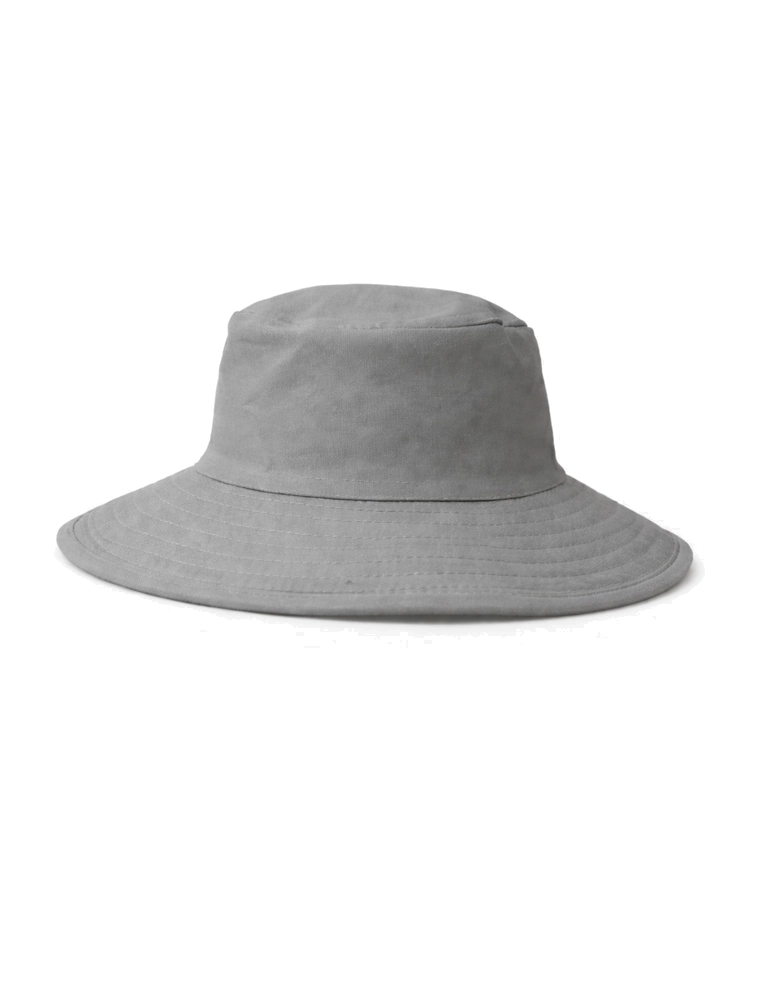
Brimmed and sun headwear. Bucket hats, legionnaire caps and broad-brimmed hats. These matter more than they look, because as covered elsewhere on this page they are the only hat types that a sun-protection standard recognises, which makes them the correct answer to an outdoor-workforce brief rather than an optional extra. Not stocked; buildable.
Food and cleanroom headwear. Bouffant caps, hairnets and beard covers. Reusable versions are a contract manufacturing item. Anything disposable is a different supply chain and we will tell you honestly if it is not something we should be quoting. This is the gap that matters if you are equipping a kitchen or a dairy unit to Schedule 4, because the chef cap on this page does not enclose hair.
Style variants of what is here. Snapbacks, truckers with a mesh rear, flat-peak caps, and five-panel constructions in colours not currently listed. These are the closest to the existing range and the easiest to add to a programme, since the base construction is familiar. A colour not on the page is a production run rather than a stock pick, so it carries a production minimum and a lead time rather than a shelf price.
Visors. Sun visors have a real institutional market — events, sports programmes, hospitality — and are not listed. Worth noting that a visor is excluded from sun-protection classification for the same reason a cap is, so buy it for the look and the shade, not for a claim.
How to run a mixed headwear requirement. Split your list into two columns before you send it. Column one: items that exist on this page in the colours you need, which can be quoted against published prices and bands. Column two: everything else, which needs a specification and a contract manufacturing quotation with its own minimum and lead time. Sending it that way saves a round trip, and it lets us tell you quickly whether the column-two items are worth building for your volume or whether you would be better served buying them elsewhere — which we will say if it is true.
What to include in a column-two specification. The headwear type. Fabric, or the performance you need if you do not know the fabric. Head sizing, in centimetres or in size bands with a distribution. Closure or fit method. Branding method, positions and artwork. Any standard the item has to be tested against, named. Annual volume and the split across drops, because an annual commitment changes what can be built. And the first delivery date, which is usually the binding constraint.
Start it in the right place. Column one goes to get a quote. Column two goes to contract manufacturing, or send both together and we will route them. If the requirement is part of a wider uniform programme, the body garments are dealt with on corporate and industrial uniforms and it is usually better to specify the headwear alongside them than separately, so the shades are set once.
ProcurementQueries Targetedbulk beanie manufacturer India, bucket hat wholesale India bulk, bouffant cap hairnet supplier bulk, snapback trucker cap manufacturer India, headwear manufacturer contract India
Who actually buys caps in bulk from factori.com, and what should each kind of buyer send us to get a real quotation?
Six buyer types, and they are not asking the same question. Governments and public bodies buy against a written specification and a tender. Institutions buy for identifiable groups. Corporates buy for events, campaigns and uniform programmes. Brands buy caps as product. Retailers buy assortments. Wholesalers buy depth in fewer lines. What each needs to send us differs, and sending the right thing once is the difference between a quotation and a conversation.
Governments, public bodies and public-sector undertakings. The requirement usually arrives as a specification you did not write and cannot alter, and the caps are one line in a larger schedule. What you need from us is a technical response against that specification, line by line, with the standards named — IS 177:1989 if it is a cotton drill, colour fastness methods, the head-circumference basis for sizing — and an honest statement of anything the specification asks for that we will not claim. Send the specification document, the quantity by colour and size band, the delivery locations and the schedule, and the bid date. Tell us what testing and documentation the tender requires, because that is often what decides whether a bid is responsive rather than the price.
Institutions — schools, colleges, hospitals, hotels, canteens, sports bodies. The cap is part of an identity worn by a defined group, so consistency across the group and across time is the real requirement. Send the group size, the sizing approach, the branding, the wash reality, and the replenishment pattern. Where the cap sits alongside a uniform, specify it with the uniform rather than after it, so the shade is fixed once. For kitchen and dairy areas, tell us which Schedule 4 requirement you are answering, because it changes the product.
Corporates. Three quite different orders travel under one name. An event or campaign order is quantity-led and date-led, and the date is usually immovable — send the date first. A uniform-programme order is consistency-led, and needs the closure, structure and shade nailed down because it will be replenished. A gifting or dealer-conference order is presentation-led, where the packing and the individual bagging matter as much as the cap. Say which of the three you are and the quotation will be right.
Brands. The cap is a product you will sell, so the specification is yours, the labelling and packaging are yours, and the tolerances are tighter than for an internal uniform. Send the tech pack if you have one, or the reference sample if you do not. Tell us the size range and the fit method, the label and tag requirement, the packing format, and the shade references. Where the construction has to be built rather than adapted, that is contract manufacturing, and it works better with an annual volume view than a single drop.
Retailers. You are buying an assortment: several styles, several colours, graded depth. The arithmetic that matters is per style and colour, not total units, so send the grid rather than the total. Tell us the price point you need to land at and let us tell you which constructions reach it, rather than the other way round.
Wholesalers and dealers. Depth in fewer lines, repeatability, and shade continuity across drops. Send the lines you want to carry, the depth per line, the reorder cadence, and the shade tolerance you can live with. Continuity across runs is the thing to negotiate explicitly, because it is what your own customers will judge you on.
What every one of them should send, whoever they are. The style. The colour split with quantities against each colour. The head-sizing basis. The closure. The branding method, positions and artwork. The delivery date and locations. And any standard the item must be tested against, named. That is one message and it produces a real quotation rather than a range. Send it to get a quote or call +91 87470 71444. We manufacture headwear to specification; the safety, food-safety, tax and compliance determinations behind that specification rest with your own advisers, and nothing on this page is safety, medical, legal, tax or compliance advice.
ProcurementQueries Targetedbulk cap supplier for government institutions corporates, promotional cap supplier brands retailers wholesalers India, corporate cap order procurement, event cap bulk order India, cap manufacturer for uniform programme
From ₹42excl. GST
View cart & checkout ›