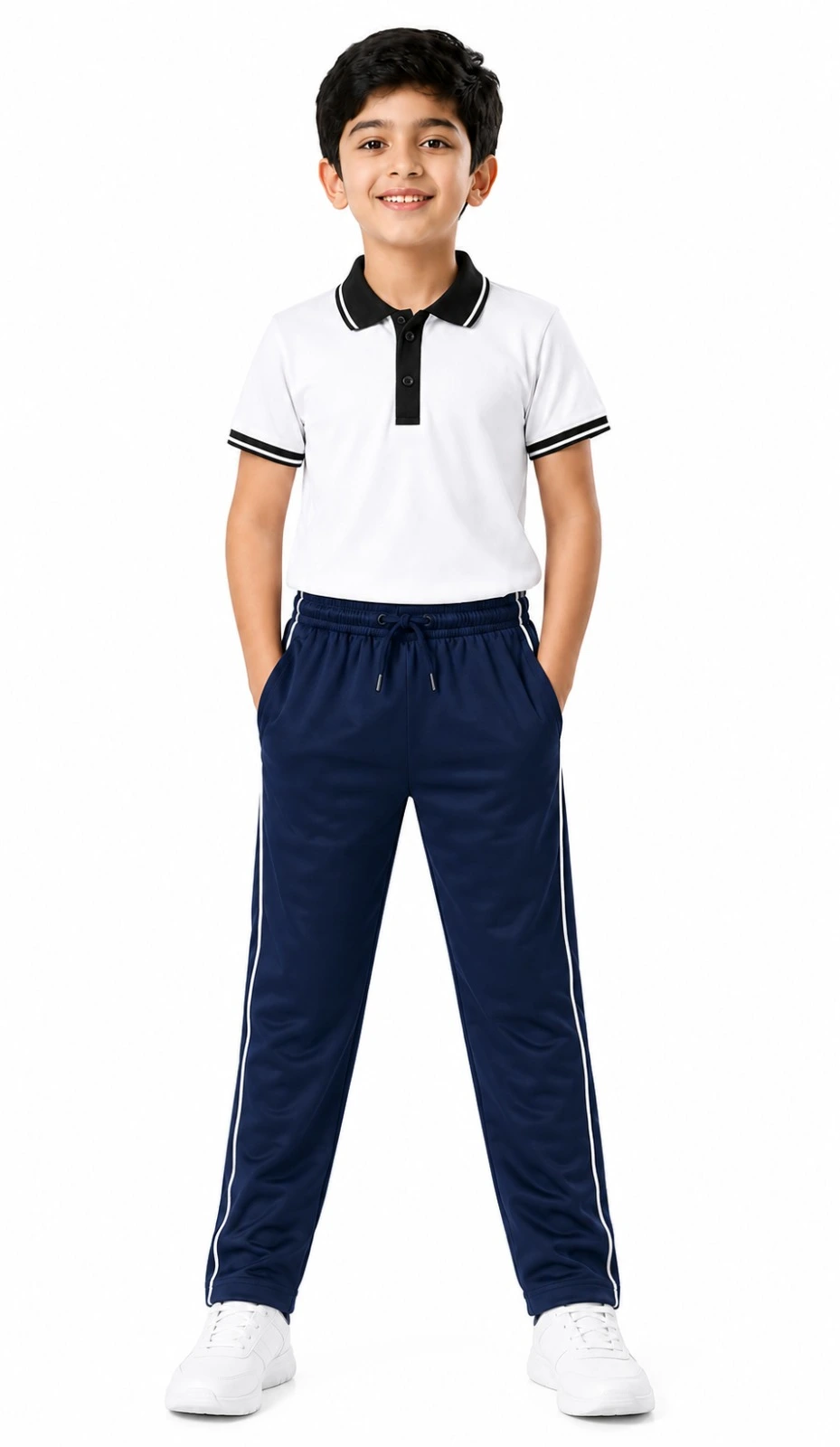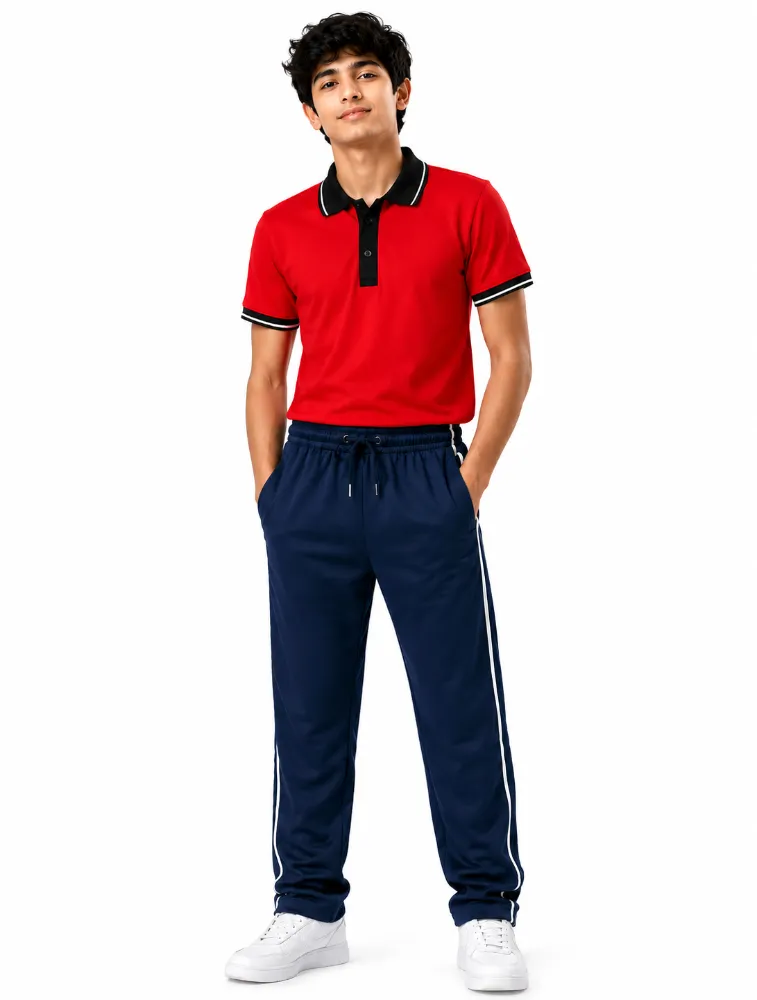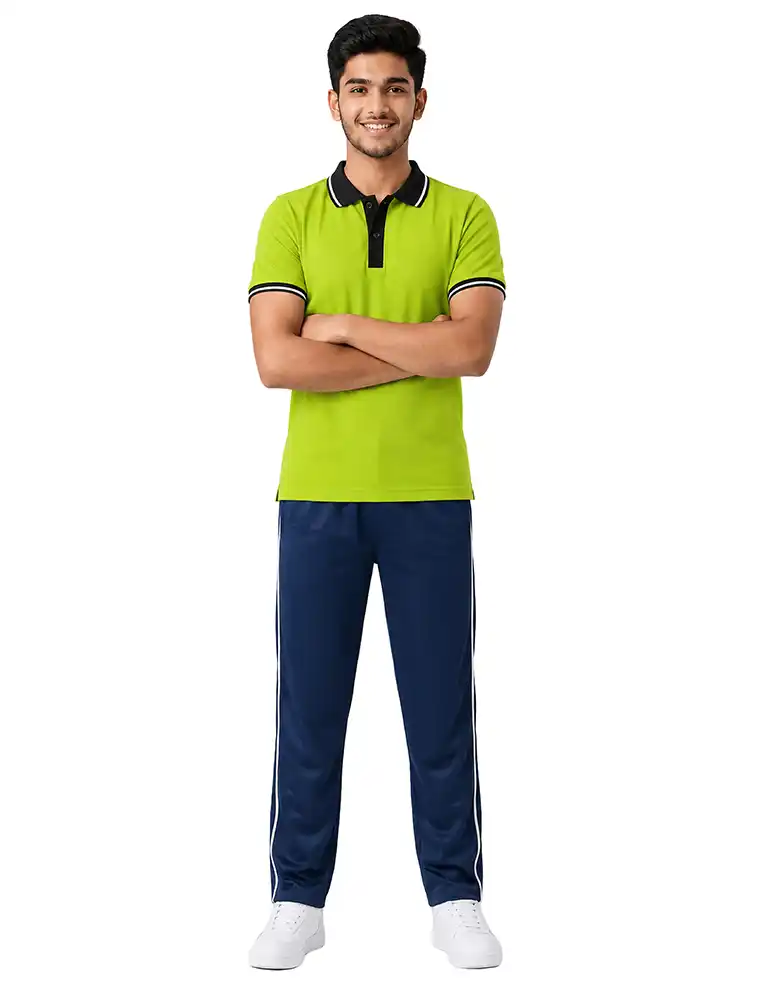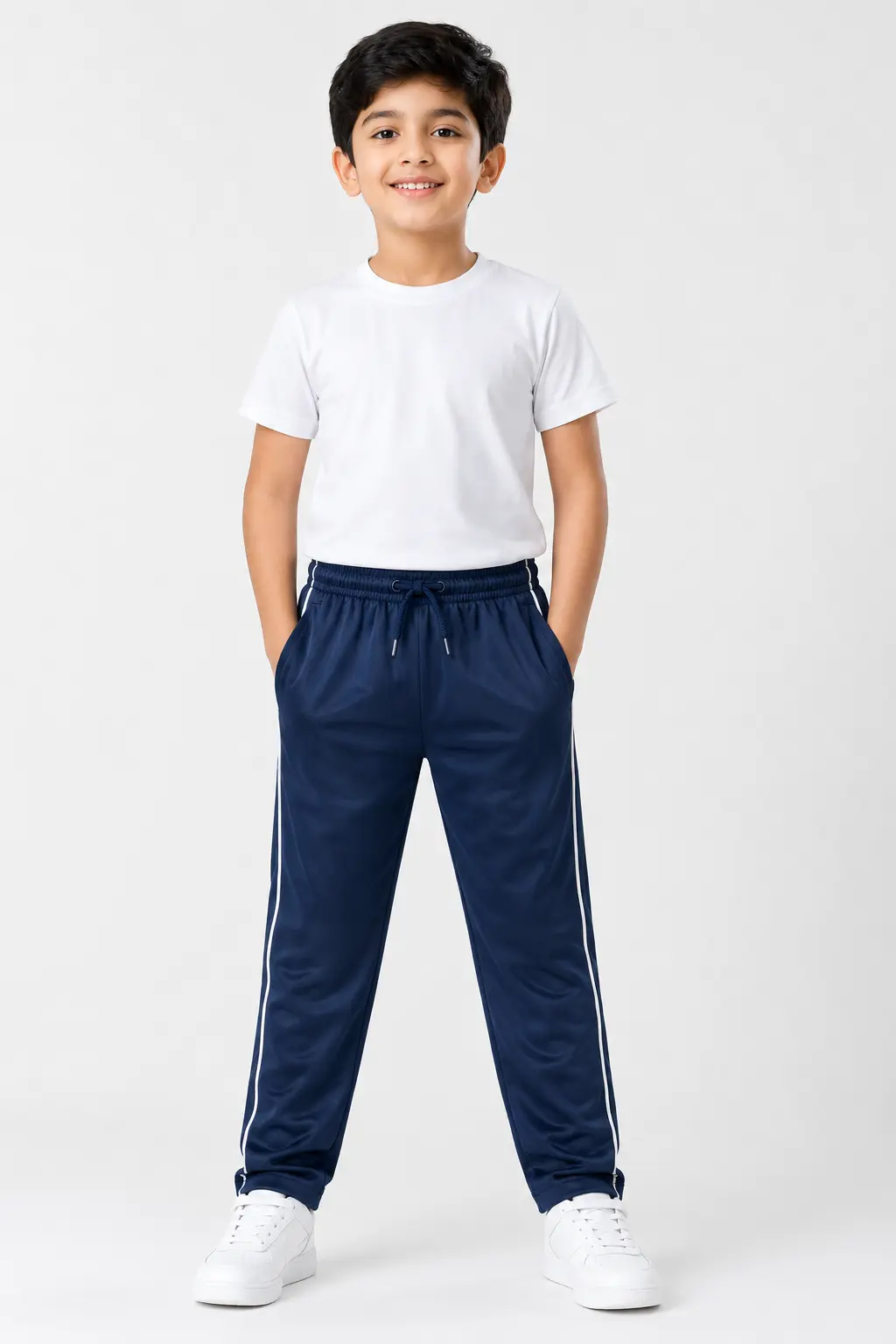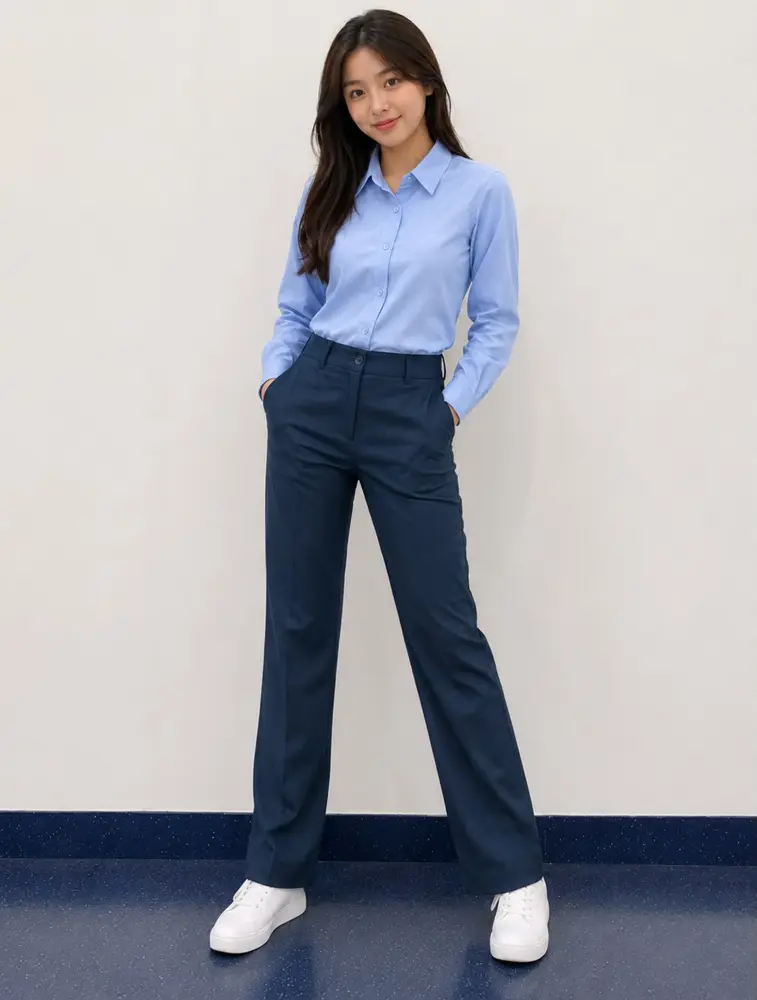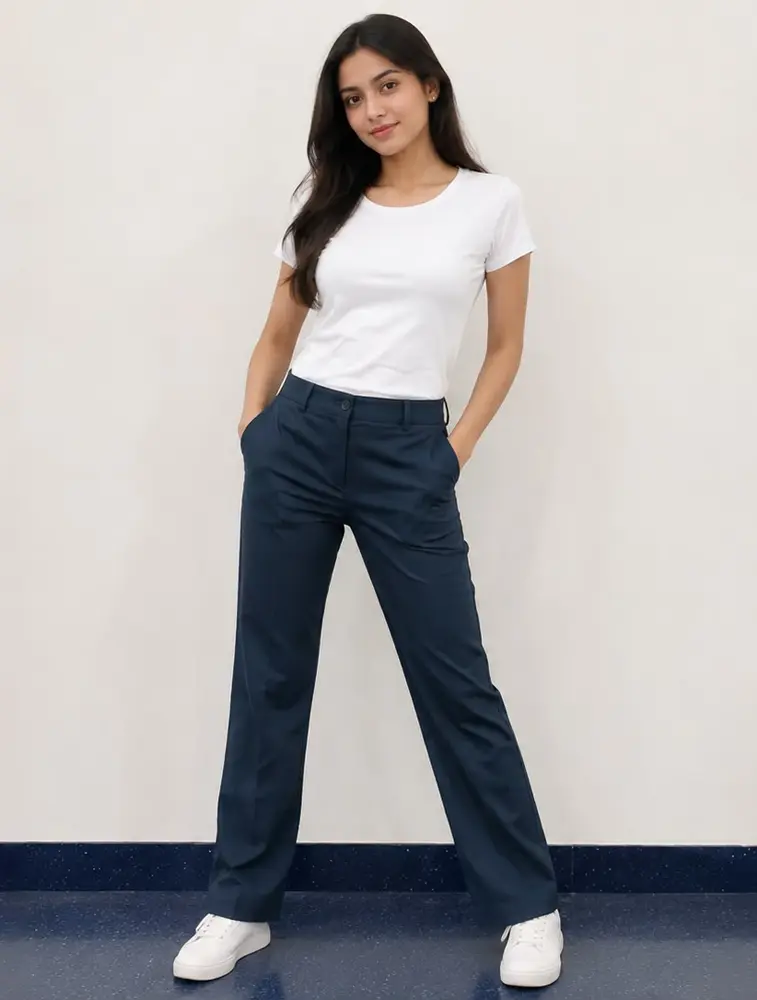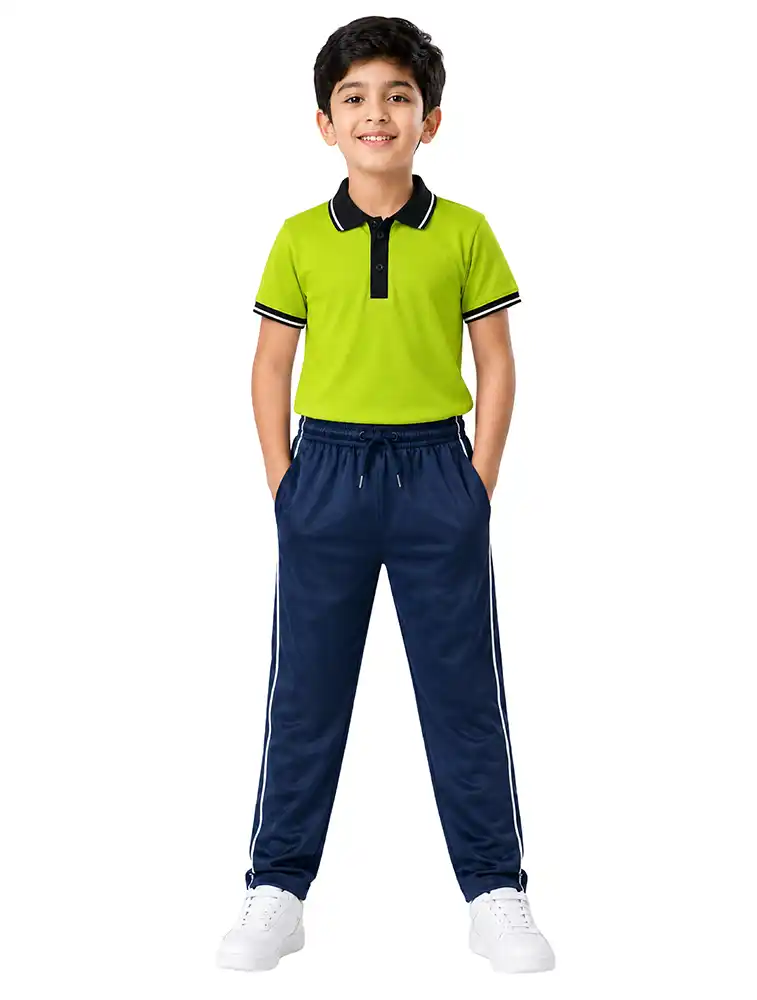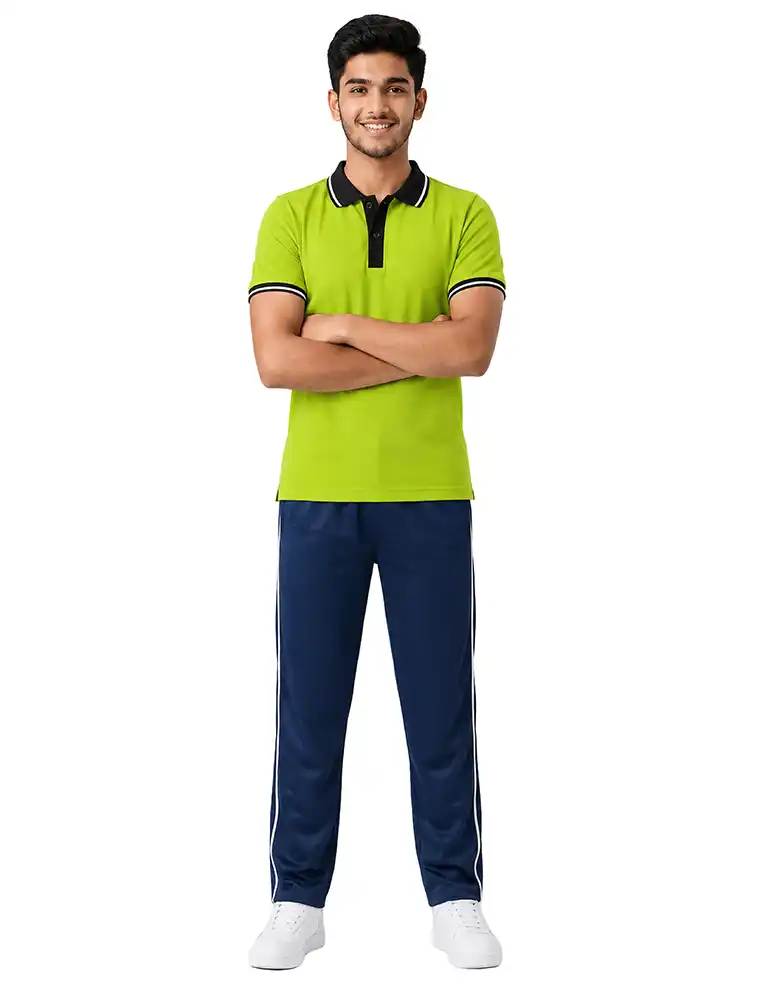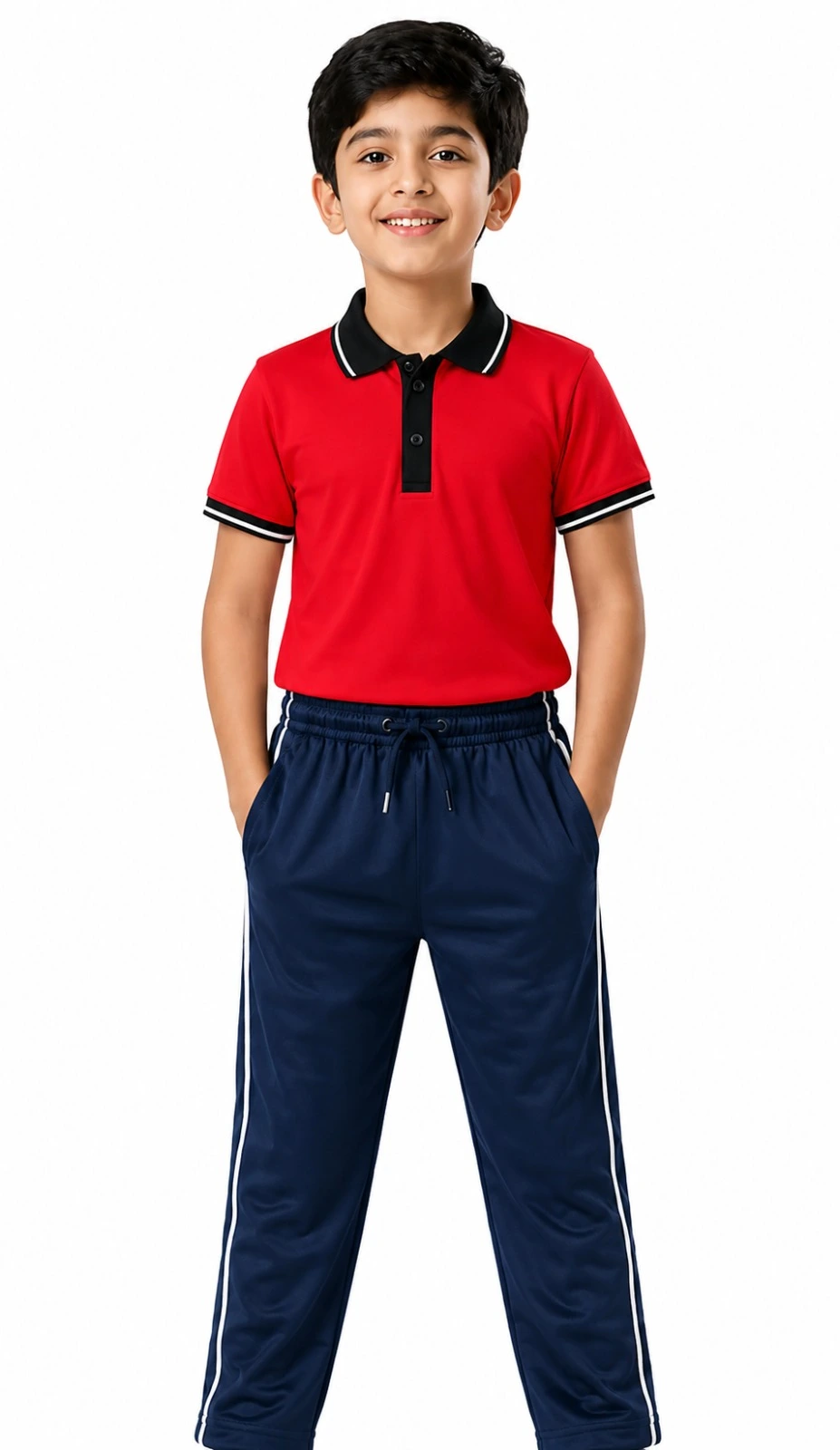
Red Kids Polycotton 220GSM Polo with Black Collar, Placket and White Tipping
4.4214 ratings
₹181.00/ piece
Enter a 6-digit Indian PIN code to see delivery options for that area.
Currently delivering to Bengaluru 560105
factori.com supplies bulk school & college uniforms from ₹154/piece across 662 partner factories — ready stock and custom programmes with GST invoices.
Brand-ready school & college uniforms for corporate, retail, uniforms and large custom programmes — sourced across partner factories with published prices.
Brand-ready school & college uniforms for offsites, launches and conferences.
Get quote →Consistent supply for schools, factories and frontline teams.
Corporate uniforms →Unbranded or private-label stock for retail brands.
Launch your store →Contract manufacturing for high-volume programmes.
Contract manufacturing →Why a school buys two quite different things. A PT kit is athletic clothing. It is knitted, it stretches, it is worn once or twice a week for an hour, it is expected to survive a field and a hot wash, and it is usually one design across the whole school with a house colour variation. A classroom uniform is formal clothing. It is mostly woven, it is worn five days a week for six or seven hours, it has to hold a press, it has gender-differentiated cuts, and it carries the school's identity in a way a games shirt does not. They are made on different machines from different cloth by different operators. Treating them as one line item on one purchase order is where a lot of uniform programmes go wrong in their first year.
What you can order from this page today. Knitted polo shirts and knitted track pants in a single 220 GSM weight, in a small set of sizes, in navy, sky blue, white, red and a neon. Single pieces are available from ready stock at 7 to 10 days. Custom production — your colour, your crest, your specification — runs from 100 pieces per style per colour at 15 to 30 days. If your requirement is genuinely a games kit for a few hundred children, this page is the right starting point and the quantities are small enough to be practical.
What has to be quoted rather than picked. Classroom uniform, because there is no honest way to publish a price for it. The cost of a school shirt depends on the cloth you specify, and school cloth specifications vary enormously — a 58/42 polycotton at one weight and a 65/35 at another are different garments at different prices, and a checked or striped house cloth is different again from a plain. The same is true of trousers, where the fabric and the finish do most of the pricing. Publishing a single figure for “school shirt” would be a number we could not stand behind, so we do not publish one.
The practical route if you need the full uniform. Send us the specification you already have — most schools running a uniform have one, even if it is a two-page note from a previous supplier — along with your roll strength by class and your two or three house colours. If you do not have a specification, send us a physical garment of each type from your current uniform. A sealed reference sample in hand is worth more than any amount of description, and it is the fastest way to a quote that will not move later. Our adult woven-shirt page at factori.com/shirts explains how woven shirting is specified and priced, and the same logic applies to a school shirt at a smaller size.
One thing to decide before you enquire. Whether you are buying the uniform centrally and issuing it, or approving a supplier and letting parents buy. That single decision changes the quantity, the packing, the size management and the payment structure more than any specification detail, and it is the first question we will ask you.
The problem with buying on trade names. None of these words is a standard. “Superpoly” from two suppliers can differ in weight, in width and in whether one face or both are brushed. “Polycotton” covers everything from 80/20 to 50/50, and the difference between those two is the difference between a garment that feels synthetic and one that feels like cloth. A trade name tells you roughly what family of fabric you are being offered. It does not tell you what you are buying, and it is not enough to write on a purchase order or into a tender specification.
What each of them actually is. Super poly is a 100 per cent polyester knit, typically about 200 GSM at 150 cm width, dual-faced, and it is the standard Indian tracksuit and track-pant cloth — light, quick-drying, cheap to produce and dimensionally very stable. Polycotton blends the durability and shape-holding of polyester with the breathability and hand of cotton; a 65/35 school cloth will take well over a hundred industrial washes, resists wrinkling and pilling, and costs less than the alternatives. Poly-viscose, which you will also be offered for classroom uniform, breathes better and absorbs better than polycotton and drapes more like a formal fabric, but it wrinkles more, is more prone to shrinking and costs more. And pique is a structure: yarn knitted so that the surface forms a raised honeycomb or waffle grid, which is what gives a polo shirt its texture and its slightly stiffer, more formal hand compared with a plain jersey T-shirt.
The naming trap that catches Indian uniform buyers specifically. The word the Indian garment trade most often uses for honeycomb pique knit is not a fabric name at all — it is the surname and registered trademark of a French apparel company, which became attached to the cloth because that company popularised the pique polo shirt in the 1920s. It is used casually and constantly in Indian mills and market quotations, and everyone in the trade knows what is meant. It still should not go on a purchase order, a tender submission, an export invoice or a product label, because it names a brand you are not buying. Write “honeycomb pique knit, 100 per cent polyester, 220 GSM” instead. It is longer, it is unambiguous, and it is the term a laboratory or a customs officer will recognise.
The three fields to insist on, every time. Whatever trade name a supplier leads with, do not accept a quote that lacks all three of these: fibre composition as a percentage (100 per cent polyester; 65/35 polyester-cotton), weight in GSM, and knit or weave structure (single jersey, honeycomb pique, interlock, plain weave, twill). Those three lines identify a cloth well enough that two quotes become comparable and a repeat order two years later is reproducible. Add a fourth if the garment is coloured — the fastness grades, which are covered separately in these FAQs.
Where our own page falls short of that standard, stated plainly. The products above are published with weight and trade name but not with fibre composition. Ask for the composition in writing before you commit a school-wide order, and we will give it to you against the specific style you are quoting. Do not infer it from the name.
What GSM measures, and what it does not. Grams per square metre is the mass of one square metre of the fabric. It correlates with opacity, durability and warmth, and it is the single most useful number on a uniform specification because it is objective and testable. What it does not tell you is fibre, structure, stretch or hand. A 220 GSM polyester pique and a 220 GSM cotton interlock behave completely differently in a school. Always read GSM alongside composition and structure — never on its own.
The polyester activewear weight ladder. These are the bands the activewear trade works in, and they are worth knowing before you sign a specification.
| Weight band | Character | Typical use in a school programme |
|---|---|---|
| 100–130 GSM | Very light, sheer, fastest drying | Running vests, hot-weather liners; too sheer for a school shirt |
| 130–160 GSM | Light, breathable, still thin | Match jerseys, athletics kit |
| 160–200 GSM | Standard T-shirt to light polo weight | Hot-climate PT shirt where drying speed matters most |
| 200–240 GSM | Substantial, structured, opaque | PT polo that must look neat and hold a collar; the band this page sits in |
| 240–280 GSM | Heavy, hard-wearing, slower to dry | Track pants and warm-up layers that take ground contact |
| 280–320 GSM | Very heavy, structured | Outer training layers, cold-region kit |
| 200–400 GSM fleece | Brushed inner face, insulating | Winter tracksuit tops and sweatshirts, not PT kit |
Reading the ladder for a polo. A PT shirt has two jobs that pull against each other: it has to dry after an hour of games, and it has to look like school uniform rather than sportswear when the child walks back into a corridor. Below about 160 GSM a polyester polo starts to look thin and can show through; above about 240 it stops drying fast enough to be comfortable in an Indian summer. 200 to 240 is the compromise most schools land on, and a structured honeycomb pique at 220 will hold a collar shape better than a plain jersey at the same weight.
Reading the ladder for a track pant. A track pant fails at the knee and the seat, from kneeling, sliding and sitting on concrete, and it is the garment parents replace mid-year. 220 GSM is serviceable. 240 to 280 lasts noticeably longer and costs a little more cloth. If your school plays on grass or gravel rather than a synthetic surface, specify the heavier band for the pant even if you keep 220 for the shirt — the extra cost per pant is small against replacing it in February.
What to do with this if you are writing a specification. Write a band and a tolerance, not a single figure: “220 GSM ±5 per cent” is enforceable and achievable, “220 GSM” exactly is neither, because commercial knitting runs to a tolerance. Ask for the GSM to be verified on the pre-production sample rather than taken from a swatch card. And be aware that everything on this page is a single 220 GSM cloth today, so if your specification calls for two weights across the kit, that is a custom production enquiry rather than a stock order.
Start with the fibre, because it explains everything else. Polyester has a moisture regain of roughly 0.4 per cent, meaning the fibre itself absorbs almost no water. That is the whole basis of synthetic sportswear: cotton absorbs water and holds it against the skin, while polyester does not absorb it and instead moves it. Every wicking technology is a way of engineering that movement. It also means a polyester garment can never be made “absorbent” in the way cotton is — if a claim implies that, the claim is confused.
The four mechanisms, and which of them are permanent.
The question to put in writing. Ask the supplier: “Is the moisture management in this fabric achieved through fibre or yarn construction, or through an applied finish? If it is a finish, state the wash count after which performance is no longer claimed.” A supplier selling construction-based wicking will answer immediately and gladly. A supplier selling a finish will answer vaguely, and that vagueness is your answer. Neither is wrong to buy — a finish on a games shirt worn twice a week for one academic year may be perfectly adequate and cheaper — but you should know which one you are paying for.
The laundry reality in a school context. School uniform is washed at home, by two hundred different households, with whatever detergent is in the cupboard, often with fabric softener, sometimes hot, occasionally with bleach. No finish survives that regime uniformly, which is why a finish-based claim produces the worst outcome of all: the kit performs inconsistently across the cohort, some children's shirts behaving differently from others, and nobody can explain why. Construction-based wicking is consistent because there is nothing to lose.
What we will and will not claim. We will tell you the fibre, the weight and the structure of the cloth we are quoting, and we will tell you which wicking mechanism it uses if you ask, because we can find that out from the mill. We will not put a percentage on how much faster a garment dries, because that number depends on a test method, a temperature and a humidity, and no product on this page has been tested to a published method. If your tender requires a measured moisture-management result, say so at enquiry — that is an accredited-laboratory test we would have to commission and quote for, not a figure we can assert.
Why age-based ordering fails. Two children of the same age in the same class can be four inches apart at the chest, and the spread widens through the middle school years. Uniform suppliers therefore sell by recommended size rather than by age, and sizes stated in inches are treated as universal fits — a 28-inch chest takes a 28, whatever the child's birthday says. If you place an order as “120 pieces for Class 5”, someone downstream has to convert that into sizes using an assumption, and that assumption is where your exchange rate comes from.
The measurements to take, and the two that get forgotten. Chest, measured around the fullest part with the tape level and the arms down. Waist, at the natural waistline, not where a belt happens to sit. Hip, for skirts and pinafores. Inseam, from crotch to the intended hem, for trousers and track pants. And then the two that are routinely skipped and cause most of the complaints: back length, from the base of the neck to the desired hem, which decides whether a shirt stays tucked in; and sleeve length, from the shoulder point to the wrist, which decides whether a blazer or a full-sleeve shirt looks fitted or borrowed. A child measured on chest alone can be given a technically correct size that still looks wrong.
How to run the measurement exercise across a school without losing a week. Two people per station, one measuring and one recording, because a single person holding a tape and a pen makes errors and cannot keep the tape level. Measure over the thin garment the child will wear under the uniform, not over a jumper. Re-measure whenever a reading is more than a centimetre off what the child's neighbours in the same class are producing — that rule alone catches most transcription errors. Record the number, never the size name, so that the conversion to sizes happens once, centrally, and can be redone if the supplier's ladder differs. And agree a written tolerance with your supplier — ±1 cm on a finished measurement is normal and reasonable; without it stated, every garment at the edge of a band becomes an argument.
The alternative when measuring 800 children is not practical. Ask for a size set — one garment in each size — and hold a trying-on session by class. A morning of children trying on beats a month of exchanges, and it produces a size distribution that is real rather than modelled. This is the approach we recommend for any first-year programme, because your school's actual distribution is the input to everything else and you only have to establish it once.
One caution about the sizes published on this page. The bands above are shown as bare numbers — (18-20), (22-24), (26-28), (30-32) — with no unit and no age guidance stated, and the largest item in the grid, (42-44), is an adult size sitting in a children's range. Read them as chest inches, which puts the children's range roughly between a small child and an early teenager. Before you order for a senior school, confirm the size ladder and the finished measurements against a specification in writing. Do not order a school's worth of kit from an unlabelled number on a grid, ours included.
Why the even split is so tempting and so wrong. Faced with eight sizes and 800 garments, 100 of each looks fair, defensible and easy to write on a purchase order. But children's sizes in any real school are distributed as a curve with a fat middle, not a flat line. The consequence is that the sizes everybody needs are exhausted first, so the school reorders them at a small quantity and a worse price, while the end sizes sit in a store room until they are given away. You pay twice: once for stock you cannot use, and once for a rush reorder of stock you should have bought in the first run.
Building the curve from your own data. Your school already holds the input: the roll, by class, by gender. Convert class strength into a size distribution using the measurement exercise, and if you have run a uniform before, use last year's actual issue and exchange records — those are the most honest data you will ever get, because they record what children actually wore rather than what was ordered. Then place the order against that curve. A school of 800 will typically find that three or four sizes account for well over half the volume, and those are the sizes to be generous on.
Where to put the buffer. Add your contingency at the two most common sizes rather than spreading it evenly. Those are the sizes an exchange will be requested in, the sizes a new admission will need, and the sizes that will get used up if they are not needed for either. Buffer at the extremes is dead stock the moment the year ends. A useful rule is to hold the buffer at around a tenth of the run concentrated in the top two sizes, and to hold nothing extra at the smallest and largest.
Do not carry a single curve between year groups. A primary school and a senior school have different curves, and a school covering both has two distributions that must be ordered separately even if the garment is identical. Gender matters too: once you are past the early primary years, boys' and girls' distributions diverge and a girls' block needs its own ladder rather than a reweighting of the boys'. Ordering one blended curve across a whole 800-child school is only a slightly better version of ordering evenly.
How the curve interacts with the minimum order. Custom production runs from 100 pieces per style per colour, and a size is not a separate style for that purpose — so a school of 800 clears the minimum comfortably on a single style and can then distribute those pieces across the sizes however the curve says. That is worth knowing, because buyers frequently assume they need 100 of every size and either inflate the order or abandon the smaller sizes. You do not. Give us the curve and we will cut to it.
What to hand us at enquiry. A table with one row per size, quantity by style and by gender cut, and a note of which two sizes you want the buffer in. That is a fifteen-minute job with a class list in front of you, and it is the difference between a programme that runs quietly and one that generates a hundred exchange requests in the first fortnight.
Why one annual order cannot cover both. A single order placed before the session opens is sized on a snapshot. Within a term, some children have outgrown a chest size, some garments have failed, and some admissions have arrived after the count. A school that has planned only one purchase now faces a reorder of a few dozen pieces, which is below anybody's efficient production quantity, at a moment when the original cloth lot may no longer exist. That is how schools end up with two visibly different navies in the same assembly.
The exchange pool, and how big it needs to be. Hold physical stock at the school, in the two sizes that dominate your curve, at roughly five to ten per cent of the issue for those sizes. Its purpose is to absorb growth and defects within the year without triggering a production run. Crucially, a crested garment cannot be resold, so a returned garment is only worth anything if it comes back clean and unworn — state that in the exchange rule you publish to parents, along with the window. An exchange pool with no stated window quietly becomes an open-ended liability on the school office.
Growth allowance in the garment itself. There are design choices that buy you a year. Elasticated or adjustable waistbands on trousers and track pants, which move a size band into a range. Deeper hems that can be let down once. A slightly longer back length so a shirt stays tucked as the child grows. These add a small amount to the make cost and they measurably reduce mid-year replacement, so they are worth pricing before you dismiss them. What does not work is deliberately ordering a size up across the board — ill-fitting uniform on day one is a complaint you will hear every day for a year.
The sealed reference sample is the thing that makes a repeat order usable. Before the first bulk run, approve one garment per style, sign it, and have both parties hold a sealed copy with the date and the order reference on the tag. Every subsequent replenishment is then made against a physical object rather than a description, which is the only reliable way to hold colour, measurements and construction steady across a year or three years. Ask for the fabric lot reference to be recorded on the sample tag too, because that is what a mill needs to come close on a repeat dye.
How to structure the arrangement commercially. Agree the year's programme as one specification with scheduled call-offs rather than as a series of unrelated orders: a main issue before the session, a replenishment window before the second term, and a small intake run. Fix the specification and the price for the academic year, and fix the lead time in writing — ready stock at 7 to 10 days and custom production at 15 to 30 days are different planning assumptions, and a school that assumes the former while ordering the latter will be short of uniform in week one. Put the replenishment lead time on the same page as the specification, not in an email nobody can find in November.
Shrinkage first, because it causes the most complaints. A garment that fits at issue and does not fit after three washes has failed, and the parent's complaint goes to the school, not the supplier. Specify dimensional change on washing as a maximum, in both length and width, and specify the wash conditions it is measured under. For woven and knitted uniform cloth, 3 per cent or less is the normal commercial expectation. Below that you are into pre-shrunk and compacted finishes that cost more. Above it you should be told before you order, not after.
The three fastness methods worth naming.
How to read the grades, which use two different scales. Staining and change in shade are graded on the grey scale, 1 to 5, where 5 means no change or no staining and 1 means severe. Light fastness is graded on the blue wool scale, 1 to 8, where higher is better. As a rule of thumb, 4–5 is the international entry level for uniform and workwear, and 6–8 is excellent and normally reserved for outdoor and technical applications. Asking for 8 across the board on a school polo is not rigour, it is an expensive specification that no commercial supplier will price sensibly — ask for what the garment's life actually requires.
Where test reports come from, and what they cost you. A meaningful fastness or shrinkage figure comes from an accredited textile laboratory testing a sample of the actual production lot. It is a real cost and a real lead time, and it is why cheap uniform quotes carry no test data. If your tender or your governing body requires test reports, say so at enquiry so it can be quoted and scheduled — it cannot be added retrospectively to a batch that has already shipped.
Stated honestly: no product published on this page carries a fastness grade or a shrinkage figure today. The grid above gives weight and trade name only. If you are writing a specification that will be tendered or audited, treat the published products as a starting point for a conversation and ask for the specification and the test data in writing against the style you are quoting. We would rather tell you that here than have you discover it at the evaluation stage. Note also that this is technical guidance on how tests are named and read; it is not a certification of any product, and we do not claim any standard we have not tested to.
The three places shade variation actually shows up. First, across sizes within one order, because a large run is dyed in batches and the batches are then cut into sizes; if size 26 came from one lot and size 30 from another, two children standing side by side show the difference. Second, between the original order and the replenishment, because the second run is a different lot, often a different yarn delivery, and sometimes a different season. Third, and least fixable, across substrates: polyester knit takes disperse dye and woven polycotton takes a combination of dye classes, so the same target navy lands slightly differently on each, and the light-scattering of a honeycomb pique surface makes it read differently again from a smooth twill. A school insisting that a knitted PT polo exactly match a woven classroom trouser is asking for something no dye house can deliver.
What controls it, in order of effectiveness.
Which colours cause the most trouble. Deep saturated house colours — maroon, bottle green, royal blue — are the hardest to reproduce consistently because a small deviation in a heavy dye load is very visible. Neon and fluorescent shades are worse still: they depend on optical brighteners and specific dye chemistry, they vary noticeably lot to lot, and they fade faster in sunlight than any conventional shade. If your school has a neon element in its games kit, expect the shortest colour life of anything in the programme and plan replacement accordingly. White and very pale shades have the opposite problem — they are easy to match on day one and show every subsequent laundry difference. Mid-tone navy and sky blue are, for good reason, the workhorses of school uniform.
What to put on the purchase order. A line stating: shade approved against signed physical swatch dated and referenced; one dye lot per garment type where the quantity permits; lots not to be split across sizes; shade tolerance and the grading method; and cloth reserved for the replenishment window. Five lines, and they remove the most common non-technical complaint a uniform programme generates.
How embroidery is priced, so you can read a quote. Embroidery is charged by stitch count, in bands — typically up to about 6,000 stitches, then 6,000 to 8,000, then 8,000 to 12,000, then 12,000 to 14,000, with the price stepping up at each band. Stitch count is driven by the physical size of the crest and by how much solid fill it contains, not by how complicated it looks. That gives you a direct lever: a crest reduced from 90 mm to 60 mm wide can drop a whole band, and simplifying a dense background fill can drop another. Ask for the stitch count on the quote. A supplier who will not state it is quoting a band you cannot check.
The detail limit that catches every school crest. Thread has a physical minimum. Text below about 5 mm in height does not resolve in embroidery — it fills in and becomes an illegible smudge. Most school crests contain a motto, a founding year or a Latin scroll set very small, and all of them fail at chest size on a shirt. The correct answer is not to embroider it badly; it is to have a reduced version of the crest drawn for small applications, with the fine text removed and the outlines slightly thickened. Have that done once, sign it off, and use it for every garment across the programme. It is a one-off design cost that prevents a permanent, repeated quality complaint.
Where each method physically belongs. Embroidery works best on stable, denser cloth — woven cotton and polycotton shirting, fleece, blazer cloth — because the base can support the stitch tension. On a light, stretchy polyester knit the fabric distorts around the stitching and the crest puckers, and the stiffened patch of thread is uncomfortable during games. Print, by contrast, sits on the surface, adds no weight and no stiffness, handles fine detail and gradients that embroidery cannot, and is the standard for athletic wear everywhere. Its weakness is life: a print on a heavily washed garment will fade and eventually crack, whereas embroidery normally outlives the garment it is on.
Minimums and lead times, which differ between the two. Embroidery can technically be set up from around a dozen pieces, though 50 or more is where it becomes sensible commercially, and it typically adds around ten days to the schedule for digitising, sampling and running. Screen print starts from around two dozen pieces and runs faster, in roughly five to fifteen days depending on colour count. Both incur a one-off set-up per design — digitising for embroidery, screens and a strike-off for print — so the cost per garment falls sharply with quantity and the efficient shape of a programme is few designs across many garments, not a bespoke treatment per garment type.
The recommendation for a typical school programme. One crest artwork, two approved versions: full crest for embroidery on blazers and classroom shirts, reduced crest for print on PT shirts and track pants. Approve both as physical strike-offs on the actual cloth before bulk, because a crest approved on paper and a crest stitched on a 220 GSM pique are different objects. And consolidate the set-ups onto one purchase order — paying for the same digitising twice because the games kit and the classroom uniform were ordered separately is an avoidable cost, and it happens constantly.
The timeline, so you can plan backwards from the session. A uniform tender runs in stages: publication and clarification, submission, technical evaluation, sampling, commercial evaluation, award, then pre-production sampling and production. Twelve to sixteen weeks to award is normal, and production sits after that — 15 to 30 days for custom manufacture on top. A school that starts the process eight weeks before the session opens has already decided it will be issuing uniform late. Start the tender in the previous session.
What a complete submission usually has to contain. Company registration and tax registrations. A technical specification response line by line against the school's specification rather than a generic brochure. Physical samples to the stated specification. Fabric test reports from an accredited laboratory where the specification calls for them. Manufacturing capacity and evidence of comparable institutional work. A delivery schedule and a distribution and fitting plan. Pricing in the requested format, which is often a per-garment breakdown rather than a total. Compliance declarations, and increasingly a sustainability statement. On government platforms there are additional platform-specific requirements around catalogue categories and bid formats.
Why bids fail, in the order it actually happens. First, technical thinness — a response that answers “polyester, good quality” where the specification asked for composition, weight, structure and named fastness methods scores low against a bidder who answered in full, even at a higher price. Second, an ambiguous distribution method — the tender asks who measures, who issues, who handles exchanges and who bears the freight on them, and a bid that leaves this vague is marked down because the evaluator can see the school absorbing the work. Third, weak or absent sustainability documentation, which now carries real weight and is the easiest points to leave on the table. Fourth, and most avoidable, administrative non-compliance: a missing signature, an unsigned annexure, samples not labelled to the specification, pricing in the wrong format. Bids are disqualified for these before anybody looks at the number.
What we will do, stated plainly. We will build to your written specification and respond to it line by line. We will produce and hold a signed pre-production sample. We will supply fabric test reports from an accredited laboratory where the specification calls for them and it has been quoted and scheduled. We will state capacity, lead times and a distribution plan in writing. We will price per garment in your format.
What we will not do. We will not certify our compliance with a scheme we are not party to, and we will not sign a declaration asserting a standard we have not tested to — including any certification we do not hold. If a tender requires a certification we do not have, we will say so at clarification stage rather than submit and hope. That is not caution for its own sake: a bid that overstates a certification and is found out mid-contract is worse for the school than a bid that was honest at the start. Nothing here is legal or procurement advice on your obligations — your tender rules are yours to interpret, with your own advisers.
The single highest-return thing a school can do. Write the specification properly before publishing. A tender that specifies composition, weight, structure, named fastness methods, shrinkage tolerance, finished measurements with tolerance, crest treatment and a distribution model gets comparable bids, and comparable bids are the whole point. A vague tender gets a spread of incomparable prices attached to incomparable garments, and the school ends up choosing on the only number it can compare, which is the wrong one.
Please read this before you use any figure from this page. Scheme amounts, eligibility rules, the number of sets funded and state-level top-ups are set and revised by government, are administered at state level, and differ between states and between years. The figures above are provided as general background only. They are not advice on your entitlement, your procurement rules or your compliance obligations, and they must be verified against the current government order or your district education office before a single rupee is committed. We are a manufacturer, not an authority on the scheme.
What a fixed per-child figure actually buys you, and the arithmetic that matters. The mistake is to divide the grant by the number of garments and shop to that number. A per-child figure has to cover a whole set, and the moment you decide how many sets and how many garments per set, the amount available per garment is fixed. So make that decision first and deliberately. Two sets of a two-piece uniform is four garments; one set plus a PT kit is a completely different shape of spend. Decide the shape, then specify inside it. Working the other way round produces a uniform that is technically within budget and unwearable by the second term.
Where to spend, in priority order. Fibre composition and weight first, because they decide whether the garment survives the year — a slightly heavier, more polyester-rich cloth on a garment worn five days a week is the highest-return rupee in the whole specification. Colour fastness second, because a faded uniform looks worse than a worn one and it is what parents and inspectors notice. Construction third: stitch density at the seams that fail, and reinforcement at the knee and seat. Finished measurements and a proper size curve fourth, because a well-fitting garment is worn and an ill-fitting one is replaced.
Where to save, and it is not where schools usually save. Cut the number of distinct SKUs, not the quality. Every additional colour, style and design is another set-up, another minimum and another line at a worse price. One crest artwork used everywhere instead of a different treatment per garment. A printed crest on the games kit instead of embroidery. Fewer house colour variants. A single fabric weight across the kit rather than two. All of these reduce cost without reducing what the child is wearing. What you should not do is drop the cloth weight, remove the fastness requirement or skip the pre-production sample — those savings arrive as replacement costs and complaints inside the same financial year.
The procurement mechanics that help a fixed budget. Aggregate. A single order across a cluster of schools, or across the whole school rather than class by class, crosses the production minimums and buys at a better price for exactly the same garment. Order once for the year rather than in fragments. Fix the specification and the price for the academic year so the budget is predictable. And ask for the quote per garment against a written specification rather than as a bundled per-child figure, because a per-child figure is impossible to audit and impossible to compare between bidders.
How to ask us for a quote against a grant. Tell us the amount per child you have to work within, the number of sets and garments it must cover, your roll strength and your size curve, and your non-negotiable specification items. We will tell you what is achievable inside it and, where it is not achievable, we will say so and show you which line is the constraint. A supplier who accepts an impossible budget without comment is not doing you a favour.
The arithmetic, done properly. Start with sets per child. One set means a child has nothing to wear on wash day, so two is the practical minimum for a five-day uniform and three is common where laundry is difficult. Then pieces per set: a shirt and a trouser is two; add a pinafore, a tie, socks or a blazer and it climbs. So 800 children at two sets of two pieces is 3,200 garments. Add one PT kit each — a polo and a track pant — and it is 4,800. That is the scale of the thing, and it is why a uniform programme should be planned as manufacturing rather than as shopping.
Why the total is not the number that matters. Production is organised by style, colour and size. A run of 4,800 garments split across two genders, four garment types, three colours and eight sizes is not one order of 4,800 — it is a set of much smaller runs, and each of them has to be individually viable. Custom production here runs from 100 pieces per style per colour, and sizes within a style are cut from the same order rather than each needing their own hundred. The good news for a school of 800 is that almost every line clears the minimum comfortably once you stop treating each size as a separate order. The bad news is that if you fragment the programme into many small distinct styles, you will find lines that do not clear it.
Where the minimum actually bites. Not on the main uniform, but on the edges: a single house colour worn by 60 children, a girls' variant of a garment in a size worn by nine, a specialist item for a small senior cohort. Those are the lines to consolidate or to reconsider. Merging two similar house shades into one, or using the same garment across two year groups, is often the difference between a viable order and a set of awkward exceptions.
How to phase it so the school is not overwhelmed. Phase by need, not by convenience. New admissions and the year groups changing uniform get the first delivery, because they have nothing. Continuing students who need replacement come next. The replenishment and exchange pool comes last, timed for the second term. Line each phase up against the lead time: ready stock at 7 to 10 days, custom production at 15 to 30 days, plus the sampling time before the first run. Working backwards from the first day of the session with those numbers is a fifteen-minute exercise that decides whether the programme is calm or chaotic.
How to ask for it to be packed, which nobody thinks about until it arrives. Ask for cartons packed and labelled by size and by class, not bulk-packed by style. Eighty cartons of mixed sizes arriving at a school office in a single week is a genuine operational problem, and the difference in cost between bulk packing and size-labelled packing is trivial next to two days of teachers sorting garments on a hall floor. Specify the packing on the purchase order along with the carton labelling format you want, and specify delivery in tranches to a named person on named dates. This is the single most under-specified part of a school uniform order and the cheapest one to fix.
The three models, and who bears the work in each. In central issue, the school takes delivery, holds stock and issues to children; the school bears the storage, sorting and exchange work, and gets the most control and the best price. In supplier-managed distribution, the supplier delivers, runs fitting sessions and handles exchanges directly; the school bears almost none of the work, and the service is priced into the garment. In parent purchase against an approved specification, the school approves and the parent buys; the school bears no logistics at all but loses control of consistency, and shade variation across the cohort becomes a certainty rather than a risk. There is no universally right answer, but there is a wrong one, which is not choosing.
What a fitting day actually needs. A size set of every garment in every size for trying on, kept separate from issue stock and clearly marked as samples. Two people per station, one fitting and one recording. A printed record sheet per class with the child's name and the size issued, because that record is what makes next year's order accurate. Space to change. A timetable by class so the whole school is not queueing at once. And a named person who owns the exceptions, because there will be children the size ladder does not fit and they need a decision on the day rather than a note in a file.
Exchanges, and the fact that governs them. A crested garment cannot be resold to anyone else, so every exchange is a real cost to somebody. That single fact should shape the policy: hold an exchange pool at the school in your two most common sizes, state a clear window — typically a set number of days from issue — require the garment to be returned unworn and unwashed with tags intact, and put in writing who pays the freight when an exchange has to go back to the supplier. Freight on exchanges is the classic unstated cost, and it is worth more argument than its value because neither party expected it. Settle it on the purchase order in one line.
Leftovers, and how not to create them. Leftover stock comes from three places: ordering evenly across sizes, ordering for a roll that changed after the count, and year-dating garments. The first two are covered by building a proper size curve and ordering close to the session. The third is entirely self-inflicted — do not put the academic year on the garment. A year-dated shirt is worthless on 1 April and a plain one is stock. Put the year on the packing list, not on the label. If you do end up with genuine surplus, the useful destinations are the exchange pool for the following year and the new-admission stock, both of which want exactly the sizes you have most of.
What to write on the purchase order. The distribution model. The named school contact and the named supplier contact. Delivery dates and tranches. Packing and carton labelling by size and class. The size set for fitting, stated as a separate line so it is not taken from issue stock. The exchange window, the condition required for return, and who bears freight. Six lines. They are the difference between a uniform programme the school remembers as well-run and one it remembers as a fortnight of sorting garments.
What creates a separate line. A different garment type, because it is a different pattern and a different set of operations. A different gender cut, because a girls' block is a distinct pattern even where the cloth and colour are identical. A different fabric or weight, because it is a different cloth to source and knit or weave. A different colour, because it is a separate dye lot. A different size, because it is a separate cutting pattern — though sizes within one style are cut from the same order and do not each need to clear the minimum. And a different print or embroidery design, because it is a separate set-up and a separate approved strike-off.
What does not create a separate line, and where schools waste money assuming it does. Delivery date does not; that is a schedule against a line. Class or section does not; that is packing and labelling. Campus does not; that is a delivery address. Quantity does not. Schools regularly split one order into per-class purchase orders, and the effect is to turn a viable production run into a set of runs that individually sit below efficient quantity, at a worse price, with a higher chance of shade variation between them. Order once for the school, then specify how it should be packed and where it should go.
Where mixing genuinely costs you, and it is set-up rather than minimum. Each distinct crest treatment carries its own digitising or screen preparation and its own approved strike-off, and those are per-design costs absorbed easily at 3,000 pieces and painful at 100. So consolidate: one crest artwork with two approved versions across the entire programme, applied to every garment, rather than a bespoke treatment per garment type. If you are tempted to give the games kit its own logo design, price both versions before you decide — the difference is usually larger than the design is worth.
PT kit and classroom uniform will not finish together. They are knitted and woven cloths made in different places on different equipment, and ready stock at 7 to 10 days and custom production at 15 to 30 days are not the same schedule. So decide and state which you want: ship complete, which is simpler to receive and slower, or partial dispatch, which gets the fast lines moving and means more freight and more receiving work. The default assumption differs between buyer and supplier, and that gap is a reliable source of a complaint neither side deserved. One line on the purchase order settles it.
The purchase order template that removes almost every later dispute. One line per style, and on each line: garment type; gender cut; fibre composition as a percentage; fabric weight in GSM with tolerance; knit or weave structure; colour with the signed shade reference; size and the finished measurements with tolerance; crest treatment, method, size and placement; quantity; and unit price. Then separate lines for the pre-production sample approval, the fastness and shrinkage requirements with the methods named, the size set for fitting, the packing and carton labelling format, the delivery tranches and dates, and the exchange terms including who bears freight. It takes half an hour longer to write and it removes nearly everything a uniform programme can argue about afterwards.
Where to start if this is your first programme. Send us your roll by class and gender, your two or three colours, a physical garment of each type if you have one, and the specification you are working to if you have one. If you would rather talk it through, call +91 874 707 1444. Payment terms, samples, export documentation and the company-level questions are answered once, in the company FAQs, and they apply to a mixed uniform programme the same way they apply to a single-line order. The games kit published above is the part you can order today; the classroom uniform is the part we quote, and the two belong on the same purchase order.