Choose your delivery location
Enter a 6-digit Indian PIN code to see delivery options for that area.
Currently delivering to Bengaluru 560105
Ready stock & made to order
Bulk shirts
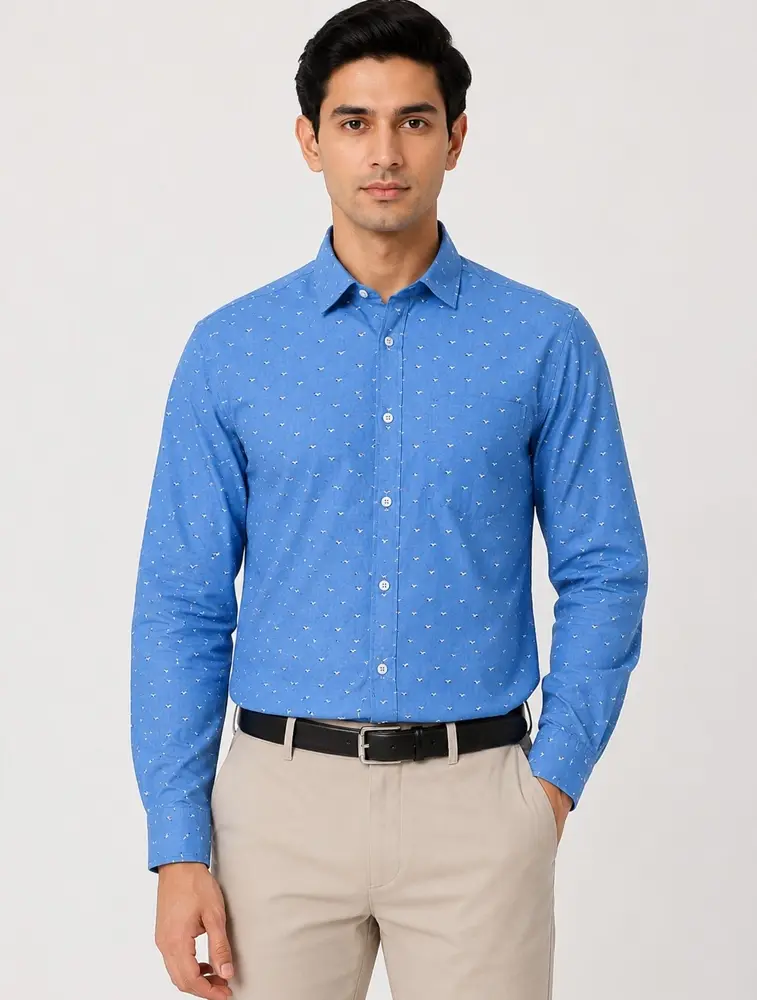
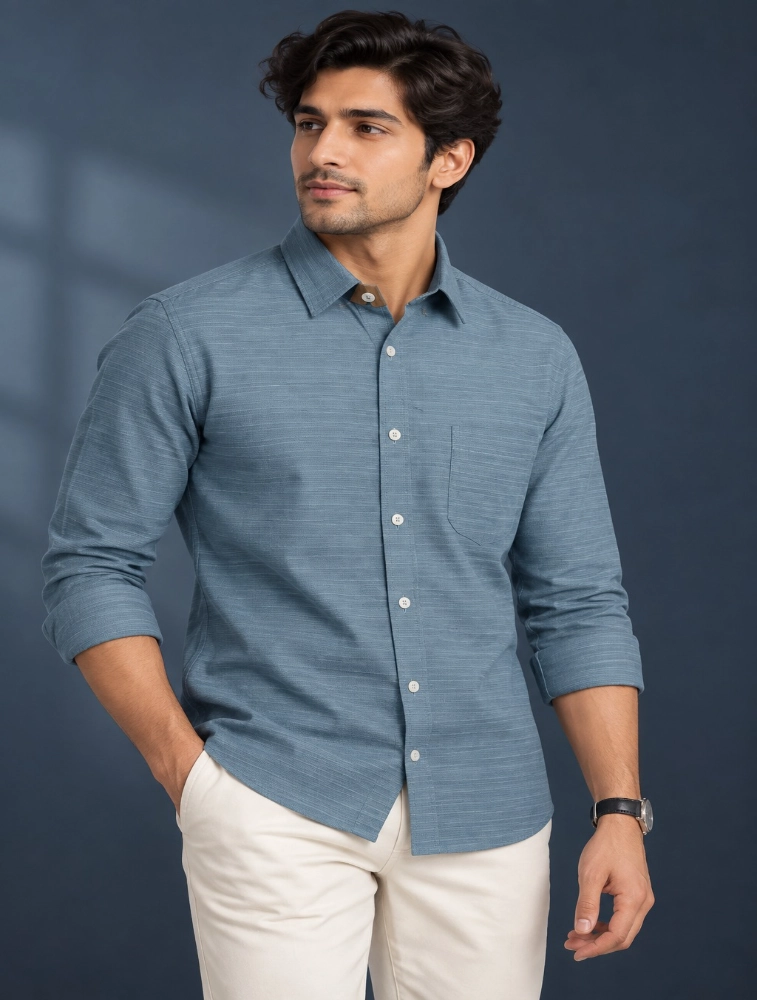
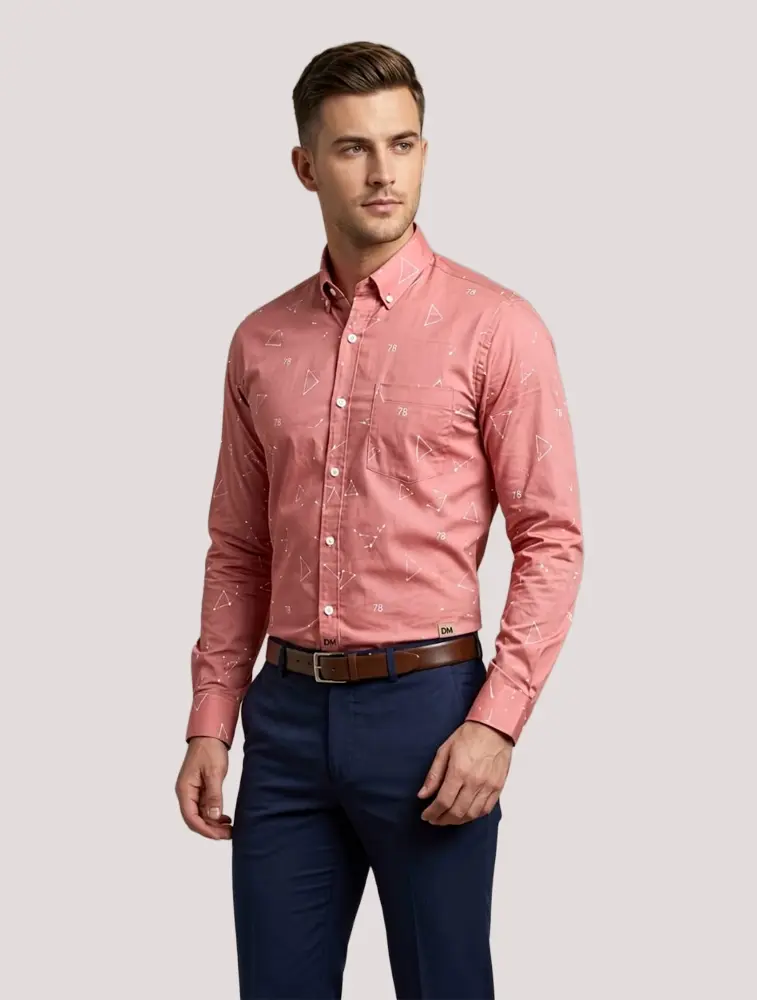
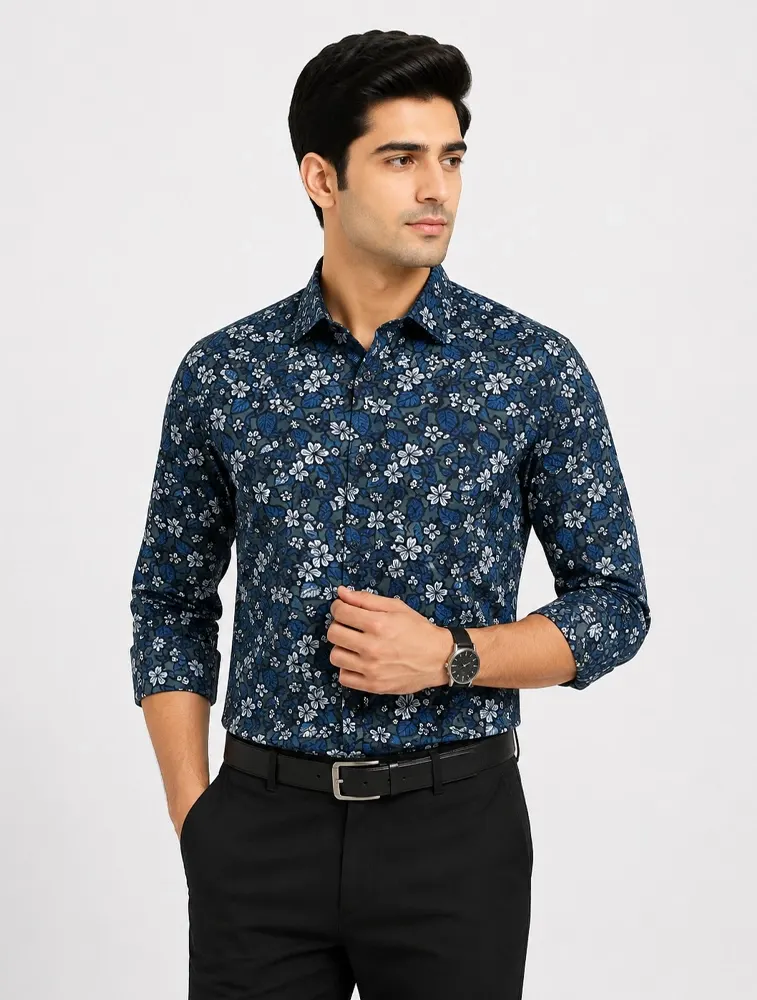
factori.com supplies bulk shirts from ₹262/piece across 662 partner factories — ready stock and custom programmes with GST invoices.
Prices verified October 2026 · shown excluding GST
₹262Entry price
Same dayDispatch on working days


Page 2 of 6
Bulk shirts for every use case
Brand-ready shirts for corporate, retail, uniforms and large custom programmes — sourced across partner factories with published prices.
Corporate & events
Brand-ready shirts for offsites, launches and conferences.
Get quote →
Uniforms & programmes
Consistent supply for schools, factories and frontline teams.
Corporate uniforms →
Own brand / resale
Unbranded or private-label stock for retail brands.
Launch your store →
Large custom runs
Contract manufacturing for high-volume programmes.
Contract manufacturing →Bulk shirts — frequently asked questions
Which shirt fabric belongs in an office, and which one belongs on a shop floor?
Polyviscose belongs in an office — it breathes better, drapes softer and takes a crease well, which is what a customer-facing shirt needs. Hundred-per-cent polyester belongs on a floor: it holds 95 per cent or more of its dry strength when wet, survives 100-plus heavy wash cycles, and shrugs off industrial laundering that would finish a softer cloth.
The two fabrics on this page, and the real difference between them. The polyester shirts and the polyviscose shirts sit Rs 46 apart at most. That gap is small enough that most buyers pick on colour and never ask what they have actually bought, which is the wrong way round. The decision is not about price at all — it is about who wears the shirt and how it gets washed.
Where polyviscose wins. Viscose is a cellulosic fibre, so a polyviscose cloth feels cooler against skin and hangs with more weight and less shine than pure polyester. In a reception, a branch, a showroom or a front office, that matters: the shirt reads as clothing rather than as workwear, and it presses to a sharp finish. The trade-off is wet strength. Viscose retains only 50 to 60 per cent of its dry strength when it is wet, so a polyviscose shirt is at its most vulnerable in the wash rather than on the body. In a domestic or gentle commercial wash that is a non-issue. Under repeated high-alkaline industrial laundering it shortens the garment’s life, and the first place it shows is a softening collar somewhere between the fifteenth and twentieth wash on a viscose-heavy cloth.
Where polyester wins. Polyester holds 95 per cent or more of its dry strength wet, recovers from wrinkling without pressing, resists the enzymes and bleach in a commercial wash cycle, and shrinks 1 per cent or less after the first wash. For a factory, a warehouse, a logistics depot, a housekeeping team or any workforce whose shirts go out to a laundry in bulk, that combination is worth more than hand feel. It also holds a printed or embroidered logo position better across a long wash life, because the base cloth is not moving under the branding.
Where neither is right, and you should say so at enquiry. Two situations rule out both fabrics on this page. Anywhere near open flame, welding sparks, hot metal or radiant heat, polyester is the wrong fibre entirely — it melts and adheres rather than charring away, which turns a burn into a worse burn. And for a workforce in sustained hot, humid outdoor conditions, a cotton-rich cloth is more comfortable than either option here. Both are quoted as custom runs rather than bought from this grid; ask for them by name at enquiry and we will quote against the specification rather than against the shelf.
Specification
Queries Targeted
polyester vs polyviscose uniform shirt, best fabric for staff uniform shirt, PV shirt vs polyester shirt, industrial uniform shirt fabric
Why do the shirts on this page range from Rs 314 to Rs 360, and what would take a quote above that?
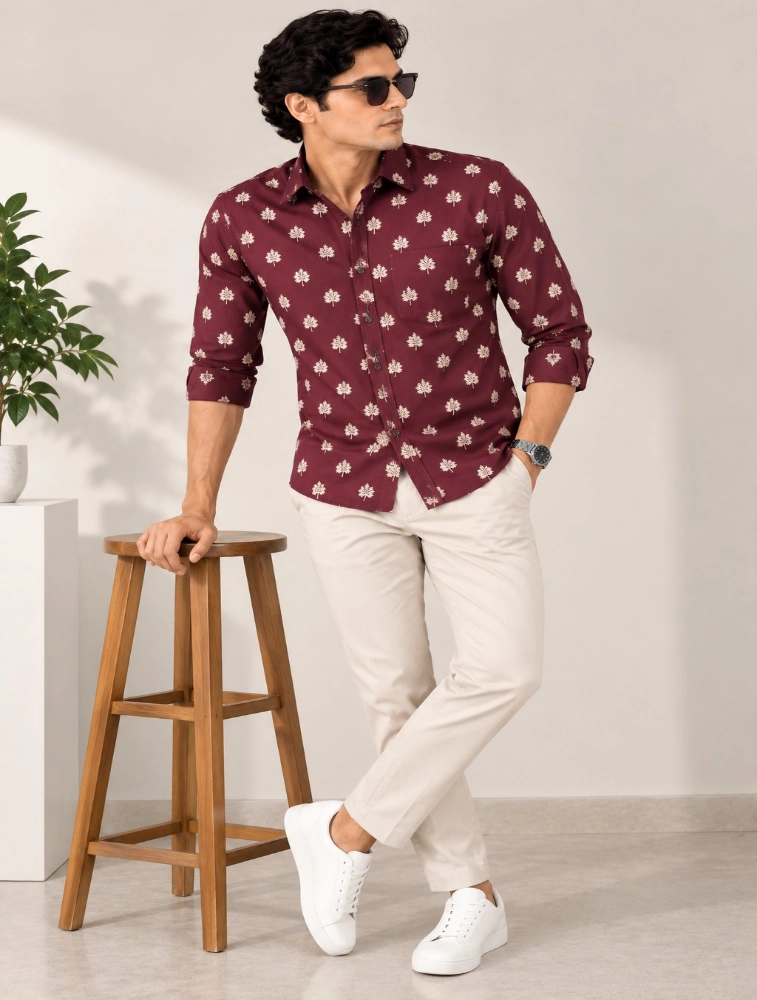
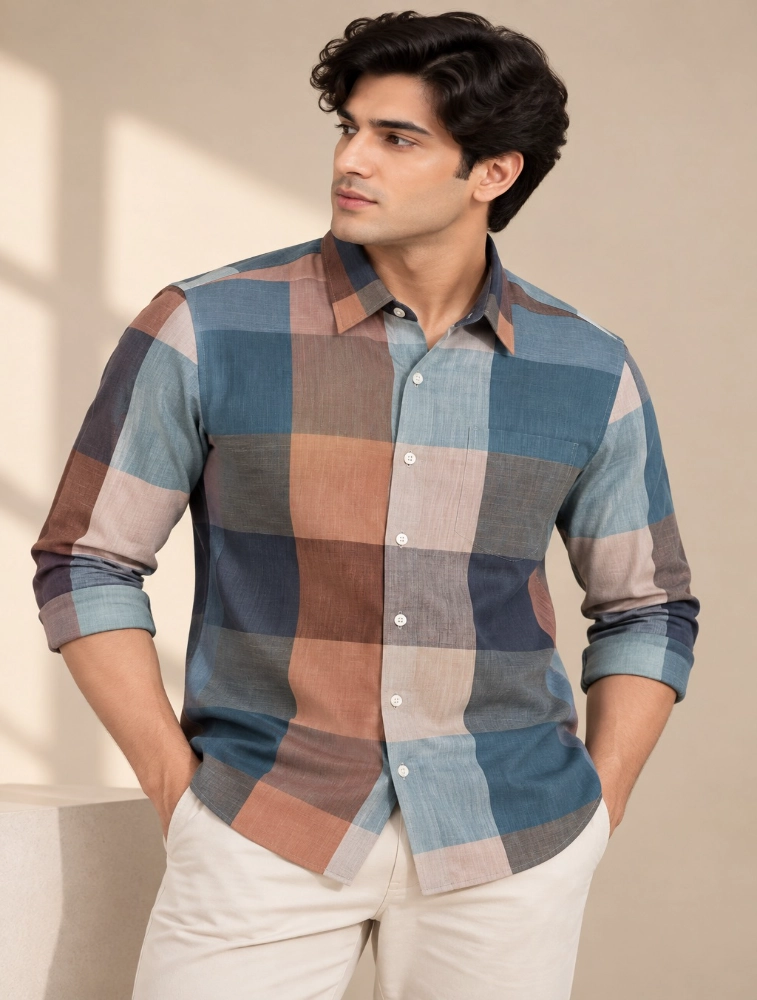
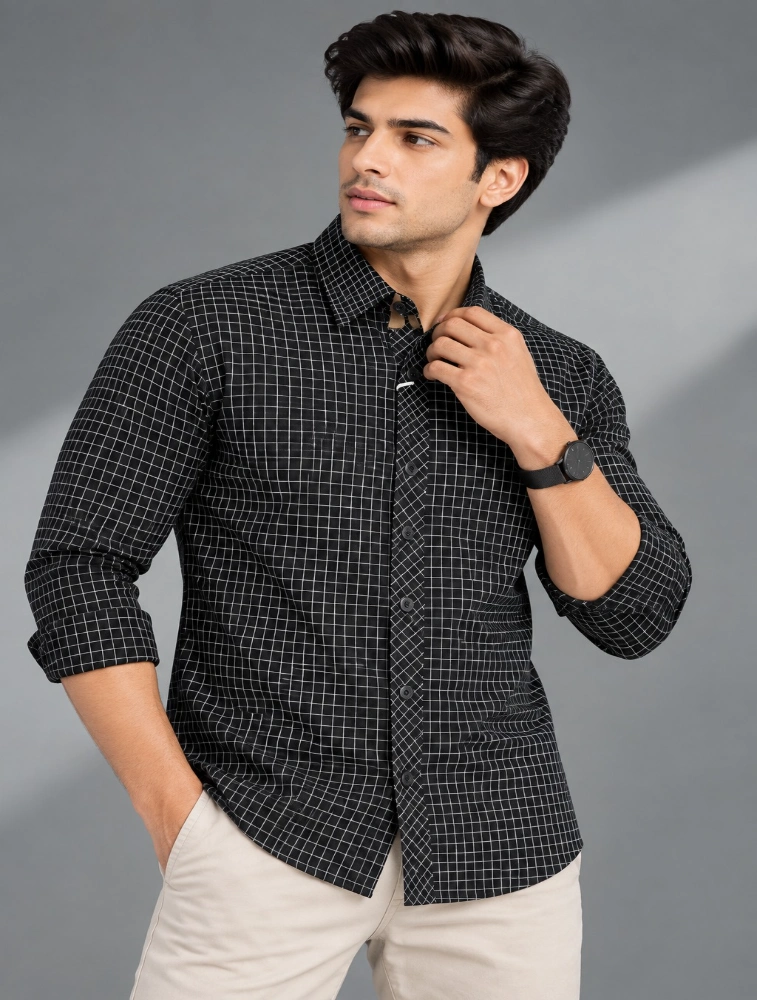
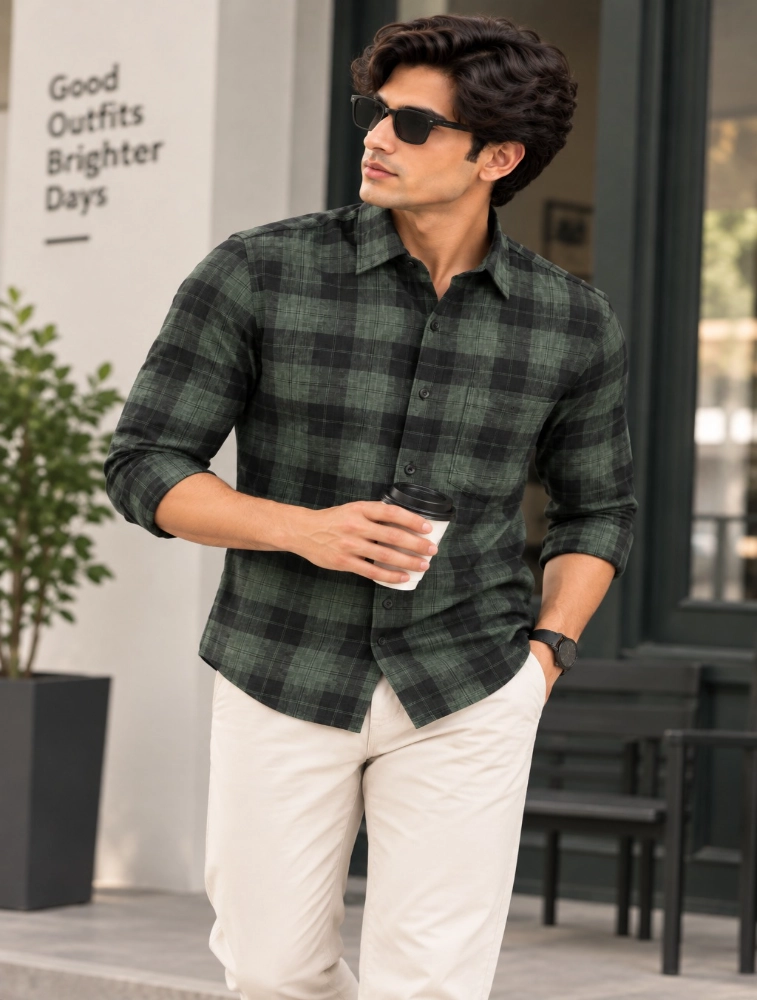
The Rs 314 to Rs 360 band on this page is plain, ready-stock, full-sleeve shirting in solid colours. Rs 314 buys the white polyester; Rs 345 buys the coloured polyester; Rs 360 buys the polyviscose. Everything that lifts a quote above Rs 360 is something added — finer yarn, cotton content, embroidery, custom colour or a lower quantity.
What sits inside the published rate. A ready-stock rate covers a cloth already woven and dyed, a standard collar and cuff make, a chest pocket, a size ladder that already exists, and packing. Nothing in it is specific to you. That is precisely why it is the lowest number on the page — the cloth was committed before your order existed, so no minimum weaving run has to be underwritten by your quantity.
The six things that move a quote upward, roughly in order of impact.
Fibre. Cotton and cotton-rich blends cost more per metre than polyester and always will. A cotton-rich uniform shirt is a materially different price point from anything on this grid, not a small step up.
Yarn count and construction. A 40s x 40s uniform poplin, a 60s x 60s dress shirting and an 80s/2 two-fold premium cloth are three different rates for the same garment shape. Finer yarn means more spinning stages and more picks per inch, and both are paid for at the loom.
Custom colour. Matching a specific brand shade means a dedicated dye lot, which carries a minimum fabric quantity. Below that quantity the dyeing cost divides across too few shirts and the per-piece rate rises sharply. Choosing from stock shades avoids this entirely.
Branding. An embroidered logo is priced by stitch count, so a dense multi-colour crest costs several times a simple two-colour monogram. Printing, woven labels, custom buttons and a name strip each add their own line.
Make details. A higher stitch density, a two-piece collar, a fused placket, a specific cuff style, a ladies’ fit block or contrast trim all add operations at the sewing line.
Quantity. Custom runs start at 100 pieces per style per colour. The per-piece rate keeps falling well past that, because cutting, marker-making, pattern setting and machine set-up are fixed costs spread across the run.
Why the factory rate is lower than a trading rate. An order placed here goes to the partner factory that already runs that construction, with one commercial layer instead of three. There is no importer margin, no distributor margin and no reseller margin stacked on top of the make cost. That is the entire reason the number is what it is. The home-page FAQ sets out how a quote is built and what payment terms apply.
Specification
Queries Targeted
bulk shirt price India, wholesale shirt rate per piece, uniform shirt cost bulk order, custom shirt price per piece factory
Why is shirting specified by yarn count and construction rather than by GSM alone?
Because two cloths at the same GSM can behave completely differently. GSM tells you how much fibre is in a square metre; count and construction tell you how it is arranged. A 40s x 40s / 133 x 72 poplin and a 45s x 45s / 110 x 70 poplin land close on GSM, but the first is denser, more opaque and far longer-wearing.
How to read a shirting specification. A line like 40s x 40s / 133 x 72 gives you four numbers. The first pair is the yarn count in warp and weft — higher count means finer yarn. The second pair is thread density: 133 ends per inch running lengthwise, 72 picks per inch running across. Together they describe a cloth precisely enough that two different mills can weave the same thing. GSM alone does not, which is why serious uniform tenders quote count and construction and treat GSM as a check figure rather than the specification.
The four constructions that cover almost every shirt order. A 45s x 45s / 110 x 70 is the airy budget end — light, cool and thin, and the first to show wear at the collar and elbow. A 40s x 40s / 133 x 72 is the balanced uniform workhorse; it is what most institutional shirting is, and it is the one to specify if you want a shirt that survives a working year. A 60s x 60s / 90 x 88 is the standard dress shirting: finer yarn, smoother face, better drape. An 80s/2 two-fold at around 144 x 80 is premium territory — two-fold yarn in both directions, noticeably finer and stronger than its weight suggests.
The GSM bands, and why whites are a special case. Shirting poplin at 85 to 95 GSM is sheer enough to show an undergarment. At 100 to 115 GSM you have a standard summer dress shirt — 110 is the number most often specified. At 120 to 135 GSM you get real opacity, and that is the band to insist on for white shirts, which is the single most common complaint in institutional uniform programmes. Polyviscose matty shirting used for corporate and school uniforms is a heavier cloth altogether, typically 240 to 300 GSM at around a 2/18 count and 58-inch width, because it is built for a longer service life rather than for lightness.
What to do with this at enquiry. If you have an existing shirt you are happy with, send it. A construction can be read off a sample far more reliably than it can be described over email, and matching a known cloth removes the largest single source of disappointment in a repeat uniform order. If you have a tender specification, send that instead and we will quote against it line by line rather than substituting a near-equivalent cloth and hoping it passes.
Specification
Queries Targeted
shirting fabric count construction meaning, EPI PPI shirting, 40s 40s 133 72 poplin, shirt fabric GSM chart
What decides whether a shirt collar still stands up after fifty washes?
The interlining and how it is fused. A collar keeps its shape because a fusible interlining is bonded to the cloth under heat and pressure. When that bond fails, the collar bubbles, ripples and separates — delamination — and no amount of pressing brings it back. Microdot fusible interlining, correctly fused, is the standard that survives a uniform’s wash life.
Why the collar and cuff are where uniform shirts die. A shirt body is a single layer of cloth doing very little. A collar is three or four layers, bonded and stitched, sitting against skin and sweat, folded in the same place every day and hit hardest by every wash. It is the highest-stress component in the garment and the one a wearer looks at when deciding whether a uniform still looks professional. A shirt with a sound body and a collapsed collar is retired just as fast as a torn one.
What to specify, in plain terms. Ask for microdot fusible interlining in the collar and cuffs rather than a sew-in or a low-grade coated interlining, and ask that the fusing is done on a continuous fusing press with controlled temperature, pressure and dwell time rather than by hand iron. Ask whether the collar is one-piece or two-piece — a two-piece collar with a separate band holds a cleaner stand and is worth the small extra cost on a customer-facing shirt. And ask for the interlining weight to be matched to the shell cloth; a heavy interlining on a light poplin gives you a stiff board of a collar that cracks at the fold, while a light interlining on a heavy matty gives you a collar that never stands at all.
How the bond is actually verified. The test is not visual on a new shirt, because a badly fused collar looks perfect until it has been washed. A pre-production sample should be washed to the cycle the shirts will actually face — and if they are going to a commercial laundry, that means an industrial cycle at 60 to 85 degrees with alkaline detergent, not a gentle home wash. Bubbling, edge lifting or a wavy collar point after that wash means the fusing parameters are wrong and it will happen to the whole order.
The stitch specification that goes with it. Collar and cuff topstitching should run at 14 to 20 stitches per inch on a dress-quality shirt and 10 to 14 on a casual make, with buttonholes at 85 to 90 stitches. Density is not cosmetic: for a 301 lockstitch, seam strength runs roughly at stitches per inch multiplied by thread strength in pounds multiplied by 1.5, so 10 SPI with a 4-pound thread gives about 60 pounds of seam strength. Drop the stitch count to save time on the line and you have measurably weakened the seam.
Specification
Queries Targeted
shirt collar interlining fusible, collar delamination bubbling wash, microdot fusing shirt collar, shirt cuff interlining specification
Should we order full-sleeve or half-sleeve shirts, and can we run both in one programme?
Full-sleeve for customer-facing and formal roles, half-sleeve for hot indoor work and anywhere near moving machinery. Yes, both can run in one programme — same cloth, same colour, same branding, two sleeve lengths — because each sleeve length is simply a separate style line at 100 pieces per style per colour.
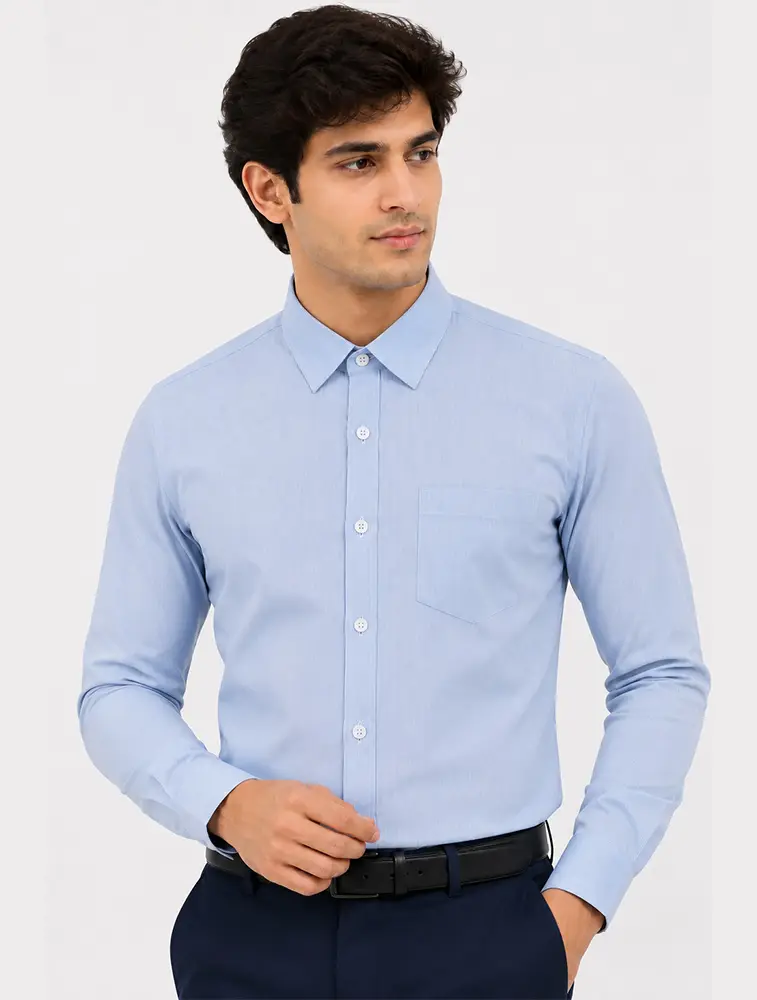
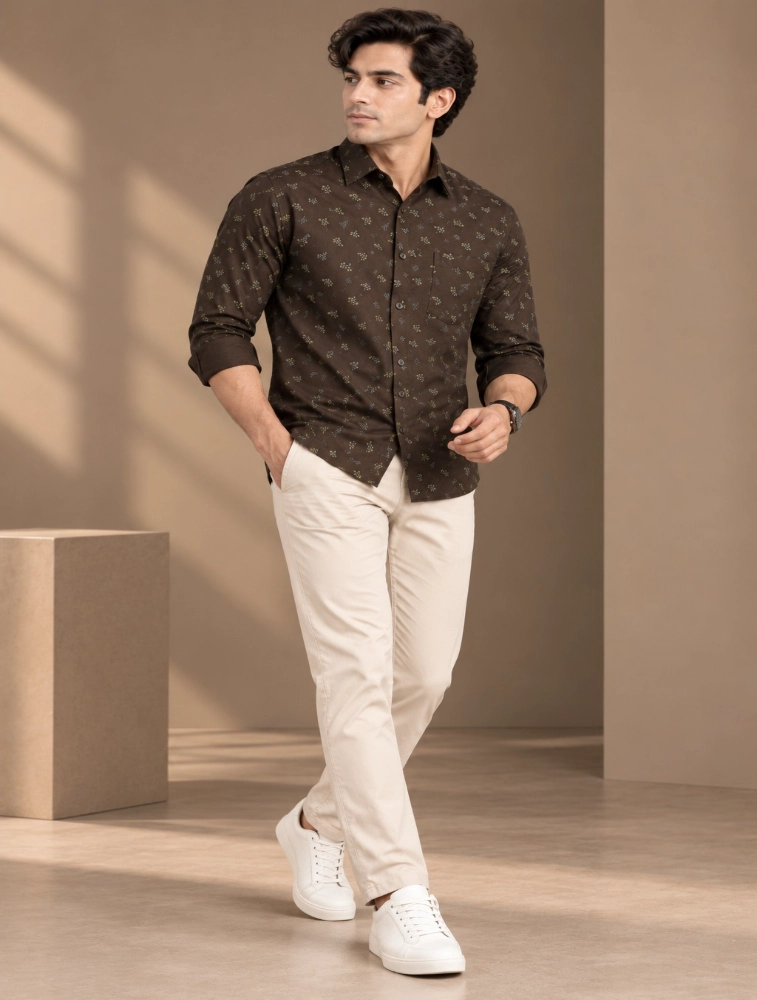
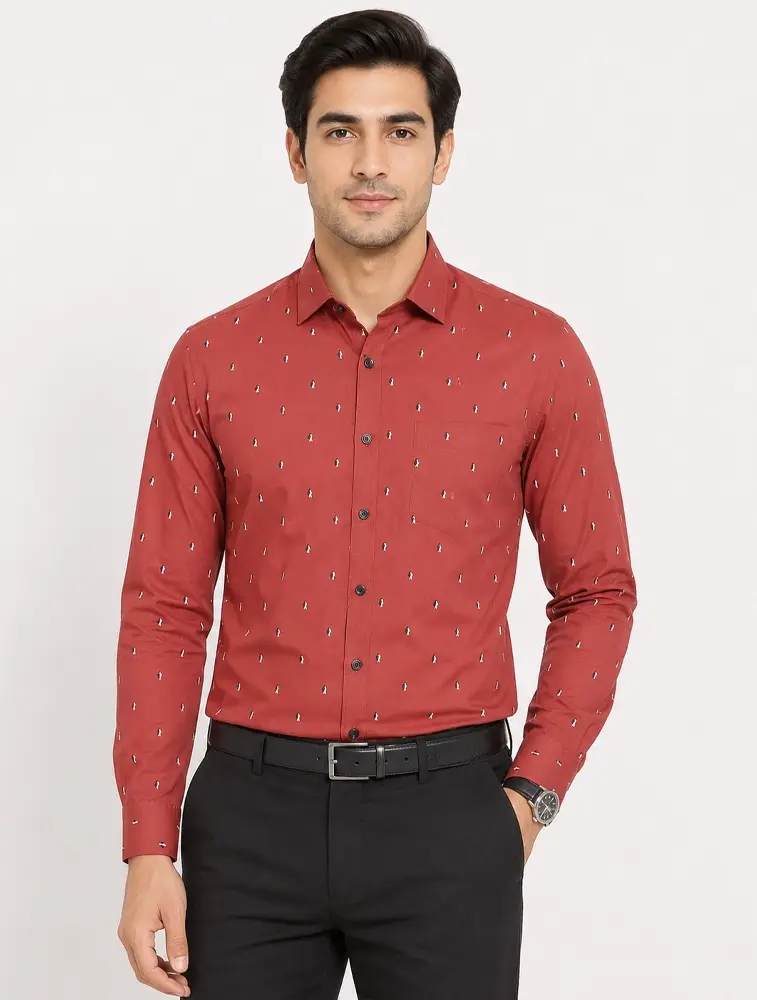
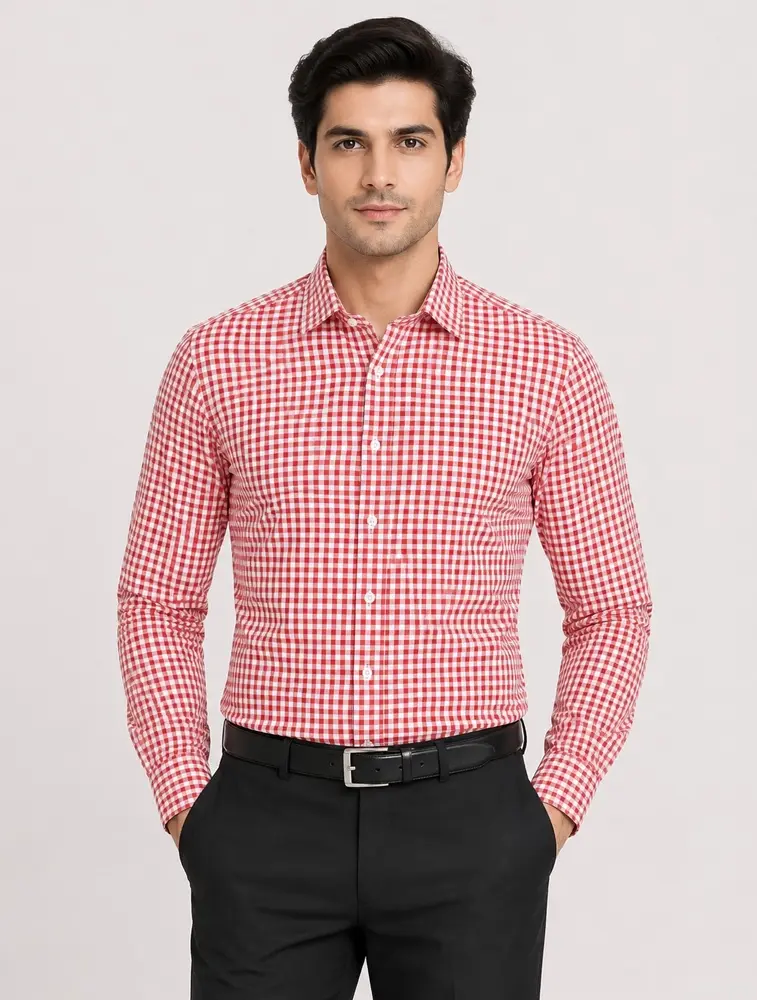
Start here: everything visible on this page is full-sleeve. All twelve shirts in the grid above are full-sleeve with a chest pocket. If your programme needs half-sleeve, it is a custom run rather than a ready-stock pick, which changes the lead time from 7 to 10 days to 15 to 30 days and brings the 100-piece-per-style minimum into play. That is worth knowing before you plan a rollout date, and it is the most common surprise in a first shirt order placed off a stock grid.
When full-sleeve is the right call. Reception, sales, branch banking, showroom, hospitality front-of-house, supervisory and any role where the shirt is part of a formal presentation. Full-sleeve reads as more senior in almost every Indian workplace, which is why many organisations use sleeve length rather than colour to separate supervisors from operators. It also gives you the option of a rolled and tabbed sleeve for a semi-formal look without a second garment.
When half-sleeve is the right call. Kitchens, warehouses, packing halls, workshops and any hot indoor environment. More importantly, half-sleeve is a safety decision around rotating machinery, conveyors, drill presses and lathes, where a loose cuff is an entanglement risk. If a plant already forbids loose sleeves, that rule decides the specification and comfort does not enter into it. Where full-sleeve is required near machinery for other reasons, specify a buttoned cuff that closes firmly rather than an elasticated or open cuff.
Ladies’ fit is a real requirement, not a variant. Nothing on this page is cut on a ladies’ block. Issuing men’s shirts to women is the single most common cause of uniform non-compliance in mixed workforces — the shirt is wrong at the shoulder, wrong at the bust and wrong in sleeve length, and people simply stop wearing it. A ladies’ fit needs its own pattern block, its own size ladder and its own minimum quantity. If your workforce is mixed, raise it at enquiry so it is quoted from the start rather than discovered at fitting.
How to structure a mixed programme. Fix one cloth and one colour family, then let sleeve length and fit block vary by role and gender. That way the whole workforce reads as one uniform, all the shirts wash and fade at the same rate because they came from the same cloth, and each line still clears its own minimum. Splitting cloth across roles is what makes a uniform look mismatched by the second year.
Specification
Queries Targeted
full sleeve vs half sleeve uniform shirt, half sleeve shirt bulk order, uniform shirt sleeve length policy, ladies fit uniform shirt bulk
How do we get the size mix right for a workforce of two thousand without measuring everyone?
Indian shirt sizes are chest measurements in inches, not letters — 38 is S, 40 is M, 42 is L, 44 is XL, 46 is XXL, 48 is XXXL. For a workforce you have not measured, order against an indicative distribution weighted to 40 and 42, then run a size-confirmation exercise before the balance is cut.
Read the size code before anything else. A shirt marked 40 fits a 40 to 41 inch chest. This trips up buyers who are used to letter sizing, because a “medium” from one brand and a 40 from another are not reliably the same garment. Specify in inches on the purchase order and the ambiguity disappears. If you are matching an existing uniform, measure the flat chest of an approved shirt across the underarm seams and double it — that number, not the label, is what the new shirts should be built to.
| SIZE | CHEST (INCHES) | LETTER | INDICATIVE SHARE OF A MIXED ORDER |
|---|---|---|---|
| 38 | 38–39 in | S | About 10 per cent |
| 40 | 40–41 in | M | About 25 per cent |
| 42 | 42–43 in | L | About 30 per cent |
| 44 | 44–45 in | XL | About 20 per cent |
| 46 | 46–47 in | XXL | About 10 per cent |
| 48 | 48–49 in | XXXL | About 5 per cent |
Treat that column as a starting distribution, not a forecast. It is a reasonable opening position for a general adult workforce and it is wrong for plenty of real ones. A young field-sales team skews smaller. A long-tenured plant workforce skews larger. A women-heavy workforce needs a ladies’ block with its own ladder rather than a reweighting of this one. Regional variation is real too. Use the distribution to place the order, not to close the question.
The survey that removes the guesswork. Circulate a single-question form asking each employee for a chest size in inches, with a set of sample shirts in sizes 38 to 48 available at each location for people to try. A morning of trying on beats a month of exchanges. For a two-thousand-piece programme, run the survey while the cloth is being prepared — it costs you no calendar time and it is the difference between a 2 per cent exchange rate and a 15 per cent one.
Where the buffer stock should sit. Order 3 to 5 per cent spare, and put almost all of it in 40 and 42. Those two sizes fit new joiners without a fresh order, so spare stock in them is genuinely reusable. Spares in 38 or 48 tend to sit in a store cupboard for years, which is not buffer — it is dead inventory with a purchase order attached.
Specification
Queries Targeted
shirt size chart India chest inches, uniform size mix ratio bulk order, shirt size 40 42 chest inches, how to order shirt sizes for staff
What happens to a uniform shirt after a hundred industrial washes?
A polyester uniform shirt survives 100-plus heavy industrial cycles and is usually retired for appearance rather than failure. A cotton shirt is visibly faded and softened by around 50. A viscose-rich shirt starts losing collar body at 15 to 20 washes and is replacement-ready at 45 to 50. If your shirts go to a commercial laundry, specify ISO 15797, not ISO 105.
The two wash standards are not interchangeable, and this is the costliest misunderstanding in uniform buying. ISO 105 simulates a single domestic wash — moderate temperature, ordinary detergent, gentle mechanical action. It is the right test for a garment someone washes at home. ISO 15797 simulates industrial laundering: 60 to 85 degrees, high-alkaline detergents with enzymes and bleach, and the heavy mechanical action of a tunnel washer. A cloth that passes ISO 105 comfortably can fail ISO 15797 badly. A test report is only meaningful if it matches the wash the shirt will actually meet, so the first question to ask about any report you are shown is which standard it was run to.
What ISO 15797 actually measures. Dimensional stability in warp and weft separately, because a cloth can hold its length and lose its width, which is exactly how a shirt ends up short in the body and tight at the chest. Colour fastness, in a cycle designed to strip colour rather than preserve it. Abrasion, tear and tensile strength measured before and after laundering, so you can see how much strength the wash cycle costs. And appearance retention — pilling, wrinkling and seam puckering — which is what actually decides whether a shirt still looks like a uniform.
First-wash shrinkage, by fibre. Pure cotton moves 3 to 5 per cent on the first wash unless it has been pre-shrunk or compacted. A 65/35 polyester-cotton settles at 1 to 2 per cent. A 65/35 polyester-viscose runs 1 to 3 per cent. Hundred-per-cent polyester is effectively stable, at or under 1 per cent. Shrinkage is not a defect if it is declared and allowed for in the pattern; it is a defect when a size 40 shirt measures 38 after the first wash because nobody built the allowance in. Ask for the declared shrinkage figure and ask whether the pattern already accounts for it.
Wrinkle recovery, which decides how the uniform looks on day 200. Pure cotton recovers poorly and needs pressing to look right. Polyester-cotton and polyester-viscose both recover well and can go from a laundry straight onto a wearer. For a workforce with no pressing arrangement, that difference is more visible day to day than any specification on the cloth ticket. It is a large part of why institutional shirting is blended rather than pure cotton, whatever the comfort argument says.
Specification
Queries Targeted
ISO 15797 industrial laundering test, uniform shirt wash life, industrial wash vs domestic wash uniform, shirt shrinkage after wash percentage
Will next season's shirts be the same shade as the ones we approve now?
Only if shade continuity is written into the order. Dyeing is a batch process, so two lots of the same colour are never identically matched. The controls that make a repeat order look like the original are a retained reference swatch, a stated tolerance, one dye lot per issue cycle, and a rule about which garments may be mixed on the same wearer.
Why the shade moves at all. A dye lot is a finite quantity of cloth dyed together in one bath. Fibre batch, bath chemistry, temperature curve and drying all influence the final shade, and none of them repeats perfectly months later. On a strong colour like maroon, black or olive, a small variation is visible when two shirts hang side by side. On white it is barely noticeable, and on a mid-grey it sits between the two. This is normal textile behaviour, not a manufacturing fault — the fault is not managing it.
The four controls that hold a programme together.
A retained reference. Approve a physical swatch, keep one copy and leave one on file with the order. Every subsequent lot is assessed against that swatch, not against memory or a photograph. A screen is not a colour reference.
A stated tolerance. Say in writing how much variation is acceptable, assessed against the standard grey scale under controlled light. A tolerance nobody wrote down becomes an argument at delivery.
One dye lot per issue cycle. If a hundred shirts go out to one department, they should come from one lot. Cloth for a full cycle is best reserved in a single dyeing so the whole department matches, even if the shirts are cut and stitched in phases.
A mixing rule. Decide whether a wearer may combine a new shirt with an older one. Most organisations issue a complete set at once precisely so that shade drift never appears on the same person.
The other kind of shade change: fading. A shirt does not only differ from lot to lot, it drifts from itself. Wash after wash strips colour, and a two-year-old shirt beside a new one shows it even when both came from the same lot. Colour fastness to washing, light and perspiration is what governs how fast that happens, and it should be tested to the wash cycle the shirts will meet — industrial if they go to a commercial laundry. A dark shirt with weak fastness looks tired within a season and undermines the programme regardless of how well it was matched at delivery.
What this means for planning. If your uniform runs on an annual cycle, the practical answer is to buy shade continuity forward: reserve cloth for the year’s full requirement in one dyeing and draw down against it, rather than re-dyeing each quarter and hoping. It costs planning rather than money, and it is the difference between a uniform and a collection of similar shirts.
Specification
Queries Targeted
dye lot shade variation uniform shirt, colour matching repeat order bulk shirts, shade continuity uniform programme, grey scale colour fastness shirt
Where should a logo, a name badge and a designation strip sit on a uniform shirt?
Logo on the left chest above the pocket, or on the pocket itself if the pocket is retained. Name on the right chest, mirroring it. Designation on the right sleeve or as a second line under the name. Company mark on the back yoke only where visibility from behind matters. Embroidery for permanence, print only where a large graphic is needed.
The left chest is the default for a reason. It is the position a viewer’s eye reaches first in conversation, it survives being seen across a counter or a table, and it sits on a flat single-layer panel that embroiders cleanly. Every shirt on this page carries a chest pocket, which forces a decision: embroider onto the pocket, or place the logo above it. Onto the pocket looks tidier and is what most corporate programmes choose; above the pocket gives a larger usable area and keeps the pocket functional without stitching through it. Decide once, in writing, and hold it across the whole programme — inconsistent logo height across a workforce is more visible than any single placement choice.
Embroidery versus print on woven shirting. Embroidery is the right default for uniform shirts. It has no adhesive layer to fail, it survives industrial laundering, and it reads as more permanent. It is priced by stitch count, so a dense multi-colour crest costs several times a simple monogram, and very fine detail or small text does not reproduce reliably below about 5 mm letter height. Print handles gradients, photographic detail and large back graphics that embroidery cannot, and it is the cheaper route for a large area, but on a woven polyester shirt going into a hot alkaline wash, print is the component most likely to be the first thing to fail. If the programme has any print, wash-test it to the actual cycle before committing the run.
Names, and the reason they change the order structure. An individually named shirt is no longer a bulk item — it is a run of one, repeated. That is entirely doable, and it is standard in hospitality and healthcare, but it changes the process: you supply a verified name list, each piece is marked and reconciled to it, and a spelling error is a remake rather than an exchange. Most programmes solve this better with a removable badge or a Velcro name strip on the right chest, so the shirt stays a stock item and the name moves with the person. If names are embroidered, agree the exact spelling and capitalisation list as a signed document before production, not by email thread.
Practical rules worth writing into the specification. Fix the logo size in millimetres, not as “small” or “standard”. Fix the distance from the shoulder seam and from the centre placket. Approve a stitched-out sample on the actual shirt colour, because thread shades read differently on maroon than on white. And approve embroidery on the same cloth the order will use — a stitch density that sits beautifully on a heavy matty can pucker on a light poplin.
Procurement
Queries Targeted
logo placement uniform shirt, embroidered logo shirt chest position, name badge on uniform shirt, shirt branding embroidery vs print
Is a polyester shirt the right choice near heat, sparks or moving machinery?
No. Polyester melts rather than chars, and molten fibre adheres to skin, which turns a minor burn into a serious one. Anywhere with open flame, welding sparks, hot metal or radiant heat, polyester is the wrong fibre and no amount of specification fixes it. Around moving machinery the issue is different — loose sleeves and cuffs, not the fibre.
The melt hazard, stated plainly. Natural fibres burn and char. Thermoplastic fibres soften, melt and stick. In a spark or contact-heat incident, a polyester shirt can transfer molten material directly onto skin and continue burning after the heat source is removed. This is why welding bays, foundries, forges, kitchens with open flame, and electrical work with arc-flash risk all specify away from polyester regardless of cost. If any part of your workforce operates in those conditions, the shirts on this page are not the right product for them, and the correct answer at enquiry is a different specification rather than a discount on this one.
What to ask for instead. For those roles the specification moves to inherently flame-resistant or FR-treated fabric, tested and certified to the relevant standard for the hazard, with the certification supplied as a document rather than a claim. That is a quoted custom garment, not a stock pick. Tell us the hazard at enquiry and it gets specified from the start; a shirt bought on colour and price and then discovered to be unsuitable is a wasted order in a category where the cost of being wrong is not measured in rupees.
Moving machinery is a make problem, not a fibre problem. Around lathes, drills, conveyors and rotating shafts, the risk is entanglement. Specify half-sleeve, or full-sleeve with a firmly buttoned cuff that closes on the wrist. Avoid loose or elasticated open cuffs, avoid a flapping placket, and consider dropping the chest pocket where objects falling from it are a hazard. Many plants already have a written rule on this; if yours does, send it and it becomes the specification.
High-visibility work has its own standard, and it is quantitative. EN ISO 20471 defines three classes by how much material is on the garment. Class 1 requires at least 0.14 square metres of fluorescent background and 0.10 square metres of retroreflective material. Class 2 requires at least 0.50 and 0.13, which is the typical hi-vis vest. Class 3 requires at least 0.80 and 0.20 and cannot be met by a sleeveless garment — it must have sleeves, which is exactly why hi-vis shirts and jackets exist rather than just vests. Retroreflective bands must be at least 50 mm wide. If a site specifies a class, the garment either meets the area requirement or it does not; there is no partial compliance and no substituting a vest for a Class 3 requirement.
Procurement
Queries Targeted
polyester shirt melt hazard, uniform shirt near welding sparks, EN ISO 20471 hi vis class 1 2 3, safety uniform shirt fabric selection
How many shirts does each employee need per year, and how is an issue cycle run?
Two shirts per employee is the minimum that works, three is the standard for daily-wear roles, and four to five for roles where the shirt gets soiled every shift. Issue on a fixed annual or half-yearly cycle rather than on request, keep 3 to 5 per cent buffer in sizes 40 and 42 for new joiners, and hold the same cloth and dye lot across each cycle.
Why two is a floor and not a plan. With two shirts, one is worn while one is washed, and there is no margin for a laundry delay, a stain or a damaged garment. The wearer then turns up in a non-uniform shirt, which is exactly the outcome the programme exists to prevent. Three shirts gives a genuine rotation and, counter-intuitively, extends the life of the set — each shirt sees a third fewer washes per year, and wash count is what retires a uniform shirt. For kitchen, housekeeping, workshop and field roles where a shirt is soiled daily, four or five is the honest number.
Run the cycle on a calendar, not on requests. A request-driven programme rewards the people who ask and penalises the people who do not, and it produces an order every month at a small-quantity rate. A calendar-driven programme — a full issue at a fixed month each year, or a half-set every six months — consolidates into one or two runs, which is where the per-piece rate comes down. It also gives you one dye lot per cycle, so everyone issued together matches.
Build the quantity from four numbers. Headcount by role. Shirts per person for that role. Expected joiners over the cycle, so new starters are clothed on day one instead of waiting for the next order. And a 3 to 5 per cent buffer for damage and size exchange, concentrated in the two middle sizes because those are the ones a new joiner is most likely to need. A two-thousand-person workforce at three shirts each is a six-thousand-piece programme, and every one of those four numbers is worth getting right before it is placed.
Set the retirement rule up front. Decide what triggers replacement — a fixed period, a wash count, or a visible-condition standard applied at a supervisor check. Without a rule, shirts stay in service until they are visibly worn out, by which point the uniform is doing reputational damage. A written condition standard, with a photograph of what “retire this” looks like, is the cheapest quality control in the whole programme.
Plan the lead time backwards from the issue date. Ready-stock shirts dispatch in about 7 to 10 days; custom runs take 15 to 30 days from approval, and that clock starts after the sample is signed off, not when the enquiry is sent. Sampling, size survey, name lists and branding approval all sit before it. For a fixed issue month, start the conversation roughly two to three months ahead and the whole thing lands without compression.
Procurement
Queries Targeted
uniform issue cycle policy, how many uniform shirts per employee per year, uniform replacement schedule staff, uniform entitlement policy India
What does a staff-uniform rate contract ask for that a single order does not?
A rate contract prices a specification rather than a shipment, so it asks for things a one-off order never does: a locked technical specification, held rates over a stated period, a quantity-variation clause, test reports against a named standard, sealed samples on both sides, delivery in call-off lots, and a defined replacement process.
The specification stops being a description and becomes a contract term. In a single order, “polyester shirt, sky blue, full sleeve” is enough to get shirts. In a rate contract it is not, because the contract must be enforceable in month eleven against cloth nobody has woven yet. That means fibre composition with a stated tolerance, yarn count and construction, GSM with a tolerance, declared shrinkage, colour fastness and dimensional stability tested to a named standard — ISO 15797 if the shirts go to a commercial laundry, ISO 105 if they are washed at home — plus stitch density, seam type and interlining type. Anything left vague is a dispute waiting for a delivery date.
Held rates and what they are held against. A contract that fixes a per-piece rate for twelve or twenty-four months is fixing it across yarn and dye price movements. Either the rate carries a stated validity period after which it is re-quoted, or it carries a defined escalation mechanism tied to input cost. A supplier who agrees to hold an unqualified rate indefinitely across a volatile input has either priced the risk into the number or is going to come back and ask — and the second is worse for the buyer than an honest escalation clause.
The quantity-variation clause is the one to read twice. Rate contracts routinely allow the buyer to draw more or less than the indicated quantity. That is reasonable, but the range has to be stated, because a run costed on ten thousand pieces and drawn at two thousand carries a completely different per-piece cost of pattern-making, marker planning, cutting and set-up. Agree the band, and agree what happens outside it, at signature. A clause that lets a buyer draw anywhere from 10 per cent to 300 per cent of the indicated quantity at one rate is not a bargain; it is a rate padded to cover the worst case.
Sealed samples, both sides. Approve a pre-production sample, seal it, and keep one with the buyer and one with the supplier. Every delivery is then assessed against a physical object rather than a paragraph. This single step removes most of what goes wrong in year two of a multi-year contract, when the people who wrote the specification have moved on.
What to send us. Send the tender document or the draft specification itself rather than a summary. We quote line by line against what is written, and where a line cannot be met exactly we say so at quotation rather than substituting a near-equivalent and letting it surface at inspection. Call +91 874 707 1444 or send the document through and it comes back itemised, size by size.
Procurement
Queries Targeted
uniform rate contract tender, staff uniform tender specification, government uniform supply contract requirements, uniform annual rate contract India
Which shirt does a hotel, a hospital and a security agency each need?
A hotel needs shade continuity and a soft hand for guest-facing roles. A hospital needs a cloth that survives repeated high-temperature laundering with bleach. A security agency needs a hard-wearing, colour-fast shirt that holds insignia and matches a prescribed shade exactly. Same garment shape, three different specifications, three different failure modes.
Hotels and hospitality. Front-of-house shirts are part of the guest experience, so hand feel, drape and shade consistency outrank almost everything. A polyviscose reads better here than pure polyester — softer, less shiny, cooler against skin. Expect a name badge on the right chest and a property mark on the left, and expect the shade to be non-negotiable because it sits against a fixed interior palette. Back-of-house is the opposite specification: kitchens are a heat and stain environment, so half-sleeve, higher wash tolerance and a colour that survives bleaching matter more than feel. One property routinely needs two specifications, and buying one for both is the usual mistake.
Healthcare. The controlling factor is the laundry, not the wearer. Hospital linen goes through high-temperature washing with strong chemistry, often daily, and the shirt must hold its dimensions, its colour and its seam strength through it. That means specifying to ISO 15797 rather than ISO 105, and it means asking for tensile and tear strength measured after laundering rather than only before. Colour coding by department or grade is common, which makes shade tolerance a functional requirement rather than an aesthetic one — if two departments are distinguished by shade, drift between lots defeats the system. Non-clinical roles in a hospital — administration, reception, facilities — are an ordinary corporate specification and should be quoted as one.
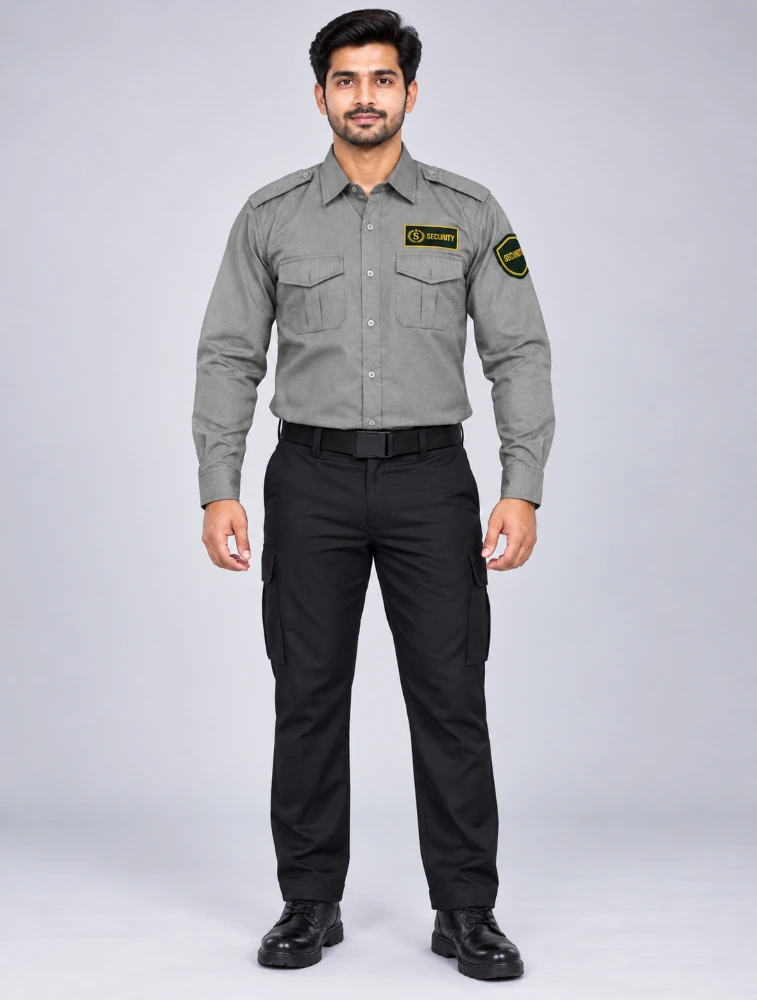
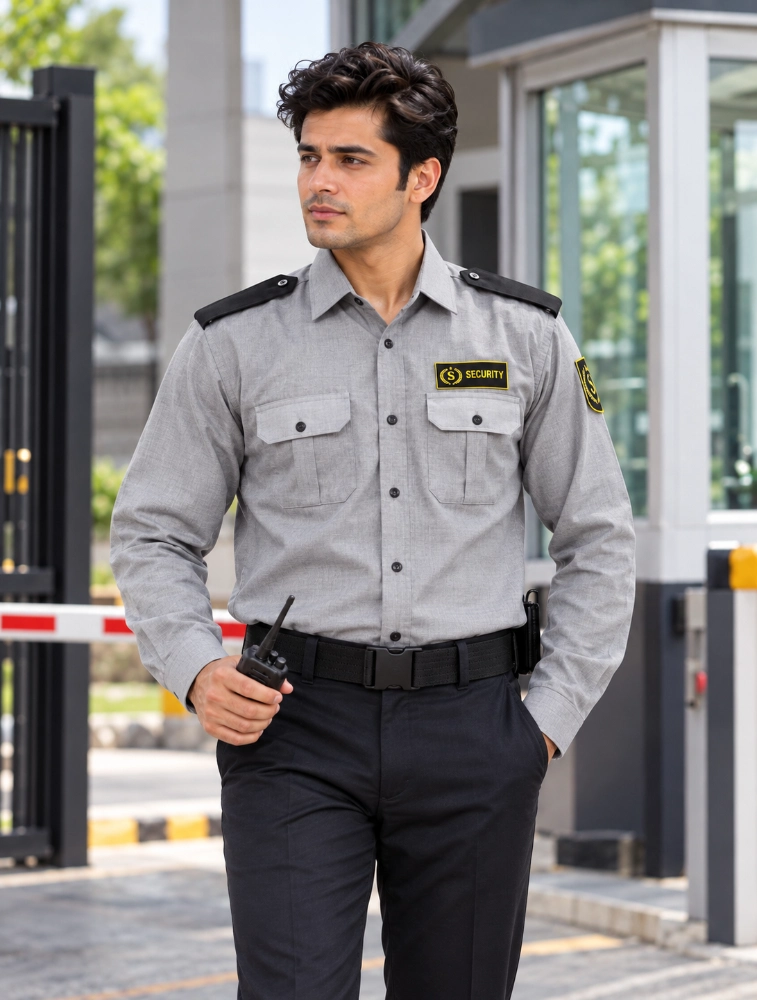
Security and guarding. The shade is usually prescribed by the client site or by regulation, and it has to match across a workforce that is recruited and replaced continuously. That makes dye-lot management the central problem: guards join every month, and a new joiner in a visibly different shade of the same colour undermines the whole point of a uniform. Reserve cloth forward for the year. Beyond shade, the shirt needs abrasion resistance, colour fastness to light for outdoor posts, epaulettes or shoulder tabs where insignia are worn, and secure closures. Full-sleeve is common for formality; hot-climate posts often need a half-sleeve line alongside it.
Manufacturing, logistics and frontline retail. Hundred-per-cent polyester is usually the right answer — wash life over hand feel, wrinkle recovery over drape, and stable dimensions so that a shirt issued at size 42 is still size 42 a year later. Add role-based colour separation if supervisors need to be identifiable at a distance across a floor, and check the machinery rule on sleeves before fixing the specification.
Procurement
Queries Targeted
hotel staff uniform shirt specification, hospital staff uniform shirt fabric, security guard uniform shirt bulk, sector uniform shirt requirements
What does a shirt brand or retail buyer need beyond the garment itself?
A shirt that is going onto a rail rather than onto a workforce needs its own label and care label, a size set graded from an approved fit sample, retail-ready folding and packing with the right closures, a barcode and price ticket where the buyer requires them, and a size ratio per carton that matches how the shirts will actually sell.
The fit block is the product. For a uniform buyer, fit is a fitting exercise. For a brand, the fit block is the thing customers recognise and come back for, and it has to be reproduced identically across every subsequent order. That means approving a fit sample, recording a full measurement chart with tolerances at every point of measure — chest, waist, shoulder, sleeve length, cuff, collar, back length — and grading the size ladder from that chart rather than from a generic block. Once approved, that chart is the specification, and every production lot is measured against it.
Labelling is a legal document, not decoration. A retail shirt carries a brand label, a size label, a care label with wash instructions, and fibre composition. Composition and care claims have to be accurate, because they are what a consumer relies on and what a regulator checks. Woven labels, printed labels, neck prints and heat transfers are all available; woven main labels and printed or woven care labels are the usual combination. Get the label artwork and content signed off early, because label lead times are frequently what holds a shirt order rather than the shirts.
Retail-ready packing has real specifications. Stand-up or flat-pack folding, the fold dimensions, collar support, a butterfly or collar band, pins or clips or a pin-free presentation, a polybag with the required warning print, and a hanger where the buyer requires hanging delivery. Barcode and price tickets, if required, go on at the factory rather than in the warehouse. All of this is agreed at sampling and photographed as an approved packing standard, so that lot ten looks like lot one.
Size ratio per carton is where money is quietly won or lost. A carton packed in an even ratio across all six sizes does not match how shirts sell, and it leaves a retailer holding the tail sizes. Specify the ratio you want per carton — weighted to the middle sizes — and specify whether cartons are solid-size or assorted. For a multi-location retailer, assorted cartons cut down on internal transfers considerably.
How this works commercially. Custom runs start at 100 pieces per style per colour, and a private-label programme is quoted against the approved fit chart, cloth specification, labelling and packing standard rather than against a stock rate. The home-page FAQ sets out the step-by-step process, sampling, payment terms and export documentation, including delivery into the 132 countries served.
Procurement
Queries Targeted
private label shirt manufacturer India, shirt manufacturing for brands, retail ready shirt packaging bulk, contract manufacturing shirts own label
How are shirts and trousers kept consistent when they are bought as a two-piece uniform?
By buying the pair as one specification rather than two orders. Fix which garment leads the shade, source both from one programme and one issue cycle, match the trouser cloth’s wash behaviour to the shirt’s so they age at the same rate, and issue complete sets so a wearer never combines a new shirt with an old trouser.
Decide which garment leads. In almost every two-piece uniform the trouser is the fixed point — usually a dark neutral — and the shirt is the element that carries colour and branding. Fix the trouser shade first, then approve the shirt against it as a physical pairing under the same light, not garment by garment on separate days. Two garments each approved perfectly in isolation can look wrong together, and nobody discovers that until the first day of issue.
Match the wash behaviour, not just the shade. This is the failure mode buyers rarely anticipate. If a shirt is polyester and a trouser is a cotton-rich cloth, they fade at different rates and shrink by different amounts — pure cotton moves 3 to 5 per cent on the first wash where polyester moves 1 per cent or less. Six months in, the set that matched at issue no longer does, and no one can point to a defect. Specify both garments to the same wash standard, and if the shirts are going to a commercial laundry, specify the trousers to ISO 15797 as well.
Keep the stitch and trim language consistent. Thread shade, button colour and finish, stitch density and any contrast detail should be specified once and applied to both garments. A shirt at 14 stitches per inch beside a trouser at 10 is normal — trousers are typically 10 to 12 — but the visible details a wearer notices should read as one design decision rather than two suppliers’ defaults.
Issue as a set, replace as a set. If the shirt is replaced annually and the trouser every two years, the uniform is permanently half new. Either align the cycles, or accept the mismatch deliberately and pick a trouser cloth whose colour is stable enough to survive an extra year. Most organisations align them, because a matched set is the entire reason for buying a two-piece uniform in the first place.
Where to look on this site. Trousers, corporate and industrial uniform sets, and school and college uniform sets are handled as their own programmes — see corporate and industrial uniforms and school and college uniforms for the paired-set categories, and the home-page FAQ for MOQ, sampling, payment terms and export documentation. If you are buying a full kit, send the requirement as one enquiry rather than one per garment. A kit quoted together is quoted against one cloth plan, one dyeing schedule and one delivery, which is both cheaper and considerably more likely to match.
Procurement
Queries Targeted
shirt and trouser uniform set bulk, matching uniform shirt trouser shade, two piece uniform procurement, corporate uniform set supplier India
From ₹262excl. GST
View cart & checkout ›